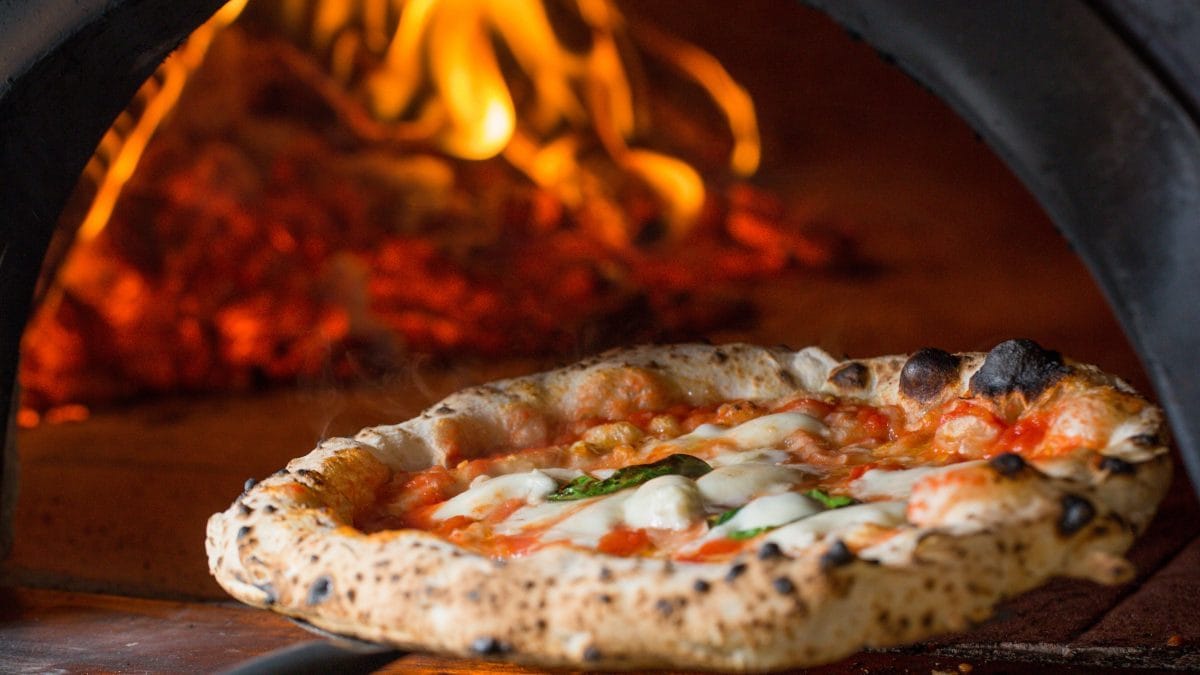
An expression of such irrepressible desires that you'll feel like you're hearing the voice of God, but it's just a pizza. A simple dough, seemingly nothing at all: a throb of water, flour, yeast, and salt, blended together by the mastery of the masters. Neapolitan pizza, by the glass, pan-baked, Italian-style, in a pan, and why not, even Chicago-style for an iconic dish that has conquered the world, originating in Naples and Ancient Greece. Historian and writer Angelo Forgione explains, "There are texts by Plato that describe the preparation of a pita, a focaccia-style dish, with oil, olives, and onions, but there are also references to Egypt. If we think about it, even today, pizza can simply be understood as a flattened disk of dough: even the escarole pizza isn't a product we could call classic in name, but it's a pizza. It's clear that the transformation into pizza as we know it today was created by the Neapolitan people in the 18th century," and from that date it has developed into different types throughout the world. Let's look at the main ones, not just the Italian ones, but also the versions born and bred outside of Italy.
1. Neapolitan Pizza

True pizza, the one that follows a specific set of rules, the only type of pizza recognized internationally. A round disk, with a soft dough and high edges due to the air that moves it outward when handling the dough, cooked exclusively in a wood-fired oven. Originally, the variations of Neapolitan pizza in terms of toppings were Marinara, with tomato, garlic, oregano, and extra virgin olive oil; Margherita, with tomato, mozzarella, basil, and extra virgin olive oil; Cosacca, with tomato and pecorino. Then there was fried pizza, with ricotta, provola, and cracklings. All of this was documented by the writer Francesco de Bourcard in the mid-19th century who, as Forgione tells us, "edited that collection of Neapolitan dishes, which was written by various writers. The chapter "The Pizza Maker" was written by Emmanuele Rocco." The first pizza we have traces of, however, is another, today almost impossible to find: Mastunicola, all the way back to the 17th century. A disc of dough topped with lard, cigoli, sheep's cheese shavings, pepper, and basil. The marinara, on the other hand, was born "very Greek": oregano, capers, Gaeta black olives, and anchovies, because in the early 1700s, tomatoes were not widely used as food, but were still kept as ornamental plants. For a classic Neapolitan pizza, we recommend Enzo Coccia and his La Notizia, on Via Michelangelo da Caravaggio, Naples.
2. Canotto Pizza

From classic to modern, Caserta-style pizza is a philosophy as well as a style: small in diameter, characterized by a very pronounced and hydrated crust. Typical characteristics are the air bubbles and softness on the palate. A special dough is made with a long process and matured for 48 hours. To try Caserta-style pizza, we recommend Carlo Sammarco 2.0 at Via Antonio Gramsci, 60 in Aversa.
3. "Pizza a Metro"

We're staying in Campania but moving south, near Vico Equense: it's the 1950s and Luigi Altamura, known as Gigino (who still runs the pizzeria today), accidentally invented "pizza a metro". Baked in a wood-fired oven, it follows the same preparation methods as the traditional pizza and is topped in the same way, but it's often divided into different flavors thanks to strips of dough placed across the meter (which in some cases is even longer). We can call it the forerunner of pizza by the slice. Gigino's pizzeria is called Pizza A Metro Da Gigino L'Università della Pizza and is located at Corso Giovanni Nicotera, 15, Vico Equense.
4. "Pizza in Pala"

A pizza created by bakers, it's tongue-shaped and a cross between a pan pizza and a meter-long pizza. Rolled out and filled directly on a peel, thin and crunchy, it features a dough made with extra virgin olive oil and type 1 flour. We recommend it at Pizzeria Sancho, Via della Torre Clementina, 142 in Fiumicino, in the province of Rome.
5. Roman Pizza

A round disk of thin, crispy dough, kneaded with soft wheat, yeast, salt, and olive or seed oil, all rolled out with a rolling pin. According to post-war recipe books, the years in which this type of pizza developed, it includes basil, pecorino cheese, and pepper, in addition to tomato and mozzarella, with a variant called "Napoli" that adds anchovies. Another typical Roman pizza is the pizza bianca, which is plain (perhaps filled with mortadella, for a proper Roman snack). Try the 180-gram version from Mirko Rizzo and Jacopo Mercuro, at Via Tor de' Schiavi 53, Rome, one of the places that brought this type of pizza back into vogue.
6. "Pizza al Taglio"

We're also in Rome, but there's also a Milanese version, which we'll get to shortly. Pizza al taglio is rolled out, topped, and left to rise in large rectangular pans to be sold by weight. Widely available in bakeries, it's usually heated through, requiring a very watery dough made with strong flours. The Milanese version "al trancio" has a much higher crust, the amount of tomato is usually minimal, while the mozzarella is abundant, covering the entire dish.
To eat pizza by the slice in Rome, we cannot fail to mention its "king", Gabriele Bonci, and therefore suggest Pizzarium (via della Meloria, 43) but since we will mention him later, we also suggest L'Antico Forno Roscioli (and everything else branded Roscioli) in via dei Chiavari 34. While for pizza by the slice in Milan we suggest Ai tre ponti, a historic restaurant in viale Corsica 95 with over 200 seats and a splendid variety of Calabrian cured meats.
7. Pisan Pizza

A round, thick pan pizza topped with just one cheese (Parmesan or mozzarella), anchovies, and capers. It's eaten as a street food, often topped with cecina (chickpea flour) (especially in the Viareggio area). To enjoy it, we recommend Pizzeria Chimenti Special, Via Emilia 323 Ospedaletto, Pisa.
8. Sicilian Pizza (Sfincione)

In the heart of Magna Graecia, the tradition of pizza is linked to that of the domination, such as the sfincione, a type born in Palermo topped with a sauce of tomato, onion, anchovies, oregano, and pieces of Ragusano caciocavallo cheese. Sicily boasts many other varieties, almost all filled. In Messina, we find the "messinese," a variant filled with endive, caciocavallo cheese, tomato, and salted anchovies, similar to the Catania version, made with caciocavallo cheese and desalted anchovies or with broccoli, cauliflower, boiled potatoes, and even spiced meat. In Syracuse, a very distinctive flat pizza is made with strips of dough covering the surface, called "lenze," and a tomato and cheese base: it resembles a tart.
Given the variety on offer, we recommend several places: for sfincione, try Spinnato 1860, a great pastry shop and ice cream parlor, at Piazza Castelnuovo 16, Palermo; for the Catania version, try Urna at Piazza Lorenzo Urna 36, Viagrande; and also try the Giummara bakery at Via Traspontino 25, Ragusa.
9. Pan Pizza

Is there something that unites Piedmont and Campania? Yes, and it's pizza. This type of pizza is widespread in northern Italy, so much so that Turin has taken over the origins of this dish. In reality, pizza nel ruotino, or pizza al tegamino, cooked in an oven at lower temperatures than traditional, has spread alongside the traditional version, particularly in provincial bakeries, to the point of becoming a characteristic of Aversa and surrounding towns. A more hydrated and moist crust, with a dough more similar to bread, and extremely long baking times, up to 18 minutes.
While in Naples it was cooked during the oven's downtime, either during preheating or cooling, in Turin it became a true specialty thanks to the pizzerias of immigrants, both Neapolitan and especially Tuscan. There are many examples of this preparation in the 1930s, which became a hallmark of the City of the Mole, also because until the late 1960s it was the only type of pizza available. We recommend two places: on Aversa, La Contrada, in Piazza Marconi, where pizza chef Roberta Esposito offers a top-quality disc, both pan-fried and traditional; while in the Piedmontese capital, there's Bricks at Via S. Francesco da Paola, 46.
10. Pizza for Tasting

For the nationalists, let's call it Gourmet Pizza, a new version that has turned purists' noses up. Tasting pizza doesn't have a specific set of rules, but rather very specific characteristics: it shouldn't have distinct flavors, but should allow the customer to savor the taste of the dough and the toppings together; it must have a soft, moist dough, preferably made with sourdough; it must be easy to digest and therefore undergo a long leavening and maturation process; it can revisit classics, but attention must be paid to the ingredients, which must be of the highest quality and seasonal. Last but not least, tasting pizza must be served in slices, and each slice must possess all the characteristics of a full pizza. The pioneer and revolutionary is undoubtedly Simone Padoan at I Tigli, Via Camporosolo 11, San Bonifacio, Verona.
Pizza Styles Around the World
While Italy has failed to unite even on pizza, abroad, immigrants dispossessed of their regions have made a real effort. Argentina and the United States, thanks to Italian immigration, have developed distinct styles, to the point that these two countries consider themselves the "inventors of pizza."
1. Argentinian Pizza (Molde and Canchera)

Derived from the pan pizza, also known as pizza al molde, it requires a dough made with flour, salt, and pepper before dissolving the yeast in sugared water and adding oil. The "a la piedra" version is cooked on a refractory stone, like Neapolitan pizza, but takes much longer to bake.
Canchera is a very niche product, ArteAr's culinary project, because it is traditionally served cold. Created by Oscar Vianini in Buenos Aires, the pizza chef would show up at the exit of soccer fields with a pizza base topped with a very spicy tomato sauce, called Marinara Argentina. In Argentina, it's synonymous with cheap, fast food pizza, but it's not as popular there either. The mandatory address is La Mezzetta, Avenida Alvarez Thomas 1321, Ciudad de Buenos Aires.
2. American Pizza and Chicago Style Pizza

In the United States, many citizens still believe that pizza is an Italian-American invention. The more erudite ones simply say that pizza is Italian, but the idea of serving it by the slice is entirely American. Matilde Serao, the first female editor of a newspaper in Europe, contradicts this. In her writings, she describes a cart that traveled along Via Duomo in early 20th-century Naples with pre-sliced pizzas to sell to merchants—or rather, female merchants. Historically, the street was home to numerous tailoring shops, with a strong female presence in the workforce, as women were the primary consumers of "cut pizza": Serao's work demonstrates not only how mistaken the Americans are but also what a highly developed city Naples was at the beginning of the 20th century.
Historiographical digressions aside, if Ted and Marshall made the 800-mile journey from New York to Gazzola's, located at 316 Kinzie Street, in Chicago, Illinois, there must have been a reason.
Chicago Style Pizza, also known as Pizza Pie, has high, buttery edges, filled with cheese, sausage, and tomato, and is baked in a round pan about 12 inches in diameter with a 2-inch edge. The entire pan is lined with dough before being topped. It's cooked at a low temperature and slowly, taking between 35 and 45 minutes. If you find yourself in the hometown of the Bulls, you can't miss Gabriele Bonci‘s two locations, at 161 Sangamon Street and 1566 Dame Ave. If you want to try the original Dish Pizza, all you have to do is go to the best: Uno Pizzeria & Grill, open since 1943.
;Resize,width=767;)
