In every field, there are false beliefs, urban legends, and habits so deeply internalized that they have become universally known truths: the world of cooking and nutrition is no exception. Food-related myths are numerous, in fact, countless, and deeply rooted in our daily habits, precisely because the world of gastronomy is so rich and varied that, over time, a whole series of beliefs have accumulated that are taken for granted to the point of never being questioned. However, as practical and objective as they may seem, some of these myths are completely false, the product of mere legends and hoaxes, the legacy of a past when science still had much to discover. We're here to debunk some of the most widespread and persistent false beliefs: here are 14 myths about the world of cooking to debunk.
1. Does Salt Make Water Boil Faster or Does It Slow Down the Boiling Point?

One of the most widespread myths in cooking is that adding salt first makes water boil faster. No, that's not how it works, but the opposite belief, which is also quite common, is equally wrong: that it slows the boiling point of water. What's the truth? From a scientific standpoint, it's true that sodium chloride, when combined with water, slightly raises the boiling point (set at 212°F/100°C) compared to when the water is "pure," but the consequences aren't such a significant delay as to cause a waste of energy. It means that the effect is so minimal at the concentrations used in cooking that it's irrelevant. So why opt for the latter? These are essentially practical reasons: salt dissolves more quickly when the water is already hot, avoiding settling on the bottom and potentially ruining the pot in the long run. Secondly, linking the timing to the salting can help you remember it.
2. Rinsing Rice and Pasta to Cool Them

There's always been a myth that you should rinse pasta and rice under running water after draining them, a tip that supposedly helps them cool faster when preparing cold dishes like mixed rice or pasta salad. In reality, this is incorrect, as it eliminates the very thing that makes pasta dishes so delicious, the element that allows sauces or other ingredients to blend perfectly with rice or pasta: starch. When you rinse pasta and rice under cold water after boiling, you remove all the residual starch, reducing their ability to hold seasonings and weakening their flavor.
3. Adding Oil to Pasta Water to Prevent it From Sticking

The web is flooded with articles and videos recommending adding oil to pasta cooking water to prevent it from sticking, one of those false myths passed down by grandmothers according to which slippery oil prevents the pasta from sticking. It's completely false: adding oil to the water to prevent the pasta from sticking is pointless. Oil and water have different densities; the former floats and therefore can't "split" the pasta. The advice is always to use plenty of water and a large pot to "dilute" the starch, but you'll be surprised: adding oil to cooking water actually has a very specific "benefit," namely, reducing the foaming and avoiding the annoying phenomenon of water overflowing the pot. But it's an extra precaution, not a necessary one: if you use plenty of salted water and stir frequently, you can even skip the oil altogether.
4. Inserting a Cork Into Octopus' Cooking Water

One of the most fascinating (and false) beliefs concerns the cork that's placed in the pot when cooking octopus: many believe it softens the cephalopod mollusks. But is this true? Absolutely not. This legend originated in Apulia (Italy), where the octopus tradition is more deeply felt than ever. Evidently, someone, many years ago, must have misunderstood the fishermen's cooking technique. They do, in fact, add a cork to the pot, but they do it for a different reason. The octopus sellers tie a cork to each octopus, each with a distinctive mark so they can immediately identify the octopus that's been cooked the longest. When a customer approaches the stall, the vendor simply pulls the string with the cork that's been infused for the longest time, and voilà: a perfectly cooked octopus, served in record time thanks to this ingenious trick. The use of cork is due precisely to its characteristics: it floats, so it is recognizable in the pan, and it does not alter the structure of the food.
5. All Types of Salt Are The Same

The world of salt is a confusing place, and it's not uncommon to hear the saying "one salt is as good as another." This isn't exactly true. While it's true that using "fine" salt doesn't make a dish healthier, it can also enhance its flavor or texture. It's no coincidence that some recipes specifically call for one type of salt over another, as each is suited to different preparations. Each type of salt, in fact, has its own differences in consistency, grain size, flavor, and processing, all characteristics that influence the final result in the kitchen. This is why it makes no difference whether you use fine salt or coarse salt for seasoning raw or cooked dishes, just as it doesn't make the same difference whether you use classic fine salt or colored/flavored salt: each has its own characteristics and influences the preparation differently.
6. The Reddish Liquid in Meat is Blood

One of the most widespread beliefs is that the reddish liquid released by red meat is the animal's blood, but this too is a false belief. The red liquid you find on meat both before and during cooking is not blood at all, but water mixed with myoglobin, a protein found in the muscle tissue of meat. Myoglobin‘s role is to help transport oxygen to muscle cells: given its red color, people tend to believe the liquid released is blood. Myoglobin is absolutely not dangerous; in fact, it is a natural protein and a source of heme iron, a form of iron easily absorbed by the body.
7. Searing the Meat Locks in The Juices

Searing meat at high temperatures (the Maillard reaction) doesn't seal in the juices: this is a widespread but false myth. Science, however, explains that not only is this belief incorrect, but talking about sealing the meat makes no sense whatsoever. Meat doesn't have pores; the skin does. Meat, on the other hand, is a muscle and as such is composed of fibers, which behave like a sponge soaked in water when squeezed. Under the effect of heat, they contract, expelling the juices, which are nothing more than liquids composed of water and fat. In fact, we only need to sear a steak to realize this because if we let it cool for a couple of minutes, we notice all the juices collecting at the bottom of the plate.
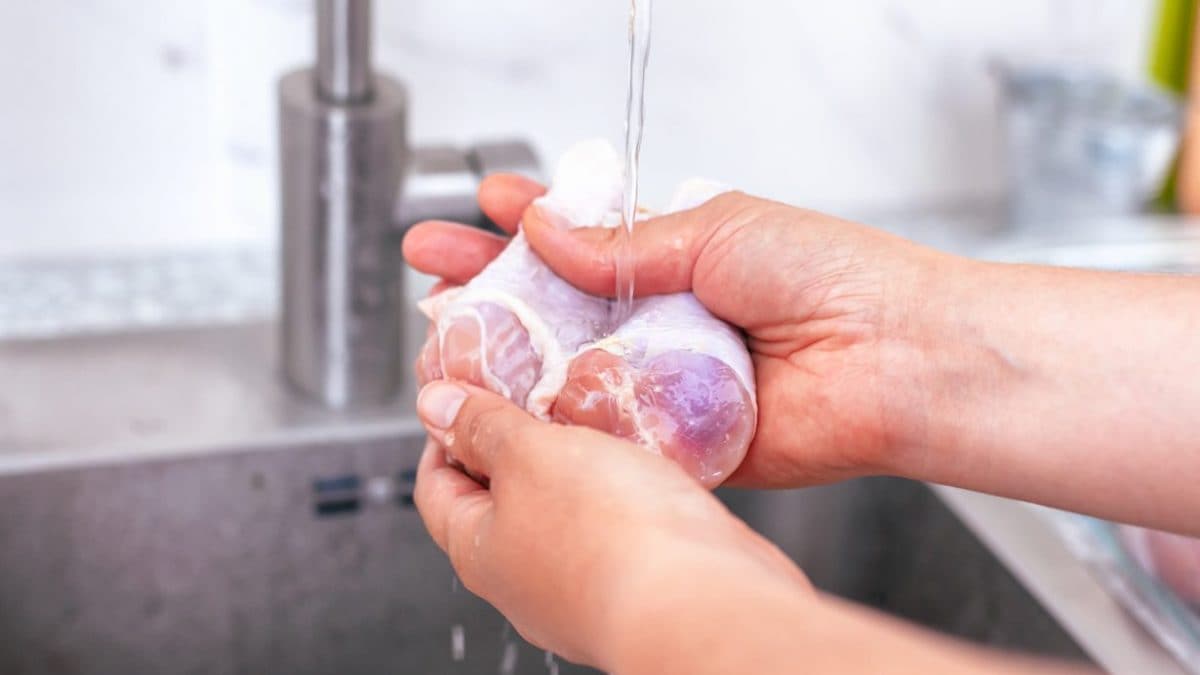
8. Washing Raw Meat

This is a myth that biologists and nutritionists have long been fighting, but the truth cannot be repeated often enough: many believe that washing raw meat helps eliminate bacteria. This is actually completely wrong, and potentially harmful. Raw chicken in particular, but this is true for all meats, hosts its own microbiota that can be contaminated by bacteria such as Salmonella or Campylobacter, which are responsible for food poisoning with symptoms such as diarrhea, fever, and vomiting, but which in rare cases can also cause very serious complications. Washing does not eliminate bacteria, but spreads them all over kitchen surfaces. The only effective way to kill pathogens is to cook the meat properly.
9. Flour Doesn't Expire

The fact that flour has a very long shelf life has created the myth that it never expires, but this is a false belief. Although less obvious, flour also exhibits signs of loss of freshness, primarily a bad odor. Furthermore, when sifting it, you may notice the presence of small insects. To preserve it longer, store it in a well-sealed container in a cool, dry place, but even this cannot protect it from deterioration forever: flour may have a long shelf life, but it is not eternal.
10. Plant-Based Drinks are Preferable to Cow's Milk

Since the popularity of plant-based drinks made from oats, almonds, rice, or coconut, the belief has spread that they are preferable to cow's milk because they are healthier and lower in fat. However, choosing these types of plant-based drinks over cow's milk isn't always the best choice: cow's milk has almost double the protein of oat milk and four times more than almond milk, and some plant-based drinks may contain added sugars. Neither cow's milk nor these drinks should be demonized or preferred in isolation: both have their advantages and disadvantages; it all simply depends on your preferences or health, but neither is healthier than the other regardless.
11. Microwaves Remove Nutrients

Perhaps created specifically to counterbalance the undeniable convenience of the microwave oven, for some reason the belief has spread that cooking in the microwave removes the nutrients present in food. This myth is completely unfounded; in fact, the opposite is true: thanks to the short cooking times, the microwave appears to help retain the nutrients we benefit from and preserve vitamins and minerals thanks to the rapid cooking times.
12. Fish and Red Wine Don't Go Well Together

You've learned that fish and red wine don't pair well: this isn't an entirely false belief, but it's not as categorical a prohibition as some might think. This belief is especially true when it comes to "oily" fish like herring or mackerel, which aren't suitable for pairing with red wine because, due to a reaction of the tannins on the palate, they would taste slightly metallic. However, outside of these cases, many red wines pair perfectly with various fish species. Pairing fish and red wine is possible, but requires caution: choose young, light, and low-tannin reds to avoid metallic aftertastes (e.g., Pinot Noir, Frappato, Lambrusco), and pair them with structured dishes like grilled tuna, soups, or tomato-based fish. Seeing is believing.
13. Brown Sugar is Better Than White Sugar

Is brown sugar better than white sugar? Many argue that brown sugar is healthier and lower in calories, a belief that has become deeply rooted in popular belief. This is a completely false belief: brown sugar and white sugar are almost identical nutritionally; the differences lie only in the type of processing, with brown sugar retaining a small percentage of molasses, responsible for the product's more distinctive flavor and dark color. Therefore, there is no "healthier" sugar than another: both should be consumed in moderation, as they have the same impact on calories, glycemic index, and overall health.
14. You Shouldn't Eat Pasta for Dinner

Let's dispel one last myth that so many people believe: eating pasta for dinner makes you fat, or at least avoid it in the evening because it's too heavy and could disrupt digestion and sleep. Both are completely wrong beliefs. Eating pasta in the evening absolutely doesn't make you fat any more than eating it at lunch, and in fact, it doesn't make you fat in general: there's no single food that, taken individually, makes you gain or lose weight; it's always the overall picture of your diet that needs to be considered. And when it comes to digestion and sleep, pasta can actually be easier to digest than many heartier main dishes: poor digestion, and the resulting disruption to sleep, depends more on how you choose to season it, not on the pasta itself. If you choose a light sauce and don't overdo it with the portions, you'll see that eating pasta for dinner won't cause any problems.
;Resize,width=767;)
