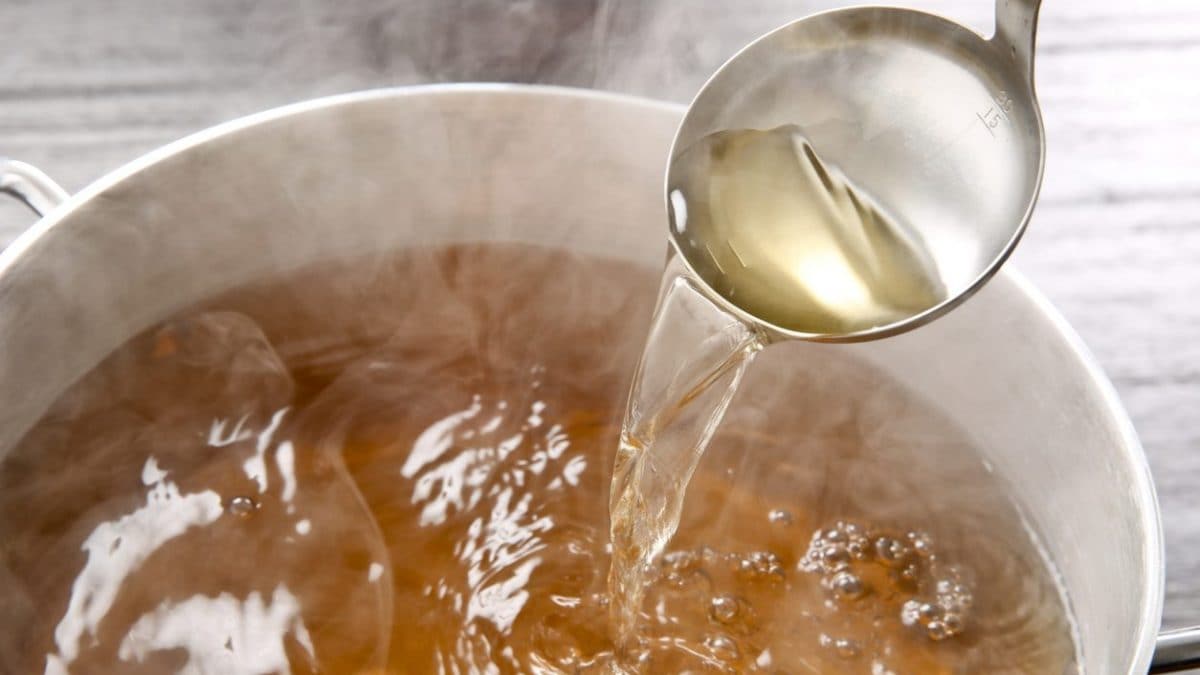
It's a precise mathematical formula: as temperatures drop, our desire to make broth increases in direct proportion. Warm, fragrant, flavorful, with pasta or tortellini, it's exactly the super-delicious treat we seek when we return home in the evening. As simple as its preparation may seem, however, there are small details to pay attention to to obtain a consistently delicious broth, whether vegetable or meat. From water temperature to the amount of salt, let's discover together all the mistakes to avoid.
1. Using The Wrong Pan

It may seem like a minor consideration—the thought is "just cook"—but in reality, it's not: choosing the wrong pot can compromise the final result. The right one should be tall and have a thick bottom, capable of holding all the ingredients—without overcrowding them —preventing the liquids from spilling out during cooking and slowing the evaporation of water. As for the material, it's recommended to use stainless steel pots, which are best suited for prolonged cooking.
2. Overdoing the Ingredients

You might mistakenly think that the more ingredients you add, the more flavorful the broth will be. This is partly true, and partly false: as with any recipe, the tastiness of a dish requires the perfect balance of all the ingredients. This means that no one ingredient should overpower the others, otherwise you risk unbalancing the flavor and resulting in a single, dominant taste.
The choice of ingredients also depends on the type of broth you want to make: use vegetables with a more delicate flavor if you want to use it in other dishes, such as risotto, so that the broth doesn't overpower the main dish; if, on the other hand, you want to enjoy it on its own, you can vary the choice of ingredients, even favoring stronger vegetables, such as cabbage or fennel (provided you like the flavor). The same goes for spices: all are welcome as long as you take into account the final use of the broth, as well as, of course, your personal taste.
A little extra tip: whether you're making vegetable or meat broth, use ingredients that you'd otherwise throw away. Whether they're scraps, like bones, or "flawed" vegetables, they can be given a new lease of life in the broth (and the planet will thank you).
3. Starting With Hot Water (Especially With Meat)

Maybe everyone knows this. Or maybe no one does. But many probably don't know it: never start making broth with hot water. This is an essential tip, especially for meat: throwing it into boiling water causes a sudden change in temperature that causes the surface proteins to coagulate, partially retaining the juices inside, as happens when boiling meat. In broth, however, we need those juices to escape from the meat to flavor the liquid we'll later eat or use: this will certainly make the meat less flavorful, but you can reuse it in other recipes.
4. Not Lightly Toasting/Browning the Ingredients

Adding everything raw directly into the water is a good option for those who want a lighter, less pronounced broth. Toasting or sautéing bones and vegetables (especially onion, carrot, and celery) for a few minutes before adding the water gives the broth more complexity and depth of flavor, as well as a more inviting, golden color. Even halving an onion and roasting it over a flame is a classic trick for a more aromatic, clear broth.
5. Cooking the Broth for a Short Time

Good things take time —like ragù, Genovese, or stew—and the same goes for broth: the ingredients need time to release all their flavors and nutrients. To calculate cooking time, start from when it starts to boil: as a guide, vegetable broth will take about 1.5 hours; meat broth, 3 to 4 hours.
6. Overdoing the Salt

The age-old question: to salt or not to salt? Of course, yes, but when should you add it? In this case, it doesn't matter what it's used for; the ideal is always at the end of cooking, and we'll explain why. If you plan to eat it plain (or perhaps with pasta), you need to consider that the water evaporates, which could lead to an overly salty broth. Therefore, it's best to add it near the end of cooking, when there's no longer any risk of it further reducing.
If, however, we use it in the preparation of other dishes, these may already be tasty and it is better to add salt when the recipe is almost finished. Finally, remember that, since cooking times are decidedly long, the ingredients will release all their properties, including their natural flavor.
7. Skimming The Broth: Yes or No?

If we're talking about fat, we're talking about meat: to obtain a "less loaded" and clearer broth, it's recommended to remove the fat with a slotted spoon as it forms and strain it thoroughly once cooked. This is very easy to do, especially when it cools, as the fat will solidify, float to the surface, and be much easier to remove. To enjoy it, simply reheat it over the stove.
This isn't a real mistake, but it all depends on the final flavor you're aiming for: removing fat is a matter of taste, not health, which is why it's important to do so only if you want a lighter, clearer broth. A little fat certainly doesn't hurt, especially for the final flavor.
8. Cooking at Too High a Temperature

Broth requires slow, gentle cooking: for this reason, the temperature should always remain between 185/85 and 205°F/95°C. This means that it should never boil vigorously, but rather simmer slowly: this way, you obtain a better quality infusion, you avoid drying out the meat too much, and you avoid the risk of altering the delicacy of the aromas – especially for vegetable broth, as vegetables have some delicate aromatic substances that can disappear at too high temperatures.
If you don't have a thermometer, no problem: just check that too many bubbles don't form on the surface, at most one or two every now and then.
9. Storing it Badly or For Too Long

One of the most common mistakes—often made carelessly—is storing broth after cooking. A perfectly prepared broth can spoil in just a few hours if not handled properly once the heat has been turned off.
The first step is cooling: leaving it at room temperature for too long invites bacterial growth and fermentation, especially if the broth contains meat or fat. To avoid this, it's important to cool it quickly, if possible by immersing the pot in cold water (or, better yet, in a bowl of ice) and stirring occasionally to help disperse the heat. Only after it's thoroughly chilled can it be stored in the refrigerator or freezer.
As for storage, the broth keeps:
- in the refrigerator for a maximum of 2-3 days, preferably in a hermetically sealed glass or steel container;
- in the freezer for up to 3 months, preferably portioned into containers or ice cube trays, so that you can defrost only the quantity you need.
A little tip: if a layer of fat forms on the surface during storage, don't remove it immediately —it acts as a sort of natural "cap" that protects the broth from air and prolongs its shelf life. You can easily remove it once reheated.
Finally, remember that it's not recommended to refreeze broth after it's thawed, and broth with an acidic odor or a cloudy, foamy appearance should never be reused. Good cooling and storage management is essential to maintaining flavor, aroma, and food safety.
;Resize,width=767;)
