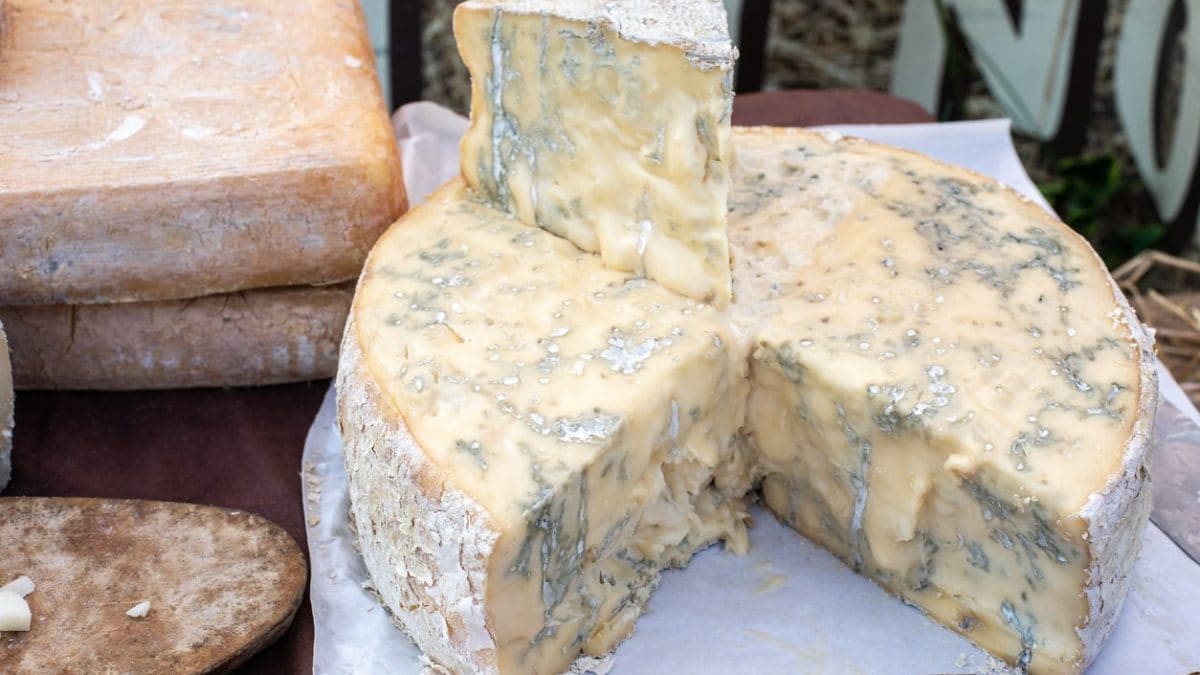
Blue cheeses represent one of the most fascinating chapters in the art of cheesemaking: products in which the science of microorganisms intertwines with rural history, geographical conditions, and the creativity of cheesemakers. Unlike most cheeses, their identity is born from a controlled encounter with mold —or rather, with selected, beneficial molds, particularly from the Penicillium genus, such as Penicillium roqueforti and Penicillium glaucum —which transform the cheese into a landscape dotted with blue, green, or gray veins.
Marbling isn't a "haphazard process," as some people think: it's a complex process that's now studied in the laboratory, but its origins lie in ancient pastoralism. Before dairies existed, shepherds exploited natural caves, humid environments rich in microflora: there, the cheeses breathed, sweated, and absorbed fungi and yeasts present in the air. Some cheeses became moldy and were discarded, while others began to display such surprising flavors and aromas that they convinced cheesemakers to reproduce the phenomenon.
This is how the "blue" family, as these cheeses are called in English, was born: a European family, with roots in Italy, France, Great Britain, Spain, Denmark and, according to some recent studies, probably also in the Middle East and Anatolia.
Today, blue cheeses are considered products of high sensorial complexity: they have spicy, mineral, saline notes, sometimes sweet and buttery; some are creamy enough to be eaten with a spoon, others are crumbly and intense, perfect for crumbling on dishes.
Alongside the globally renowned names —Gorgonzola, Roquefort, Stilton—there's a world of lesser-known cheeses and local rarities worth rediscovering. Blue cheeses have ancient histories and powerful identities: Italy, France, the United Kingdom, Spain, and Denmark are home to some of the world's most iconic blue cheeses, born among natural caves, windswept pastures, and time-honored local traditions. Each of these cheeses is a piece of the great map of "blue" cheeses, with unique and often inimitable sensory personalities.
1. Gorgonzola PDO (Italy)

Gorgonzola PDO is the benchmark, the Italian blue cheese, and the best-known of European blue cheeses. Its origins certainly date back to the Middle Ages in Lombardy, in an area where natural caves and the availability of cow's milk allowed cheesemakers to master the marbling. There are two versions of Gorgonzola DOP: the sweet, creamy, almost spoonable version, with hints of cream, butter, yogurt, and a moderate spiciness; the spicy version, crumbly, drier, and more assertive, closely resembling some French blue cheeses in terms of aromatic intensity.
It's a "bridge" cheese that approaches the more intense blues: in the spicy version, it becomes an aromatic giant that holds up to complex pairings (mustards, botrytized wines). Its distinctive feature is the extraordinary balance between the sweetness of the milk and the savory punch of the mold. Perfect with pears, honey, walnuts, risotto, soft polenta, and gnocchi.
2. Bleu d'Auvergne (France)

One of the most harmonious French blues. Created in the 19th century by Antoine Roussel, today it is an AOC, or PDO, beloved by enthusiasts. Soft, buttery texture, with widespread and even blue veining, aromas of undergrowth, mushrooms, and walnuts, moderate spiciness, never aggressive. Excellent as a table wine, excellent in the kitchen, especially for sauces, tartlets, and gnocchi.
3. Roquefort (France)

The "shepherd" of blues, perhaps the most iconic and authoritative: Roquefort AOC. It is made exclusively from sheep's milk and matures in the famous Combalou caves, where Penicillium roquefori, the mold that defines its identity, thrives naturally. It is one of the most distinctive blues in the world: it smells of humidity, salt, minerals, wool, and mountain herbs, and has a unique melt-in-your-mouth texture. It is an almost mystical experience, best enjoyed with black bread, blackberry honey, or figs.
4. Fourme d'Ambert (France)

An ancient blue cheese, considered among the most accessible to delicate palates. Soft, delicate, and slightly sweet, with notes of butter, cream, and fresh mushrooms, it offers a very mild spiciness. It's the perfect "first blue cheese": it introduces you to the world of blue cheeses without being intimidating.
5. Blue Stilton (UK)

Blue Stilton is the king of English cheeses and the historic pride of Leicester and Derbyshire. It has a crumbly yet creamy texture, with aromas of butter, hazelnut, and grass, and a masterful balance of saltiness and sweetness. For centuries, it has been a staple in rural taverns and aristocratic British tables alike.
6. Wensleydale Blue (UK)

A lighter, fresher blue cheese, moist and with delicate notes of wild honey: Wensleydale Blue. While less intensely blue-veined than other British blues, it retains a strong traditional identity, linked to a fascinating monastic history. Ideal for those seeking a gentle, aromatic blue cheese. Not to be confused with “classic” Wensleydale, which is a non-blue cheese with a white, crumbly texture, often also sold in fruit-flavored versions.
7. Shropshire Blue (Scotland / England)

Known as the "orange blue cheese" thanks to the color provided by annatto, it was created in the 1970s and combines tradition and contemporary flavor. It has a soft and creamy texture, a slightly sweet flavor, and a much more effortless personality than the wilder blue cheeses. Excellent for those who want a lively but not overpowering blue cheese.
8. Valdeón (Spain)

Produced in the high mountains, often with goat's milk or a blend of goat's milk, it's a rustic Spanish blue. It has a creamy texture and wild aromas, with a very flavorful yet surprisingly balanced taste. It's a distinctive cheese, deeply rooted in its terroir.
9. Cabrales (Spain)

Cabrales is one of Europe's most extreme and powerful blue cheeses. Produced in Asturias with mixed milk and aged in natural caves, it is strong, spicy, pungent, and uncompromising. An intense experience, reserved for expert palates and lovers of more radical flavors: definitely not for novices.
10. Danablu (Denmark)

A “modern” blue, created to offer an elegant and more delicate blue marbling. Inspired by Roquefort but with soft, sweetish aromas, Danablu combines balance and accessibility. It is ideal for those looking for a versatile blue cheese, suitable for both the table and the kitchen.
;Resize,width=767;)
