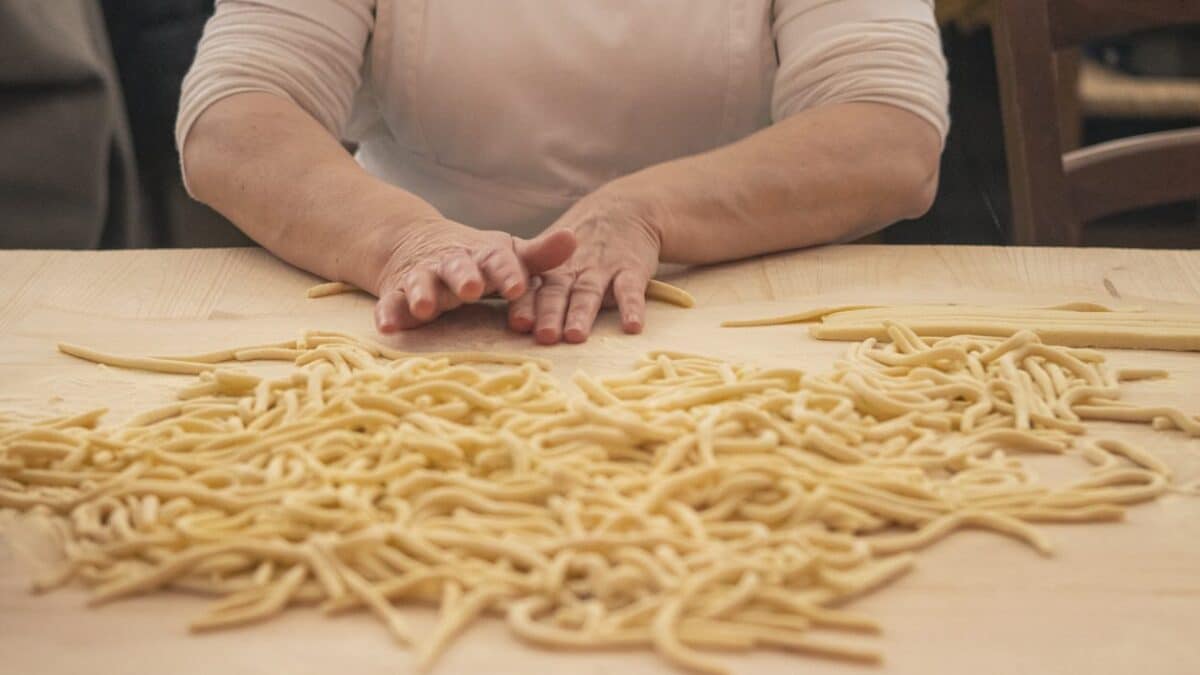
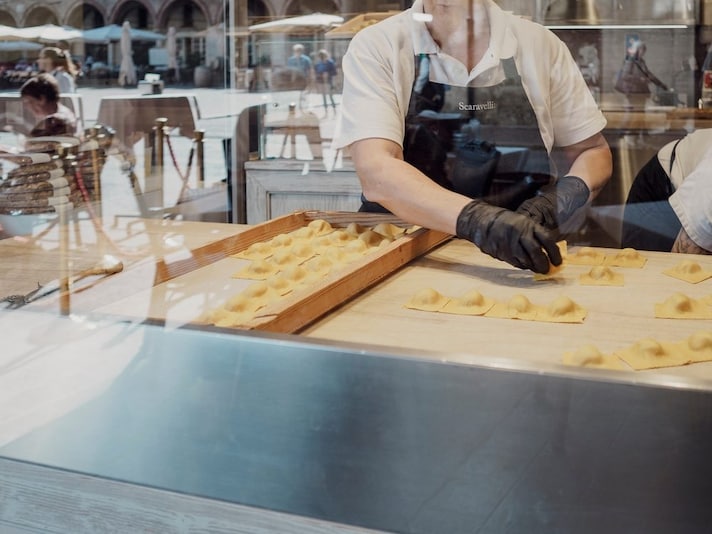
In Rome's historic center, the scene has become familiar: women in aprons knead the dough behind large windows, rolling out the dough before the eyes of passersby, and transforming the pasta making process into a live spectacle. Outside, meanwhile, groups of tourists take photos, film, and wait to enter to order carbonara, gricia, amatriciana, or cacio e pepe.
That seemingly spontaneous and profoundly Italian image, however, is apparently the result of a deliberate commercial operation. This is supported by a Washington Post report on the so-called "pasta grandmothers" who work in the windows of some Roman restaurants, especially in the areas most frequented by foreign visitors.
According to the newspaper, rather than portraying the capital's true gastronomic tradition, these windows showcase the Italy tourists want to see: artisanal, reassuring, familiar, and timeless. A powerful image, perfect for social media, but not necessarily faithful to Roman cuisine.
The Kitchen Transformed Into a Show
Pasta making, traditionally confined to the kitchen, is brought to the forefront and transformed into a continuous performance. The display window not only serves to showcase the manual labor, but also becomes a scenic element capable of attracting attention before the customer even reads the menu.
The mechanism is simple and effective: anyone passing by sees a woman kneading dough, immediately associates the scene with Italian authenticity, and perceives the restaurant as a traditional place. The artisanal gesture thus becomes a form of visual communication, immediately understandable even to those unfamiliar with the local cuisine.
Some observers consider it one of the most successful food marketing strategies of recent years; others, however, see it as a representation constructed exclusively for the tourist public.
The Fresh Pasta Paradox
The most curious aspect concerns the pasta displayed in the windows. Many of Rome's iconic dishes, in fact, are not traditionally made with fresh pasta: carbonara, gricia, and amatriciana are historically associated primarily with dried pasta, such as spaghetti, rigatoni, or bucatini.
In some cases, these dishes can also be served with tonnarelli, but the image of the sfoglina kneading large quantities of dough doesn't necessarily represent the heart of Rome's culinary tradition. Rather, the scene evokes a gastronomic imagery linked to other regions of Italy, particularly Emilia-Romagna, where the production of pasta dough has a deeply rooted history.
The paradox, therefore, is evident: in restaurants that promise visitors “true Roman cuisine”, the most exposed and photographed element may be precisely the least representative of the city.
Brilliant Marketing or Just a Tourist Trap?
The phenomenon divides experts, food guides, and Roman restaurant connoisseurs. Food writer and popularizer Katie Parla considers these windows an extremely intelligent marketing tool: they're recognizable, photogenic, and capable of conveying a sense of craftsmanship in a matter of seconds.
Food guide Sophie Minchilli has a completely different opinion, considering them a useful signal for identifying places built primarily for tourism: in her interpretation, the sfogline in the windows are “pure theatre”, a stage design designed to confirm the stereotypes of visitors.
Among the factors fueling suspicion is also the continuous opening hours: many of these restaurants serve Roman dishes throughout the day, without the traditional afternoon break; a choice perfectly suited to the needs of tourists, but far from the habits of many historic trattorias, which close between lunch and dinner.
The Precedent of Bari's Orecchiette
The Roman debate also brings to mind, with some differences, the case of orecchiette in Bari Vecchia. In the famous "street of pasta makers," the pasta making in front of homes has become one of the most photographed images of the city over the years and a real attraction for visitors.
In that case, however, the manual processing stems from a domestic practice deeply tied to the neighborhood's history. Controversy arose when the tourist and commercial success raised questions about the authenticity of the products sold, the possible presence of industrial pasta presented as artisanal, and compliance with rules regarding traceability, authorizations, and hygiene and sanitation conditions.
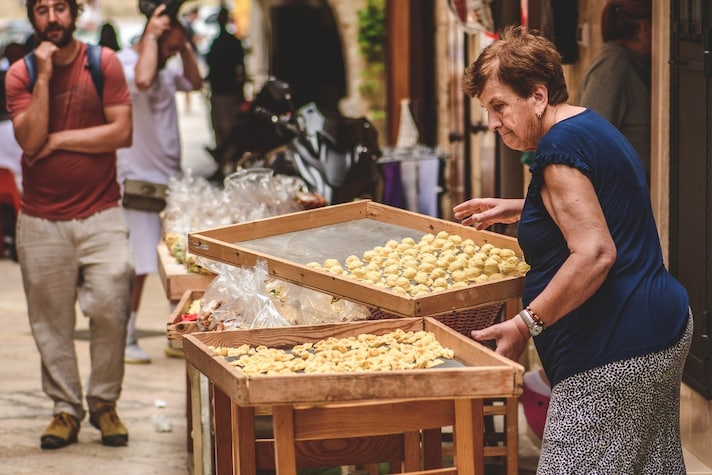
The parallel with Rome is therefore not perfect, but it is significant. In Bari, a real tradition risks being altered or exploited by the pressure of the tourist market; in Rome, according to critics, it is the very idea of tradition that is being reconstructed as a stage set. In both cases, the act of kneading dough in front of an audience ceases to be simply a gastronomic practice and becomes part of a commercial narrative.
The Restaurateurs' Reply
The restaurateurs, however, reject the accusation of deceiving the public: the presence of workers in the window, they explain, is intended to highlight the artisanal work that normally remains hidden. Preparing food in front of customers allows them to showcase the craftsmanship, time, and care required to create certain products. Marketing, therefore, is not denied, but rather presented as a tool to enhance the production process.
From this perspective, the window display wouldn't necessarily be a forgery, but a contemporary form of gastronomic storytelling. The problem arises when the representation is perceived as authentic historical testimony, while it is actually the result of a precise selection of images, gestures, and symbols.
The Italy That Tourists Want to See
Food historian Karima Moyer-Nocchi offers a less clear-cut interpretation. According to this interpretation, restaurants don't just sell pasta, but a specific idea of Italy. The "grandmother" kneading dough evokes family, tradition, domestic labor, and a cuisine passed down through the generations. She's a figure capable of instilling trust and familiarity even to those from the other side of the world.
Authenticity, in this case, doesn't necessarily mean historical accuracy: it becomes an emotion, a narrative in which the customer wishes to identify. Visitors don't just buy a dish, but the experience of having entered, at least for a few hours, the Italy they imagined before their trip.
The Center of Rome as A Great Stage
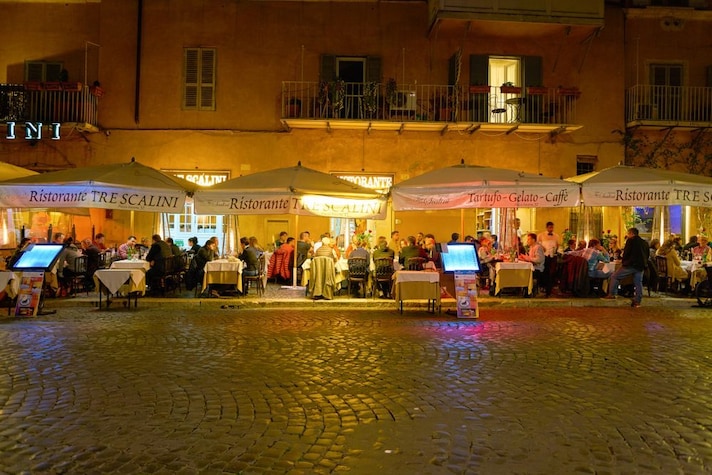
The debate over sfogline is part of a broader issue: the transformation of Rome's historic center under the pressure of mass tourism. Neighborhoods like Trastevere, Campo de' Fiori, and the areas around major monuments have become spaces increasingly built around visitor expectations. Menus translated into multiple languages, round-the-clock service, iconic dishes available at all hours, and settings designed to be photographed are now integral to the commercial offering.
In this process, some places risk losing their original function as lively neighborhoods and taking on the characteristics of a large urban landscape. A real city that, to meet tourist demand, ends up continually representing itself.
The "pasta grandmothers" are therefore much more than a gastronomic curiosity: they are the symbol of a Rome suspended between tradition and spectacle, authenticity and marketing, daily life and tourist attraction. The point is not simply to establish whether the pasta is good or not, but to understand what idea of the city is being served with the dish.
;Resize,width=767;)
