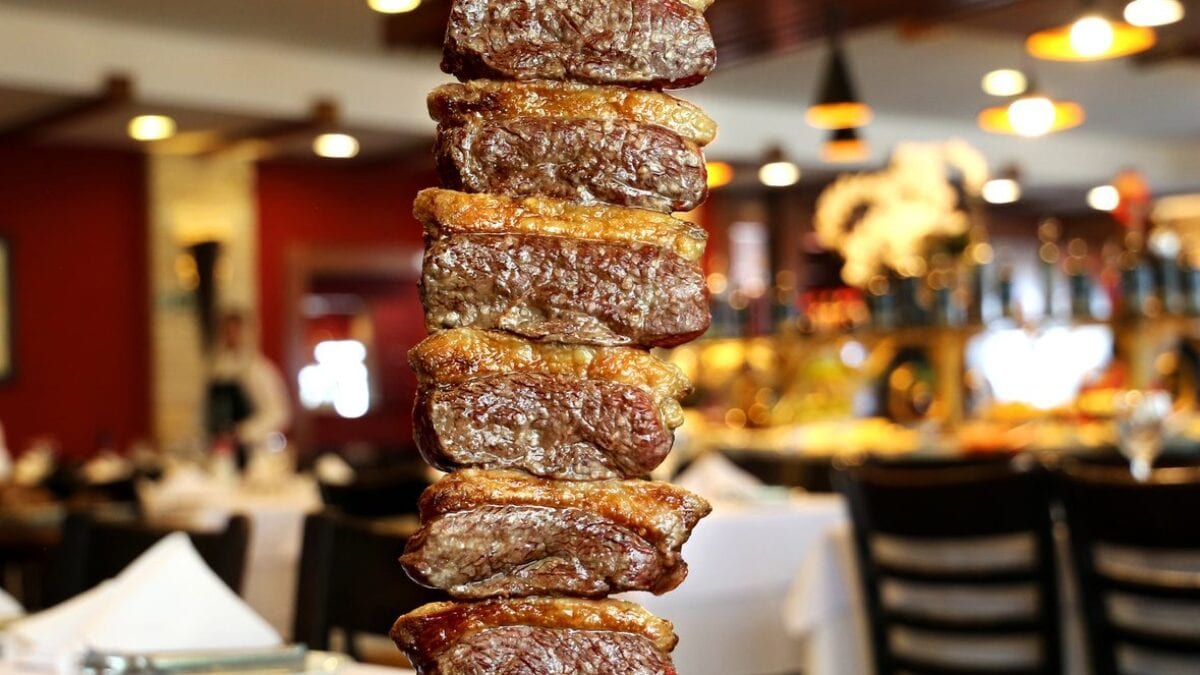
It's always said that to truly understand a people, you must learn their gastronomic traditions. It's no coincidence that some, such as the Japanese tea ceremony, have become so iconic that they've become an experience to be enjoyed and enjoyed even by travelers. In Brazil, among the exquisite typical dishes, the gastronomic ritual to try is churrasco: it's not just a typical meat-based meal but an experience that tells the story of the country, a moment of sharing and a sort of ritual, performed with a collective choreography that involves the kitchen, the dining room, and the diners. The very act of entering a churrascaria has something mystical about it. The buzz of the room, the smell of the grill, and the constant passage of figures crossing the spaces with smoking skewers immediately create a sense of suspended anticipation, as if the meal had already begun before even sitting down at the table.
In this gastronomic universe, what's striking is not just what you eat, but how it all happens. Every detail has a precise function within a fluid and continuous mechanism, where nothing is left to chance and, at the same time, everything appears natural. It is precisely in this tension between control and spontaneity that churrasco finds its strength, transforming a simple meal into an experience that speaks to the senses even before words. Let's discover the history, craftsmanship, and atmosphere behind the Brazilian tradition of churrasco.
What is Churrasco, One of Brazil's Most Iconic Gastronomic Traditions
Churrasco is a mixed grill of meats, mainly beef, pork, chicken, and mutton, simply salted and grilled. It is the national dish par excellence in Brazil (particularly in the Rio Grande do Sul region), also popular in South American countries such as Argentina and Uruguay, but it is much more than a simple typical recipe. This term of Spanish-Portuguese origin, in fact, refers to the entire ritual that accompanies the preparation, cooking, and serving of meat, one of the most authentic expressions of Brazilian culture and identity.
The origins of churrasco lie in the vast plains of southern Brazil, specifically in the state of Rio Grande do Sul, around the 17th century. History has it that the gaúchos, the region's traditional herdsmen, during their long journeys following their herds across the pampas, would grill large pieces of beef skewered on skewers and cooked directly over live coals. Legend has it that at the time, to flavor the meat, the cuts were tied to the horse so that it would be salted with the animal's sweat. Cooking took place on an improvised brazier, skewering pieces of meat on a piece of green wood placed in the center of the coals to prevent it from burning. While the meat cooked from the bottom up, slices were cut with a knife and eaten. It is said that the gaúchos learned this technique directly from the region's indigenous people, who would cook small animals captured in the forest in the same way.
How did this simple custom become a defining gastronomic tradition throughout Brazil? Everything changed during the 20th century: with the modernization of agriculture and economic growth, many inhabitants of southern Brazil began migrating to the country's large urban centers (such as São Paulo and Rio de Janeiro) in search of work. As they moved, they brought with them their culture and culinary traditions, including the tradition of churrasco. The real turning point that made churrasco a mass phenomenon, however, was the invention of the rodízio service. According to tradition, the idea arose from an accidental mistake in a churrascaria in the south, when a waiter accidentally served the wrong table. To remedy the situation, he offered the meat to the customers, giving rise to the concept of a fixed-price meal in which waiters constantly circulate among the tables offering different cuts of freshly cooked meat.
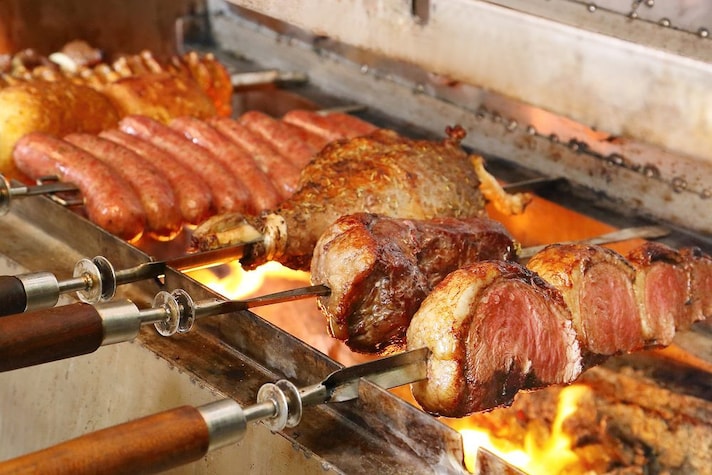
This informal and convivial formula became extremely popular among workers and travelers, especially truck drivers. During the 1970s and 1980s, pioneering restaurateurs from the South, such as the famous Fogo de Chao chain, transformed the tradition into a fine dining experience, spreading the format throughout Brazil and making churrasco an experience accessible to everyone. Today, churrasco is the protagonist of family celebrations, celebrations, and gatherings with friends, moments in which food becomes a powerful tool for social aggregation, but it is also a sought-after experience for tourists. Its cultural importance is such that churrascarias, restaurants specializing in this tradition, are considered true national institutions. Through churrasco, some of the deepest values of Brazilian society are reflected: hospitality, a sense of community, and the valorization of local raw materials. For this reason, churrasco is not only one of Brazil's most beloved dishes, but also one of the gastronomic emblems that best express the country's history, traditions, and spirit.
How Does Service Work During Churrasco?
Churrasco stands out for the attention paid to the quality of the meat and the simplicity of its preparation, but the abundance and the way the meat is served to customers are also crucial. The churrasco experience is also distinguished by its unique and spectacular service, which transforms the meal into a true convivial ritual. In traditional Brazilian churrascarias, the meat is not ordered from a menu and served in individual courses, but is delivered continuously to the table according to the rodízio system, an all-you-can-eat formula that allows guests to sample numerous cuts and preparations.
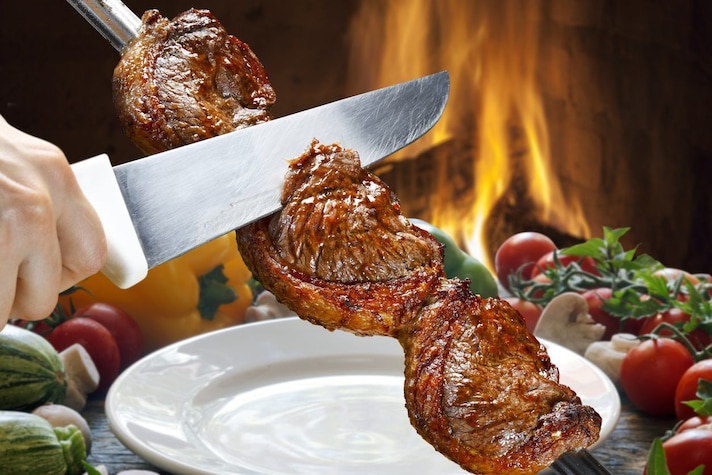
The protagonists of this service are the passadores, specialized waiters who move between the tables with long skewers on which the various cuts of meat are skewered, fresh from the grill. Once they reach the diners, the passadores present the specialty fresh from the kitchen and, with a quick and precise gesture, slice thinly directly onto the plate. The service proceeds continuously and rhythmically, offering a alternating selection of beef, pork, lamb, and chicken, often interspersed with other small specialties. In many churrascarias, customers can control the pace of service with a colored disc or a sign placed on the table: green indicates that they wish to continue receiving courses, while red indicates a pause. This system helps create a dynamic and engaging atmosphere, in which the direct interaction between the passadores and the guests becomes an integral part of the gastronomic experience. Churrasco, therefore, is not just a method of cooking, but a true culinary spectacle that celebrates abundance, sharing, and the Brazilian art of hospitality.
What is Rodízio, and Why Has This "Continuous Flow" System Become Famous?
Rodízio is the service system that best defines the Brazilian churrasco experience. The term derives from the Portuguese verb rodar, meaning "to turn," and evokes the idea of a continuous, circular flow of dishes flowing seamlessly between the kitchen, grill, and tables. In a churrascaria that adopts this format, customers generally pay a fixed price and have the opportunity to sample a wide variety of cuts of meat served directly by the passadores throughout the meal. Unlike traditional restaurants, where diners select individual courses from a menu, in rodízio, the food flows continuously to guests, creating a dynamic and participatory experience.
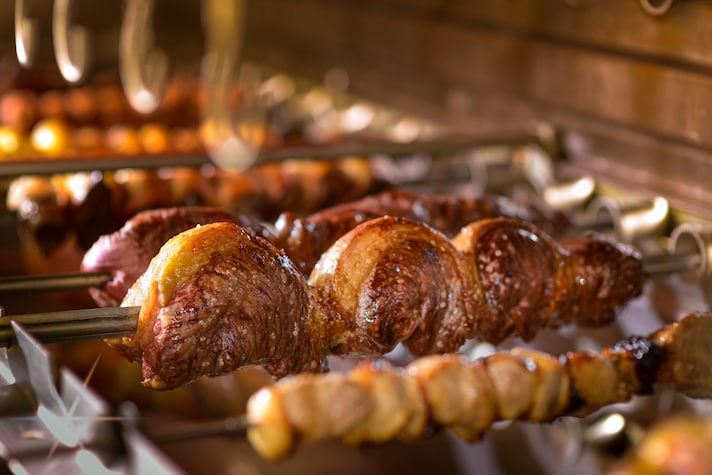
This model emphasizes variety and abundance, allowing you to taste different cuts, each with its own unique texture, marbling, and flavor, and compare their qualities in a single gastronomic journey. The international success of rodízio is linked precisely to this ability to transform a meal into a spectacular and social event: the constant rotation of smoking skewers, direct contact with the passadores, and the freedom to choose how much and what to eat have won over audiences well beyond Brazil's borders. Don't mistake the rodízio system for a commercial formula, because it reflects a specific Brazilian concept of hospitality and conviviality. Its logic is based on the idea that abundance should be shared and that mealtimes should be unhurried, encouraging socialization and the pleasure of being together.
It's no coincidence that this system has enjoyed worldwide success: it's an engaging format, capable of making every dinner a memorable experience. Churrascarias have in some ways anticipated the growing demand for immersive dining experiences, in which service goes beyond simply bringing food to the table, but becomes an integral part of the culinary narrative.
The Hierarchy of Service and The Different Cuts of Meat That Are The Protagonists of Churrasco
The hierarchy of the churrasco isn't limited to the distinction between kitchen and dining room, but is configured as a highly coordinated system in which each figure contributes to maintaining a constant rhythm of the experience. The churrasqueiro isn't just a grill chef, but a true fire manager: his skill lies in reading the meat and the embers as dynamic elements, adjusting the distance, heat, and rotation times of the skewers to achieve uniform results across a wide variety of cuts. Alongside him, the support team manages the preparation, salting, and "resting" of the meat, which is essential for preserving its internal juices. The passadores, on the other hand, represent the most sophisticated level of interaction with the customer: they don't simply serve, but they interpret the dining room, observing which tables are slowing down, which prefer fattier or leaner cuts, and modulating the flow of food accordingly. In this sense, the rodízio functions as an adaptive, almost "intelligent" system, in which service is constantly self-regulating.
Even the sequence of cuts is not random, but follows a precise sensorial and gastronomic logic. The process tends to begin with more delicate and lean cuts, such as alcatra, and then progressively opens up to more flavorful and fatty meats, such as picanha, which represents the central moment of the experience. Subsequently, more structured and intense cuts come into play, such as fraldinha (beef diaphragm or breast), until arriving at slow-cooked preparations such as rib, which often constitutes the highlight of the meal for its complexity and depth of flavor. This progression is not only gastronomic, but also physiological: it serves to guide the palate, preventing the intensity of fat and flavor from immediately saturating the perception. At the same time, pork and poultry variants, such as spiced sausages and corações de frango (chicken hearts), function as aromatic "interludes," capable of renewing the gustatory attention between one beef cut and the next. The flavour of the meat, often not marinated but simply seasoned with coarse salt, is that of the classic grill to which are added the spicy notes of a light smoke, due to the cooking particularly close to the embers.
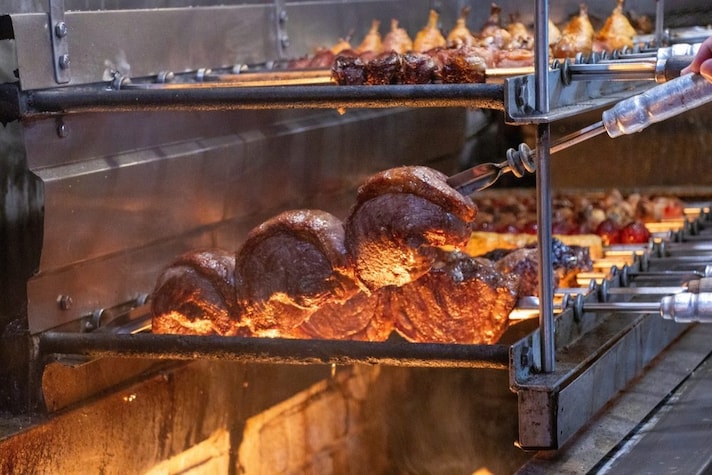
This rigorous architecture reveals the deepest nature of churrasco: a system in which cooking technique, service management, and the construction of the tasting menu are inseparable. The hierarchy is therefore not only organizational, but also narrative, guiding the diner through a progression of flavors designed to transform the meal into a coherent, continuous, and progressively more intense experience.
Churrasco's Curiosities and Traditional Vs. Modern Rituals
Over time, a veritable unwritten code of conduct has developed around churrasco, as well as a series of curiosities that enrich its cultural appeal. Among the lesser-known curiosities is the role it played in ennobling picanha, now considered one of the most prized meats in the world. In reality, in Brazil, it wasn't always a "noble" cut: for a long time, it was undervalued outside the southern part of the country, while in the gaucho tradition , it represented a simple yet extremely flavorful piece, enhanced precisely by grilling. Only with the spread of modern churrascarias did it acquire the status of an iconic national and international cut.
Another peculiarity concerns the salting of the meat. In the most traditional version of churrasco, only coarse salt is used, applied just before cooking, and no marinade is used. This choice serves not only aromatic purposes but also technical ones, as it helps create a crust that retains the meat's internal juices. Furthermore, in the most traditional churrascarias, the fire is never completely extinguished during service: the embers are kept alive and constant, almost as if to symbolize a continuity between past and present, between the ritual of the gauchos and the modernity of global catering.
In the transition from its rural origins to modern churrascarias, churrasco has also undergone a significant evolution. While in traditional southern Brazilian versions, cooking took place on simple spits, often outdoors and with an almost family-style fire, today many restaurants have transformed this practice into a highly structured experience, with elegant settings, buffets of international side dishes, and extremely organized service management. However, even in the most contemporary versions, the core of the system remains unchanged: the meat served at the table without interruption and the idea of shared abundance. Some modern variations have also introduced adaptations for a global audience, including international cuts, less fatty options, or even gourmet interpretations of the tradition, without altering the principle of rodízio.
What hasn't changed, however, is the rodízio etiquette: simple and precise, it applies not only to those serving but also to those seated to eat. For example, the small disc on the table indicating green or red isn't a decorative detail, but a shared language between customer and passadores, and ignoring it means interrupting the collective rhythm of service. Even the tasting method follows certain implicit customs: meats are served in small portions, cut directly at the table by the passador, allowing for a continuous and varied tasting. It's not uncommon for diners to wait for the desired cut to arrive without actively "chasing" the service. For this reason, too, a rodízio meal can easily last more than two hours. Not because the service is slow, but because it's designed to be continuous, varied (there are at least ten cuts offered), and potentially endless, until the customer "interrupts" the flow.
It is precisely this balance between roots and innovation that explains the global spread of churrasco: from a rural ritual of gauchos to an international gastronomic experience, it has retained its convivial identity, adapting to urban and contemporary contexts without losing its connection to its origins. This ability to evolve without losing its essence lies one of the main reasons for its global success.

