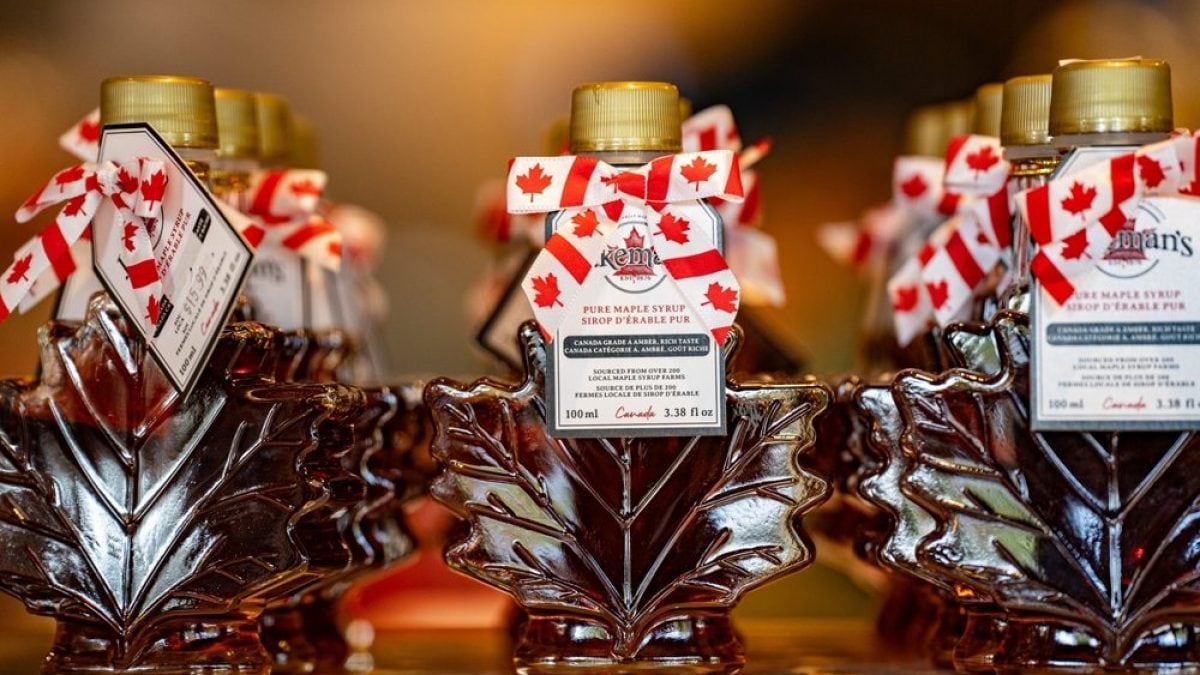
When a food stops being simply a product and becomes a national symbol, every crack in its integrity takes on a much broader significance, transcending the economic and touching the cultural. This is the case of maple syrup, Canada's gastronomic emblem and an integral part of its collective identity, so much so that the maple leaf —from which everything originates—stands at the center of the national flag. It is not just a raw material or an ingredient: it is an element deeply rooted in the country's imagination, linked to its history, its territories, and an idea of authenticity built over time.
Produced primarily in the French-speaking province of Quebec, which alone accounts for almost all Canadian production and a dominant share of global production, maple syrup has always been associated with high quality standards and a strictly controlled supply chain. This reputation has helped transform it into a true "liquid gold," capable of supporting an entire economic sector and strengthening Canada's international image as a country linked to nature and authenticity.
Precisely for this reason, the scandal that has emerged in recent weeks has an impact that goes far beyond the single case of food fraud. For the first time, one of the country's most iconic and regulated products has been implicated in a documented episode of adulteration, calling into question a system that seemed impervious to these types of practices. What's at stake isn't just the quality of a few cans of syrup, but the overall trust in a national symbol built over decades of production, control, and storytelling.
The Investigation Started From a Detail
What brought the case to light wasn't institutional controls, but a seemingly insignificant detail: an unusual flavor. This is how the investigation by Radio-Canada's Enquête program began, which from a simple suspicious tasting uncovered a systematic fraud. The product in question, sold as pure maple syrup, actually contained a significant amount of added cane sugar, a prohibited practice that profoundly alters the product's nature.
Laboratory analyses, conducted with the support of the ACER Centre —the leading body for maple syrup control in Quebec—confirmed the suspicions: it was not accidental contamination, but deliberate alteration. This discovery marks a turning point: it is the first time such a case of explicit adulteration has been documented in Canada in the maple syrup industry, historically considered one of the most regulated.

The Issue of Origins
At the same time, the investigation uncovered a second level of irregularity, perhaps less immediate but equally significant: the falsification of origin. Part of the syrup was purchased in other provinces, such as Ontario and New Brunswick, and then labeled as a product from Quebec, the region at the heart of global production. This operation exploits the symbolic and commercial value of the geographical designation, betraying consumer expectations.
But the scandal's significance extends far beyond this single case: the maple syrup industry is worth approximately one billion Canadian dollars a year, and Quebec dominates the global market. In this context, trust in the quality and authenticity of the product is crucial, not only for consumers but for the entire economic system. This is also underscored by Canadian academic research, including that of the University of Guelph.
A Precedent That Weighs
This isn't the first time maple syrup has been at the center of controversy: in 2011, Canada was rocked by the infamous "Great Maple Syrup Heist," a multimillion-dollar theft involving strategic reserves of the product. However, while back then it was a case of organized crime tied to the commodity's economic value, today the problem appears more insidious: it involves the supply chain itself and the possibility of fraudulent practices creeping into a system considered secure.
;Resize,width=767;)
