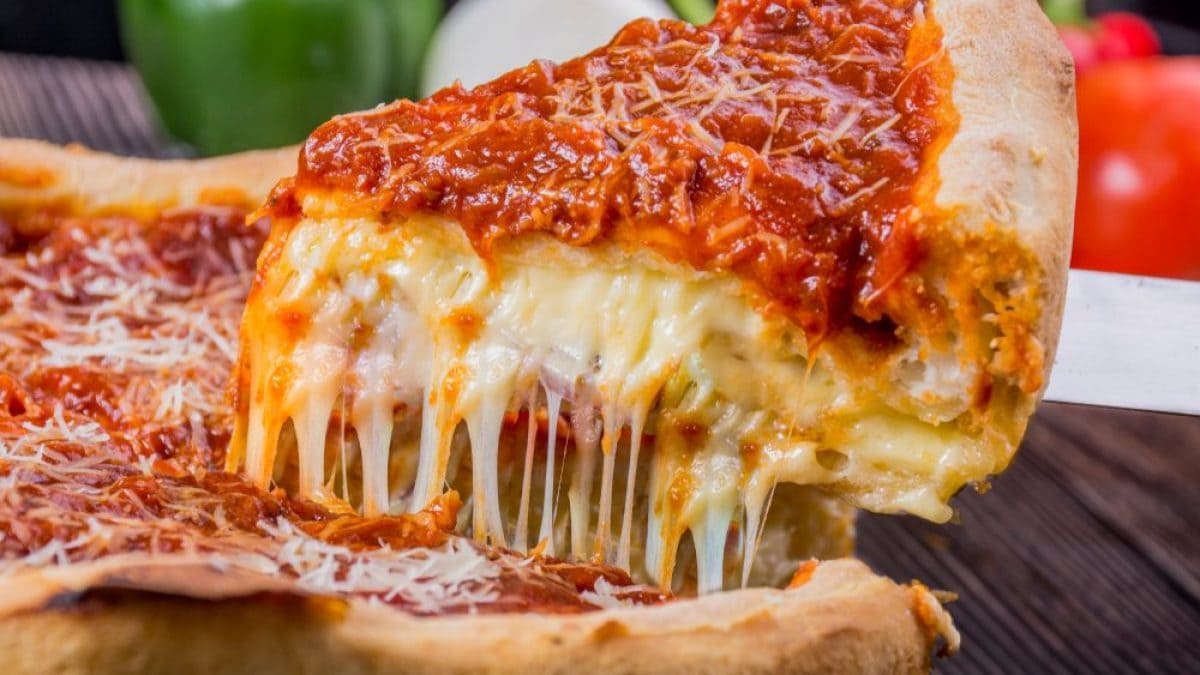
In the beating heart of Chicago, amidst the glittering lights and urban bustle, a pizza was born that revolutionized tradition. Not an imitation of the classic Italian Margherita, nor the thin or crispy New York-style, but a creation that, with its high crust and rich toppings, has conquered the palates of Americans and beyond: deep dish pizza, also called deep pan pizza or Chicago-style pizza.
A dish that's more than just food, but a true experience, capable of recounting the city's history, its culinary roots, and its evolution. Born in the 1940s in a small Chicago pizzeria, this pizza is now a gastronomic icon, a symbol of substance and passion that, with every bite, transports the eater on a journey through time and the traditions of an ever-evolving city.
How Chicago's Deep Dish Pizza Was Born
Chicago-style pizza was born in 1943, when a man named Ike Sewell decided to open a restaurant called Pizzeria Uno. Sewell and his partner, Ric Riccardo, were determined to create a pizza that was different from traditional Neapolitan or New York-style pizza, which had a thin crust and was quick to prepare. Sewell wanted a pizza that could be a true "dish," more substantial and rich.
Deep dish pizza is, in fact, a "layered" pizza: the pizza base is made with a very thick dough that is spread along the bottom and sides of a pan, creating a high (but not thick) crust. Unlike traditional pizza, where the ingredients are layered on the dough in a fairly simple order, deep dish pizza uses a different method of layering.
Here's the typical sequence for a Chicago pizza:
- The dough: dense and crispy, often more similar to shortcrust pastry than to traditional pizza dough.
- Cheese: mainly stretched curd cheese is used, preferably mozzarella, which is spread over the bottom of the pizza.
- Miscellaneous ingredients: Items such as sausage, peppers, mushrooms, and onions should be placed on top of the cheese.
- The tomato sauce: thick and full-bodied, it is poured on top, covering everything very abundantly.

The Chicago Influence and The Evolution of Deep Dish
The creation of this pizza was not only a matter of culinary innovation, but also a response to the growing demand for hearty dishes among Chicagoans: then as now, the city was a transit point for many workers and immigrants seeking filling and satisfying dishes.
Pizzeria Uno became an instant hit, and deep dish pizza quickly gained popularity. Over the next few decades, other Chicago pizzerias began creating their own versions of the pizza, but Sewell and Riccardo's original recipe is still considered the foundation of Chicago pizza. In 1955, Sewell opened Pizzeria Due, further elevating Chicago pizza to fame. Over the years, other renowned pizzerias such as Lou Malnati's and Giordano's have continued to serve the pizza, each with slight variations in preparation and ingredients.

Today, Chicago deep dish pizza is a culinary icon of Chicago and one of the most famous pizzas in the United States. For tourists and Chicago residents, eating a Chicago pizza is a must-try tradition: it's often served in deep pans and eaten with a fork and knife due to its thick, hearty texture. Variations of this pizza exist, with the addition of ingredients such as ground beef, pepperoni, shrimp, or vegetables, but the classic recipe remains the one with sausage, cheese, and tomato sauce.
;Resize,width=767;)
