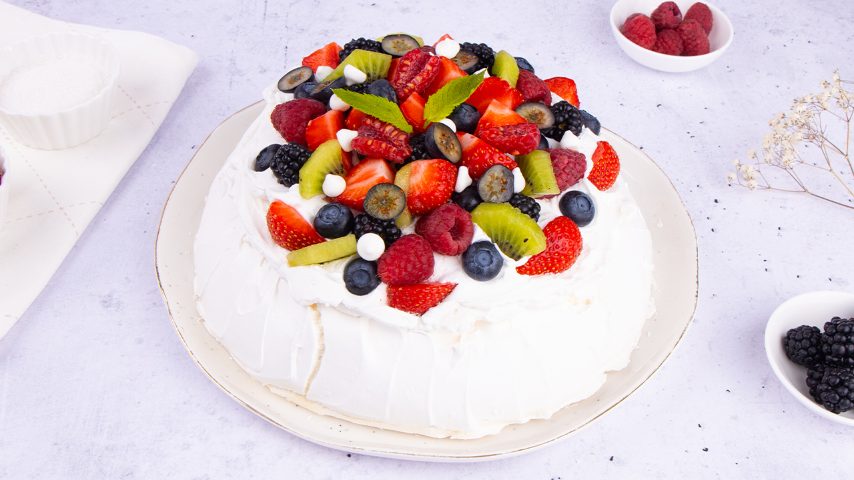
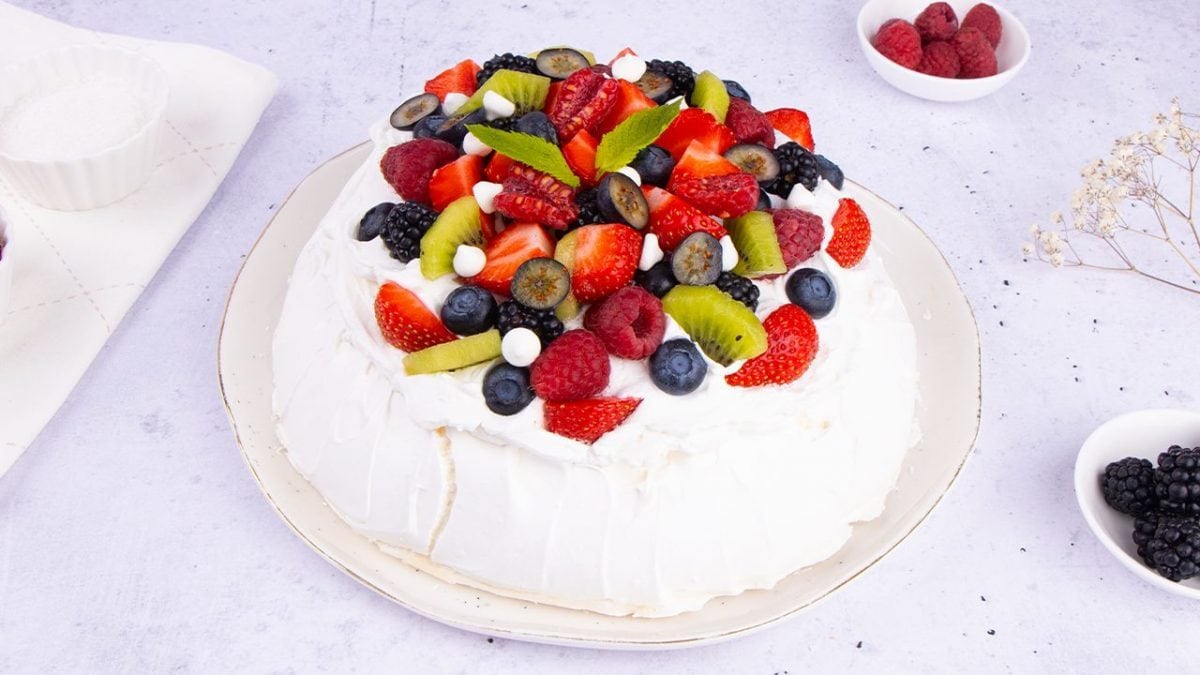
Pavlova with Cream and Berries is an elegant dessert built around a crisp meringue shell with a soft, delicate center, topped generously with vanilla whipped cream and fresh fruit.
Despite its impressive appearance, the preparation is surprisingly straightforward. The egg whites and sugar are first warmed over a bain-marie, then whipped until glossy and firm before being shaped into the characteristic pavlova disk.
Once baked slowly and cooled completely, the meringue becomes the perfect base for fluffy cream, colorful berries, fresh fruit, and decorative meringues. It is an ideal dessert for celebrations, dinner parties, birthdays, or whenever you want to serve something light-looking but wonderfully indulgent.
Why Everyone Will Love This Recipe
Pavlova is all about contrast. The exterior is delicate and crisp, while the center remains softer and almost marshmallow-like. The whipped cream adds richness without making the dessert feel heavy, while berries and other fresh fruits bring acidity and freshness that balance the sweetness of the meringue.
It is also an exceptionally beautiful dessert. Piled high with colorful fruit, mint, and small meringues, it becomes an effortless centerpiece for a special table. Another advantage is that the meringue base can be prepared ahead, leaving only the cream and decoration to complete shortly before serving.
What Is Pavlova?
Pavlova is a meringue-based dessert traditionally topped with whipped cream and fresh fruit. Its defining texture combines a crisp outer shell with a soft, tender center.
The dessert was named after Anna Pavlova, the celebrated Russian ballerina who toured Australia and New Zealand during the 1920s. Both countries have long claimed a connection to the dessert’s creation, and its precise origin remains the subject of culinary debate.
Whatever its birthplace, pavlova became particularly associated with Australia and New Zealand and is now a classic celebratory dessert in both countries.
Fresh berries are an especially popular topping because their tartness balances the very sweet meringue, while whipped cream adds a smooth, cooling contrast.
Cooking Tips
- Make sure the mixing bowl and beaters are completely clean and free from grease because even a small amount of fat can prevent egg whites from whipping properly.
- Separate the eggs carefully because any trace of yolk in the whites can interfere with the formation of a stable meringue.
- Warm the egg whites and sugar gently over the bain-marie while stirring continuously because the goal is to dissolve the sugar without cooking the whites.
- Rub a small amount of the warm mixture between your fingertips before whipping because it should feel smooth rather than grainy once the sugar has dissolved.
- Whip the meringue until it becomes thick, glossy, and firm enough to hold its shape because an under-whipped mixture may spread during baking.
- Shape a shallow indentation in the center before baking because this creates a natural space for the whipped cream and fruit.
- Bake the pavlova at a very low temperature because slow drying helps create a crisp shell without excessively browning the meringue.
- Let the meringue cool completely inside the switched-off oven because a gradual temperature change reduces the risk of dramatic cracking or collapse.
- Whip the fresh cream while it is very cold because chilled cream reaches a stable, fluffy consistency more easily.
- Add the cream and fresh fruit only shortly before serving because moisture from the toppings gradually softens the meringue shell.
Frequently Asked Questions
Why Did My Pavlova Crack?
Some cracking is completely normal and is part of pavlova’s rustic appearance. Large cracks can develop when the meringue cools too quickly, which is why leaving it inside the oven after baking helps reduce sudden temperature changes.
How Do I Know When the Meringue Is Whipped Enough?
The mixture should be glossy, thick, and capable of holding firm peaks when the beaters are lifted. It should also feel smooth rather than gritty, since undissolved sugar can affect the final texture.
Can I Use Different Fruits?
Absolutely. Strawberries, raspberries, blueberries, blackberries, kiwi, passion fruit, peaches, mango, or cherries all work well. Slightly tart fruits are especially good because they balance the sweetness of the meringue.
Why Is My Pavlova Sticky on the Outside?
Humidity is often responsible for a sticky surface because sugar in the meringue attracts moisture from the air. It can also happen if the pavlova has been covered or refrigerated before serving, so keep the plain meringue in a dry place until you are ready to decorate it.
Can I Make Individual Mini Pavlovas?
Yes. Pipe or spoon smaller portions onto the baking tray and create a small indentation in each one. They will generally need less baking time than one large pavlova, so monitor them carefully and cool them gradually in the oven.
What Can I Use Instead of Whipped Cream?
Mascarpone cream, lightly sweetened Greek yogurt, or a mixture of mascarpone and cream can all work. Keep the topping reasonably thick so it stays in the center rather than running over the delicate meringue.
How to Store
The undecorated pavlova base is best stored at room temperature in an airtight container in a cool, dry place for up to 1 day. Once topped with whipped cream and fruit, keep the pavlova refrigerated and enjoy it within 24 hours, as the cream and fruit will gradually soften the meringue. For the best texture, assemble the dessert shortly before serving.
How to Freeze
The plain baked meringue base can be frozen, although it is delicate and must be protected carefully from moisture and breakage. Once completely cool, wrap it gently and place it inside a rigid freezer-safe container for up to 1 month. Thaw it at room temperature while still protected from humidity. Do not freeze the pavlova after adding whipped cream and fresh fruit, as both the texture and appearance will deteriorate after thawing.
Ingredients
How to Make Pavlova with Cream and Fresh Fruit

Prepare the meringue: collect the egg whites and granulated sugar in a bowl.
Prepare the meringue: collect the egg whites and granulated sugar in a bowl.

Place the container over a pan half filled with boiling water and let the sugar dissolve in a bain-marie, stirring continuously with a whisk.
Place the container over a pan half filled with boiling water and let the sugar dissolve in a bain-marie, stirring continuously with a whisk.

When the mixture has reached a temperature of around 60°C, remove from the heat.
When the mixture has reached a temperature of around 60°C, remove from the heat.

Whip everything together with a pair of electric whisks.
Whip everything together with a pair of electric whisks.

At the end you should obtain a very firm and frothy meringue.
At the end you should obtain a very firm and frothy meringue.

Draw a disc of 18-20 cm in diameter on a baking tray lined with baking paper, then pour the prepared meringue in the centre.
Draw a disc of 18-20 cm in diameter on a baking tray lined with baking paper, then pour the prepared meringue in the centre.

Spread the meringue evenly, so as to obtain a fairly thick disc and, using a spatula, make a slight hollow in the centre. Then place in the oven at 140°F/60°C and leave to cook for about 2 hours.
Spread the meringue evenly, so as to obtain a fairly thick disc and, using a spatula, make a slight hollow in the centre. Then place in the oven at 140°F/60°C and leave to cook for about 2 hours.

Once the cooking time is up, let the pavlova cool in the turned-off oven with the door slightly open, then take it out of the oven.
Once the cooking time is up, let the pavlova cool in the turned-off oven with the door slightly open, then take it out of the oven.

Collect the fresh cream, vanilla extract and icing sugar in a bowl.
Collect the fresh cream, vanilla extract and icing sugar in a bowl.

Whip the cream until stiff with a pair of electric whisks.
Whip the cream until stiff with a pair of electric whisks.

Arrange the pavlova on a serving plate and fill the center with whipped cream.
Arrange the pavlova on a serving plate and fill the center with whipped cream.

Decorate as desired with the fresh fruit mix, sprinkle the cake with some crunchy meringues and garnish with a sprig of mint.
Decorate as desired with the fresh fruit mix, sprinkle the cake with some crunchy meringues and garnish with a sprig of mint.

Bring the pavlova to the table, cut it into slices and serve. Enjoy!
Bring the pavlova to the table, cut it into slices and serve. Enjoy!


