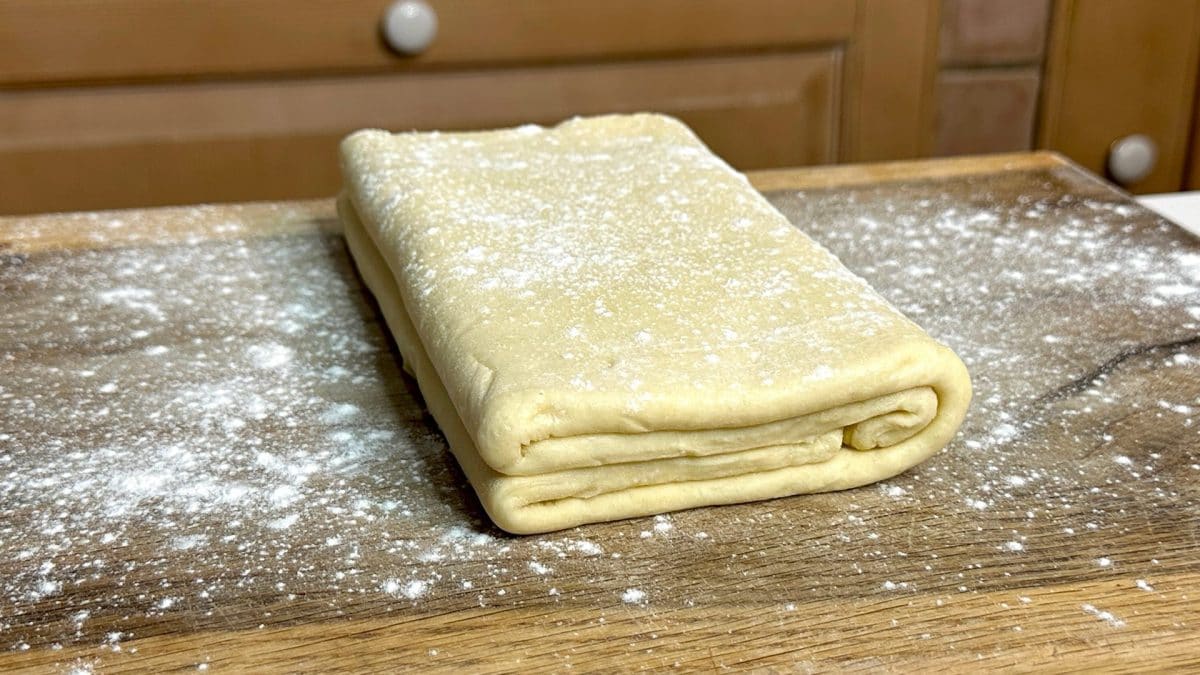
Homemade Puff Pastry, like choux pastry and shortcrust pastry, is a typical basic pastry in French pastry-making, though it has now become a classic in American pastry-making as well. Often called pâte feuilletée due to its appearance and extreme lightness, it is characterized by its neutral flavor, making it ideal for both sweet and savory recipes.
The process is a bit tricky, but with the tips and tricks we're going to give you, you too can make puff pastry at home without too much difficulty. You'll just need to make two separate doughs: the pastel dough, made from flour, salt, and water, and the dough, made from flour and diced butter. The dough is enclosed in the pastel dough, and the resulting dough is then rolled out and folded over itself several times, allowing for the required resting time after each "round of pastry."
The puff pastry should then rest in the refrigerator for at least 6 hours, or even better, overnight. It will then be ready to be used as you prefer.
Ingredients
How to Make Puff Pastry at Home
How to Prepare The Dough

Cut the butter, cold but workable, into cubes, then transfer them to the bowl of the stand mixer.
Cut the butter, cold but workable, into cubes, then transfer them to the bowl of the stand mixer.

Add the flour, fit the leaf hook and knead briefly until the ingredients are combined.
Add the flour, fit the leaf hook and knead briefly until the ingredients are combined.

Transfer the mixture onto a sheet of baking paper and cover it with another sheet of paper.
Transfer the mixture onto a sheet of baking paper and cover it with another sheet of paper.

Proceed to roll it out with a rolling pin to obtain a uniform rectangle, about 1 cm thick.
Proceed to roll it out with a rolling pin to obtain a uniform rectangle, about 1 cm thick.

Fold the baking paper over the dough, so that it completely envelops it, then put it in the refrigerator for 1 hour.
Fold the baking paper over the dough, so that it completely envelops it, then put it in the refrigerator for 1 hour.
How to Prepare The Pastel Dough

Take care of the pastry: pour the flour and salt into the bowl of the stand mixer.
Take care of the pastry: pour the flour and salt into the bowl of the stand mixer.

Start kneading with the hook, pouring in the water little by little.
Start kneading with the hook, pouring in the water little by little.

Work the ingredients until you obtain a rough mixture.
Work the ingredients until you obtain a rough mixture.

Roll out the pastry to give it a rectangular and rather elongated shape, then fold one of the two edges towards the center.
Roll out the pastry to give it a rectangular and rather elongated shape, then fold one of the two edges towards the center.

Cover it with the other flap and slightly stretch out the resulting rectangle.
Cover it with the other flap and slightly stretch out the resulting rectangle.

Then wrap it in cling film and let it rest in the refrigerator for 1 hour.
Then wrap it in cling film and let it rest in the refrigerator for 1 hour.

Once the resting time has elapsed, take the pastry out of the fridge and roll it out with a rolling pin to form a rectangle about 1 cm thick, wide enough to contain the dough inside.
Once the resting time has elapsed, take the pastry out of the fridge and roll it out with a rolling pin to form a rectangle about 1 cm thick, wide enough to contain the dough inside.

Close the edges of the pastry on the dough and seal the edges carefully, pinching them with your fingers.
Close the edges of the pastry on the dough and seal the edges carefully, pinching them with your fingers.

Flatten everything with a rolling pin, then proceed with the fold turns.
Flatten everything with a rolling pin, then proceed with the fold turns.
How to Fold the Puff Pastry to Get a Perfect Result

Roll out the dough to obtain a long rectangle, then fold one of the flaps towards the center.
Roll out the dough to obtain a long rectangle, then fold one of the flaps towards the center.

Overlap the other flap, so as to form a 3-fold. Wrap the resulting rectangle in cling film and refrigerate for 1 hour. Resting is essential because it allows the butter to firm up and the dough to relax.
Overlap the other flap, so as to form a 3-fold. Wrap the resulting rectangle in cling film and refrigerate for 1 hour. Resting is essential because it allows the butter to firm up and the dough to relax.

After this time, take the dough and roll it out again on the surface dusted with flour.
After this time, take the dough and roll it out again on the surface dusted with flour.

Make a long rectangle and proceed with a 4-fold.
Make a long rectangle and proceed with a 4-fold.

Fold the first flap, reaching about 1/3 of the puff pastry rectangle.
Fold the first flap, reaching about 1/3 of the puff pastry rectangle.

Take the other flap and fold it so that it reaches the first one.
Take the other flap and fold it so that it reaches the first one.

Fold the puff pastry over itself again to obtain 4 layers. Wrap the rectangle in cling film again and place in the refrigerator for 1 hour.
Fold the puff pastry over itself again to obtain 4 layers. Wrap the rectangle in cling film again and place in the refrigerator for 1 hour.

Repeat both operations: first make a 3-fold, then back in the fridge for 1 hour.
Repeat both operations: first make a 3-fold, then back in the fridge for 1 hour.

Proceed with a 4-fold. After this final fold, let the puff pastry rest in the refrigerator for at least 6 hours, or even better, overnight.
Proceed with a 4-fold. After this final fold, let the puff pastry rest in the refrigerator for at least 6 hours, or even better, overnight.

Your puff pastry will be ready to use. Enjoy as you prefer!
Your puff pastry will be ready to use. Enjoy as you prefer!
How to Roll Out and Cook Puff Pastry
Puff pastry can be rolled out with a rolling pin on a floured surface. The ideal thickness is usually very thin, around 2 mm maximum. To prevent it from puffing up excessively during baking, prick it with the prongs of a fork.
Baking times vary depending on the filling chosen and the size of the pie: savory pies with fillings will take up to 40 minutes, while 15-20 minutes are sufficient for rustic pies and mignon pastries. The oven temperature must always be between 375°F/190°C and 390°F/200°C, so that the pastry is perfectly golden, crispy, and flaky.
How Do I Keep The Puff Pastry From Getting Soggy?
The important rule is to never leave the pastry in direct contact with ingredients from which it would absorb too much moisture, such as eggs, creams, or cheeses, resulting in a soggy pastry after cooking. For savory dishes, you can insulate the pastry with a layer of breadcrumbs, while for sweet dishes, simply dust it with granulated or powdered sugar.
What Can I Use Puff Pastry For?
You can use it to bring to the table delicious pain au chocolat, croissants, fruit parcels, and mille-feuille, as well as stuffed rustic pastries, appetizers, and delicious starters.
Use it to make vol-au-vents, pizzas and breadsticks, filled baskets, meatloaf in a crust and fillet Wellington to bring to the table as second courses, or apple triangles, chocolate braid and cannoli to serve at the end of a special dinner.
Storage & Freezing Instructions
Puff pastry can be stored in the refrigerator, wrapped in plastic wrap, for up to 2 days; alternatively, it can be stored in the freezer for up to 3 months, also wrapped in plastic wrap. If needed, let it thaw slowly in the refrigerator for at least 3-4 hours, then leave it at room temperature for 15 minutes.
;Resize,width=767;)
