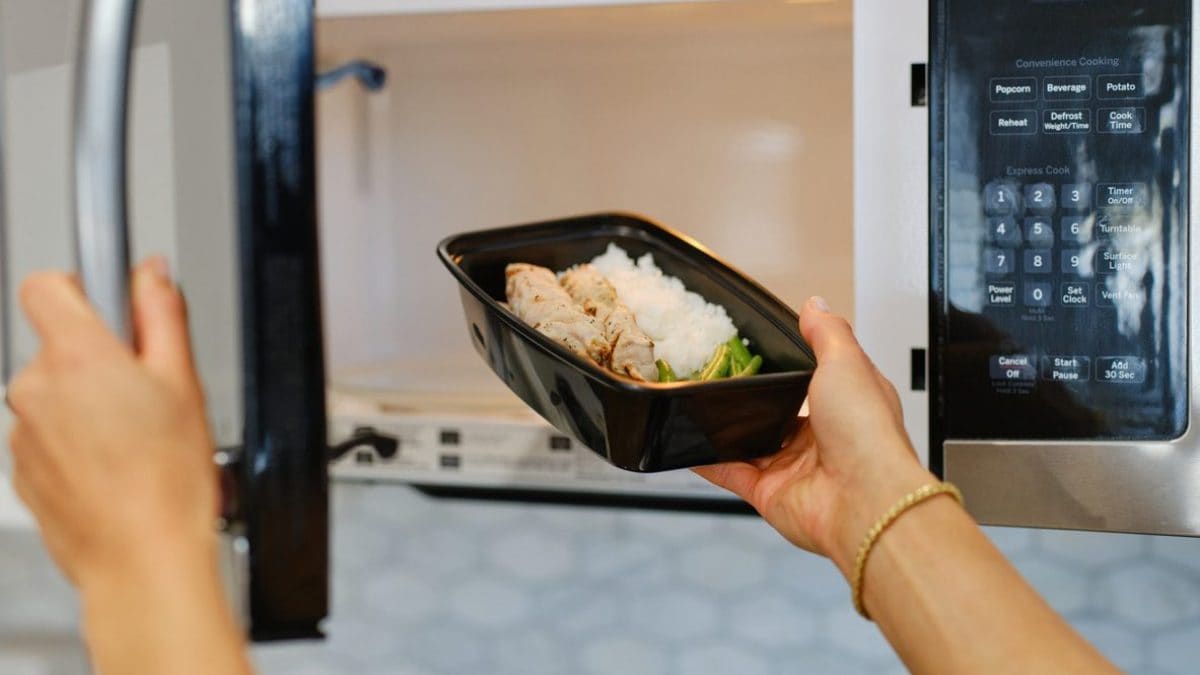
It's an everyday occurrence: you open the refrigerator, take out a ready-made meal, pop it in the microwave "as is," as directed on the package, and in a few minutes, lunch is served. A simple, quick, and now standardized gesture. But according to Greenpeace International's new report, "Are We Cooked? The Hidden Health Risks of Plastic-Packaged Ready Meals," that very step in the microwave could transform the container into an invisible source of food contamination.
The report, which analyzes 24 scientific studies published in peer-reviewed journals, highlights the release of micro- and nanoplastics and potentially toxic chemicals during the heating of foods in plastic packaging. Microwaves, in particular, emerge as the most critical environment.
The Microwave as a Release Accelerator
According to the data reported in the report, just five minutes of microwave heating releases between 326,000 and 534,000 plastic particles from a food sample. This is up to seven times higher than that recorded with heating in a traditional oven.
The mechanism is linked to the heat and physical stresses that the plastic is subjected to: high temperatures and direct contact with food, especially if rich in fats or oils, promote the fragmentation of the material and the detachment of microscopic particles. In the microwave, the process is particularly intense because the heating is rapid, often uneven, and occurs in direct contact with the container.
The result is a migration of solid fragments and chemical molecules directly into the food which is then consumed.
Microplastics and Additives, As Well
The problem isn't just about physical particles: the report highlights that heat can break the polymer bonds of common plastics, such as polypropylene and polystyrene, facilitating the release of chemical additives used in packaging production.
Among the most frequently cited substances are bisphenols, phthalates, PFAS, plasticizers, and antioxidants. Of the more than 16,000 substances associated with plastics, more than 4,200 are considered highly hazardous. Many of these are not adequately regulated when used in food contact materials. The presence of fatty foods, sauces, or oily dressings can further increase chemical migration, as these substances tend to dissolve more easily in lipids.

Does "Microwave Safe" Really Mean Safe?
A key point of the report concerns labels. The term "microwave safe" does not necessarily mean there are no particles or chemicals released, but it does indicate that the container will not deform or melt under intended conditions of use.
The difference is substantial: packaging can retain its shape and be technically suitable for heating, yet still release microplastics and additives in significant quantities. Greenpeace argues that current regulations do not adequately address cumulative effects and repeated exposures over time.
The report then draws attention to the exposure of children and fetuses. According to the data cited, at least 1,396 chemicals derived from plastic have already been detected in the human body: some are capable of crossing the placenta, exposing the fetus at delicate stages of development.
In children, whose metabolism is faster and organs are still developing, the potential impact affects the endocrine and nervous systems, as well as neurological development. While the document doesn't address immediate effects, it emphasizes the need to assess the long-term risk, considering the frequency with which ready-to-eat meals are consumed.
A Growing Market and a Collective Cost
The global ready-to-eat meal industry is booming and is estimated to be worth nearly $190 billion. At the same time, the report highlights the health costs associated with diseases associated with plastic chemicals. In the United States, these costs are estimated to be approximately $250 billion annually. Considering the entire life cycle of plastic, from raw material extraction to disposal, the global social and environmental cost is estimated at over $1 trillion annually.
Greenpeace therefore calls on governments engaged in the negotiations for the United Nations Global Plastics Treaty to apply the precautionary principle and intervene at source, reducing plastic production and strengthening the regulation of food contact materials.
What it Means for Those Who Cook and Consume
For those who spend their days in the kitchen, juggling work, family, and tight schedules, the microwave isn't a luxury but an ally: fast, practical, and an integral part of household organization. The point isn't to demonize it, nor to give up ready-made meals when needed. The key is understanding where to intervene to reduce exposure, which, according to the report, can add up over time.
While we await further scientific research and any regulatory updates, the first precaution is simple: transfer the food to a glass or ceramic container before placing it in the microwave. This quick step doesn't affect the cooking time or quality of the food, but it eliminates direct contact between hot food and plastic at the most critical moment: heating.

Particular attention should be paid to foods high in fat or sauces, which can encourage the migration of substances from the container. Avoiding reusing disposable trays or containers that are visibly worn, scratched, or deformed is also a good practice, as the integrity of the material affects the stability of the plastic when subjected to heat.
For those who use reusable containers, it's helpful to check that they're actually certified for food use and microwave use, while keeping in mind that the wording "suitable" doesn't automatically mean "inert." The most prudent alternative, when possible, remains glass, a material stable at high temperatures and free of plastic additives.
;Resize,width=767;)
