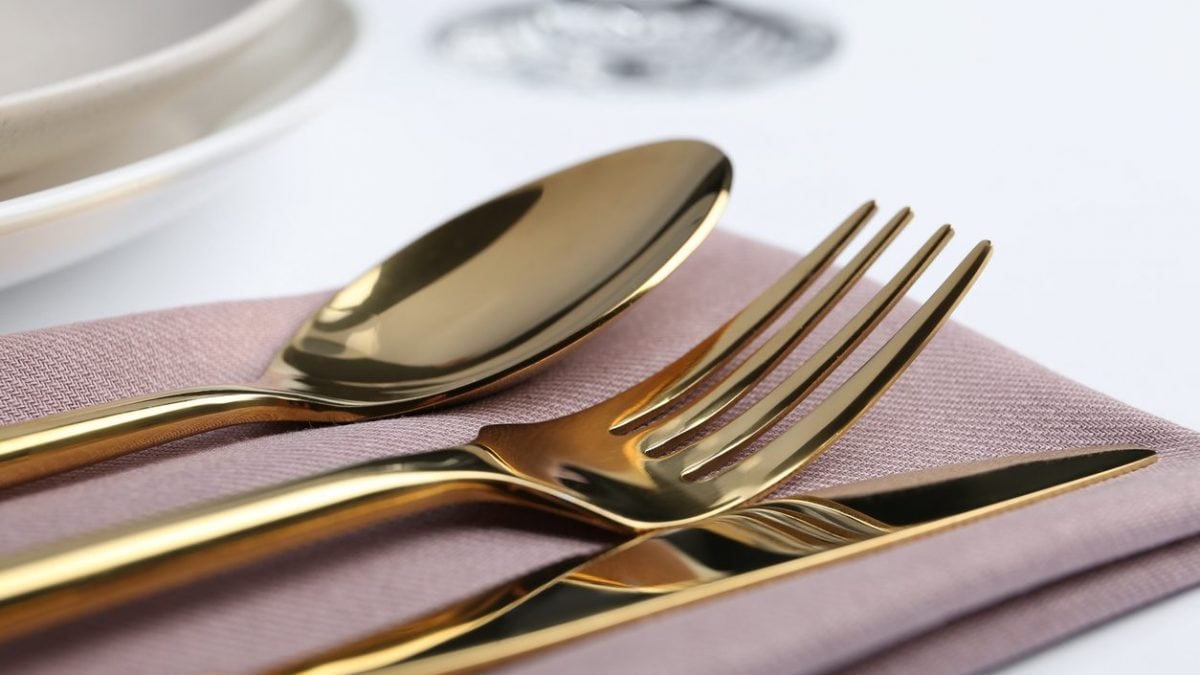
We have long since overcome the belief that the flavor of a food depends exclusively on taste. Numerous studies demonstrate how this is constructed primarily through smell, but can also be influenced by other senses, such as hearing, touch, and sight. Indeed, according to some researchers at the University of Oxford, the weight of cutlery can alter our perception of a food: no, this isn't science fiction, but gastrophysics.
The Heavier the Cutlery, The Higher the Perceived Quality
About a month ago, a reel appeared on the University of Oxford's Instagram page in which Charles Spence, professor of experimental psychology and director of the Crossmodal Research Laboratory, claims that the simplest way to make a dish more appreciated by the people it's prepared for is "to serve it with heavy cutlery. Adding weight to knives, forks, and spoons makes the dishes taste better." According to the father of gastrophysics—"gastro from gastronomy and physics from psychophysics," as he himself explains— the weight of cutlery influences the perception of food, as reported in a study he published several years ago in the journal Flavour.
The experiment conducted by him and his team involved serving the same dish, first with lighter and then heavier cutlery, to approximately 130 participants: the result was that the dish consumed with the heavier cutlery was judged to be tastier, more valuable, and of superior quality. The subjects even stated that they were willing to pay more, despite there being, obviously, no real difference in preparation. The reason behind this judgment is psychological: the brain associates concepts such as solidity, value, and care with a heavier object, thus transferring these sensations to the dish we are eating, regardless of what we are actually consuming.
The Role of Color and Shape
Over the years, Charles Spence has dedicated himself to various research studies investigating the connection between our perception of food and other elements apparently belonging to sensory spheres other than taste – hence the term multisensory experience – such as the effect that the sound of crispy chips has on us. In addition to studying how the weight of cutlery influences the way we perceive food, Spence, together with a team of experts, has also analyzed the role of color. During various tests, a yogurt, for example, was judged sweeter and more pleasant if consumed on a white spoon, while stronger color contrasts led to different evaluations, even if they were the same food. The same yogurt, therefore, was perceived differently on a black spoon, while the strawberry yogurt was considered less sweet if served on a blue spoon, a color generally associated with less sweet foods.
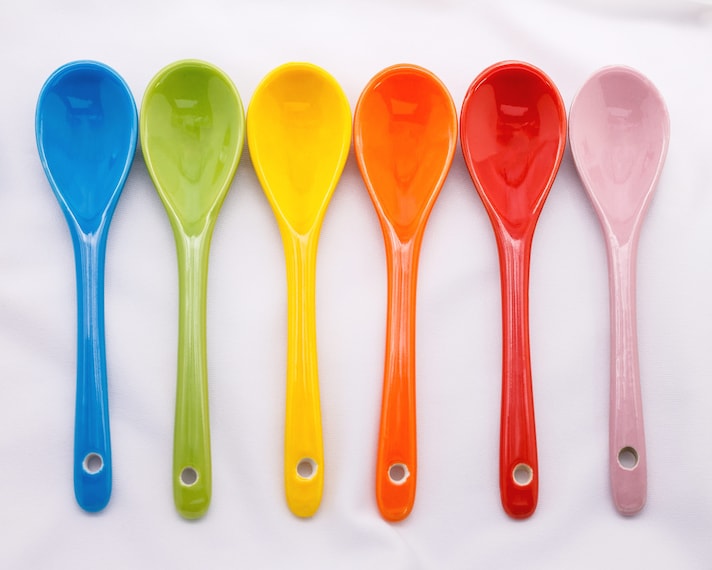
The explanation behind these behaviors is that the brain integrates visual and tactile information before the food is even placed in our mouth, creating expectations that inevitably end up influencing the perceived taste. For the same reason, even the shape of a piece of cutlery can change our perception: study participants perceived cheese as saltier when tasted with a knife, compared to when eaten with a fork, spoon, or toothpick. Smaller spoons, on the other hand, tend to make food taste sweeter, because they are usually associated with desserts.
;Resize,width=767;)
