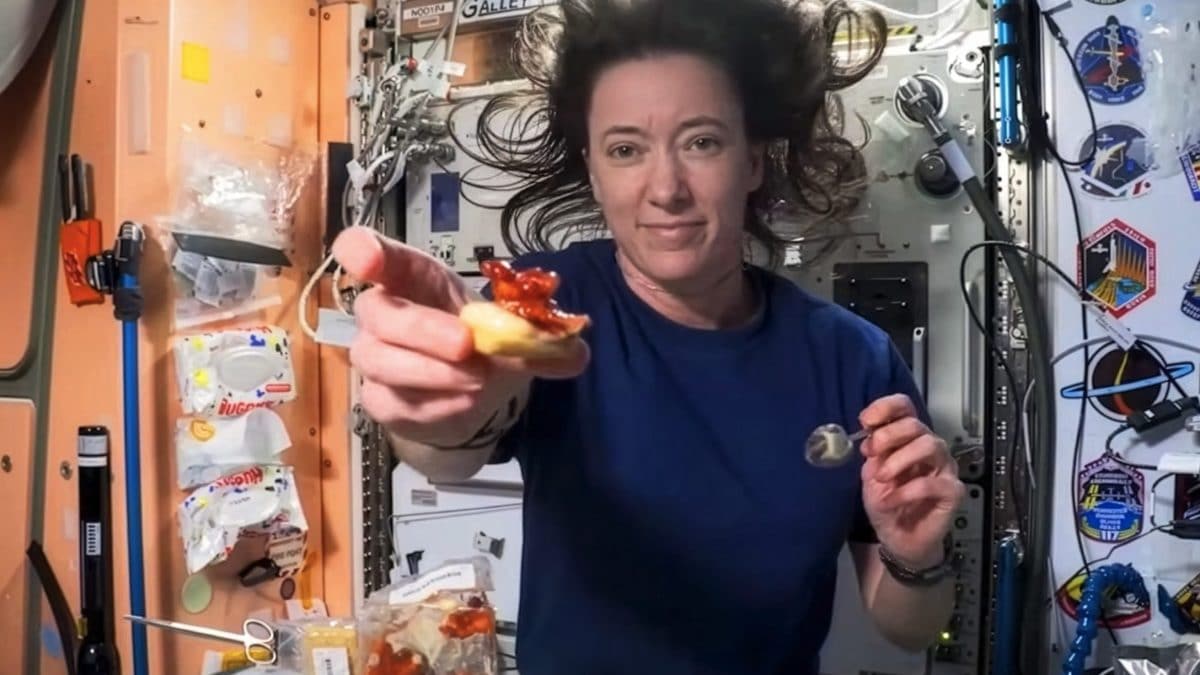
The scene is concrete, almost everyday, but simply moving it in space completely changes perspective: an astronaut opens a bag, adds water, stirs, and begins eating a shrimp cocktail while everything around remains suspended. It's not an experiment, it's lunch aboard Artemis II: the gesture is the same as on Earth, but each step is adapted to a context in which nothing can be left to chance: consistencies, packaging, consumption methods.
The point isn't the visual effect, but what it reveals: in space, eating isn't futuristic or abstract; it's extremely practical. Food exists, it's recognizable, but it's completely redesigned to function in zero gravity. Every element—from the water added on the spot to the shape of the container—meets precise requirements for safety, preservation, and ease of use. Even a simple dish becomes the result of careful design, where nothing is superfluous and everything must work right the first time.
Real Dishes, Treated in a Radical Way
In the official NASA video, Christina Koch shows it unfiltered: the shrimp cocktail is first dehydrated and then brought back to an edible consistency by adding water directly to the bag. Alongside it are completely dried green beans, which in space have nothing of the familiar appearance until they are rehydrated. And then the macaroni and cheese, mentioned almost as a guarantee: there too, comfort food arrives, but through a technical process. These are joined by other dishes documented in NASA's Artemis II materials, such as beef brisket, vegetable quiche, gratin broccoli , and rice or couscous– based preparations. The dish itself doesn't change, but everything that happens before it is eaten changes.

Overall, the Artemis II menu resembled a well-organized pantry rather than a kitchen: NASA, in fact, describes hundreds of food and beverage options, selected in consultation with the astronauts. It includes tortillas (preferred to bread because they don't crumb), dried fruit, beverages like coffee, tea, lemonade, and sweet treats like chocolate or fruit spreads. There are no fresh ingredients: everything must be stable at room temperature and ready to use, without the need for refrigeration.
The Case of the Floating Nutella Jar
The video of the floating Nutella jar, which quickly went viral, fits into this context. The scene is perfectly consistent with microgravity: any object, if not fixed, remains suspended. However, there are no official indications that Nutella is part of Artemis's menu. NASA materials refer more generally to spreadable creams —chocolate, fruit, or similar—precisely because they have a stable consistency and are easy to handle in zero gravity.
Water That Doesn't Fall
Physics makes all this necessary: as Commander Reid Wiseman explains in the same video, water in space doesn't flow but gathers in perfect spheres suspended in the air, governed by surface tension. It's not just a curious effect: it's the basic condition under which any food-related gesture occurs. A drop doesn't fall on the table —because a table, in fact, isn't necessary—but stays there, floating, until someone intercepts it.
This means that drinking, pouring, or even just handling a liquid requires constant attention: it's a behavior that completely changes the way we think about food. If even drinking becomes a gesture to be managed with precision, then every ingredient must be designed to stay where it is and not turn into something uncontrollable.
Eating Without Support
The most obvious difference isn't what you eat, but how: there are usually no plates or surfaces to place anything on, no gravity to hold a bite in place while you bring it to your mouth. In microgravity, you can't simply put something down and leave it there, because nothing stays put. Most food is consumed directly from sealed bags, designed to contain every element and be handled with one hand. You open it, add water when needed, close it again, and eat from there.
It's a forced system: in microgravity, even the most banal gesture—leaving something alone for a moment—no longer works, because that object simply disappears. The meal thus becomes a closed operation, controlled from start to finish, in which each step serves to prevent food from being lost and to keep the environment under control.
;Resize,width=767;)
