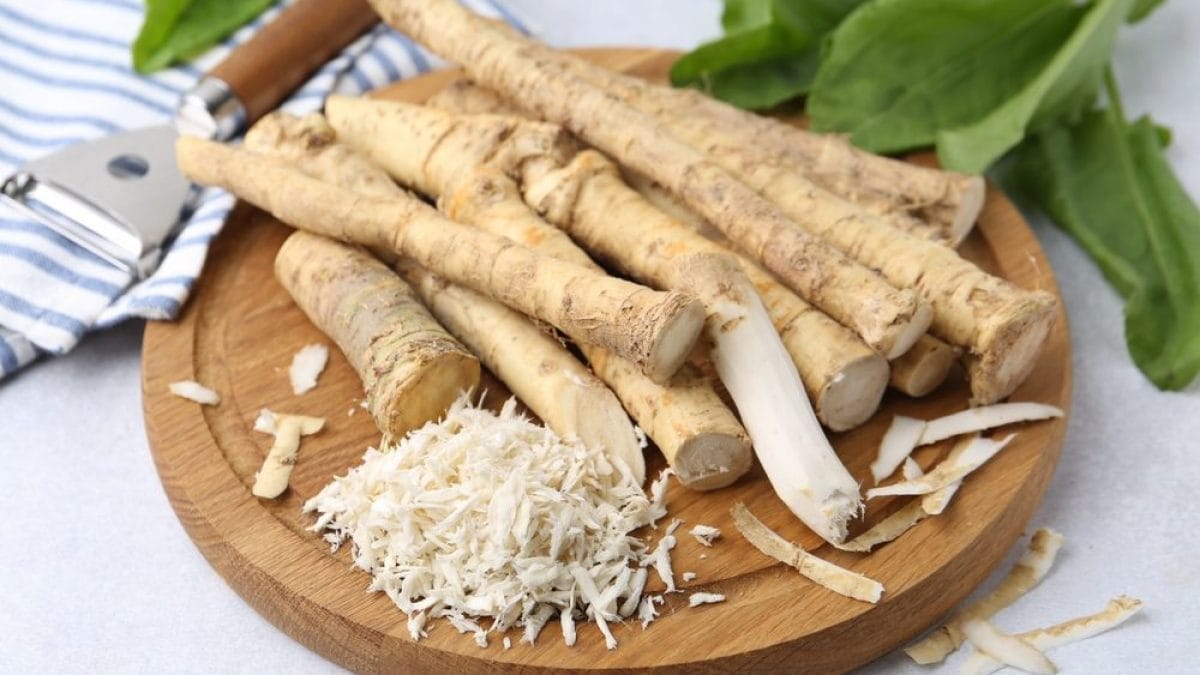
It's called horseradish, but also cren, and it's one of the roots with the most distinctive and easily recognizable flavor: it has a strong, intense flavor, and naturally so spicy that some people find it almost unbearable. Horseradish, Armoracia rusticana, isn't hugely popular in the West, but it's especially widespread in Asia, where it's highly prized since ancient times; it's no coincidence that the root is native to Western Asia and Eastern Europe. Although it's the most commonly used part of the root—it's the fleshiest and the one with the characteristic pungent flavor—horseradish is actually a plant: its scientific name is Armoracia rusticana and it belongs to the Brassicaceae family, the same as cabbage and mustard.
Horseradish can be used both cooked and raw in more or less elaborate recipes and is known for its distinctive flavor, while its beneficial properties are less well-known. In reality, this root boasts numerous positive effects on the human body, including strong antibacterial and anti-inflammatory properties, diuretic properties, and a protective effect on the stomach and the entire digestive system. Let's learn more about all the properties and benefits of horseradish, the contraindications to watch out for, and the recipes for using it best in the kitchen.
Properties and Benefits
Horseradish root is almost 96% water and contains very little fat and calories (about 30 kcal per 100 grams), while also providing an excellent supply of vitamin C and minerals, particularly calcium, potassium, phosphorus, and iron. A good source of fiber, as well as glucosinolate compounds, horseradish is also rich in antioxidants, bioactive compounds, including glucosinolates and their derivatives, and isothiocyanates, which give the root its flavor and characteristic pungent odor. All this nutritional richness makes the root a food with countless benefits, if consumed in the right quantities.
1. Immune System Support
Thanks to its high vitamin C content, horseradish is very useful for supporting the immune system, especially during colds, flu, and congestion. This is because it has excellent anti-inflammatory and antibiotic properties provided by various substances, including glucosinolates, which have a natural antibiotic effect and help the body defend itself from infections.
2. Antibacterial Properties
Horseradish contains an essential oil often used as an antimicrobial and recognized for its antibacterial properties, made even stronger by its high vitamin C content, which, as explained, strengthens the immune system. Furthermore, the root is an excellent aid in treating respiratory tract infections because it has strong expectorant properties, making it very useful in cases of sinusitis and bronchitis for clearing the airways of mucus and phlegm, and for relieving coughs and flu symptoms.

3. Correct Functioning of the Digestive System
Regularly consuming this root, paying attention to the right proportions, helps promote proper digestive function. Thanks to its sulfur compounds, it offers significant digestive benefits, while the presence of essential oils (isothiocyanates) stimulates the secretion of gastric enzymes, improving digestion, especially of fatty foods. Its antimicrobial properties help fight harmful bacteria in the digestive tract, and the compounds in horseradish stimulate bile production and gallbladder emptying, helping prevent hyperacidity and bile reflux.
4. Diuretic Effect
Horseradish has strong diuretic and draining properties because it is composed almost entirely of water, useful for promoting urination, combating water retention, and purifying the body. Thanks to its high potassium and sulfur content, it helps eliminate toxins and improve fluid circulation. Furthermore, thanks to the root's antimicrobial properties, it has an antiseptic effect on the urinary tract.
Horseradish's Contraindications
Horseradish has many benefits, but it can also have several side effects, especially if consumed in excess. This is because its nutrients are so concentrated that excessive consumption can cause side effects that counteract the product's normal benefits, especially kidney and stomach problems. For this reason, the European Food Safety Authority (EFSA) has established a recommended limit for horseradish consumption, setting a maximum daily intake of 0.2 milligrams per kilogram of body weight.
Horseradish should be avoided in the presence of particular physical conditions, as it is both a stimulant and an irritant. Do not consume it, or consult your doctor, if you suffer from ulcers, gastritis, or are pregnant. Also be careful if you have thyroid dysfunction, as it can interfere with thyroid function and may also conflict with medications used to treat these conditions. Finally, remember to be careful when handling horseradish root, precisely because it is a strong irritant: its very intense odor can cause tearing and, in some cases, eye irritation, possibly leading to conjunctivitis or headaches. Always wear gloves when handling horseradish, or remember not to touch your face and to wash your hands thoroughly after handling the root.

Are Horseradish and Daikon the Same Thing?
The answer is no. Horseradish (Armoracia rusticana) is often confused with daikon (Raphanus sativus var. longipinnatus) due to a combination of botanical, linguistic, and commercial factors. Both belong to the Brassicaceae family, sharing a light – colored, fleshy root and a spicy flavor due to similar sulfur compounds, elements that make them easily identifiable at first glance.
The confusion increases when it comes to common names: daikon is sometimes called “white radish” or “long white radish,” while the term “horseradish” is used generically to indicate spicy roots, without distinction between species. Even the scientific name can be misleading, because daikon belongs to the genus Raphanus, the same as common radishes, while horseradish proper is classified in the genus Armoracia; the phonetic similarity between “horseradish” and “Raphanus” leads to misunderstandings, even though they are distinct genera. In short, family resemblances, comparable external appearance, and terminological ambiguities contribute to the overlapping of two plants that, from a botanical point of view, remain clearly different.
Horseradish's Culinary Uses
Prized since ancient times for its distinctive flavor and numerous beneficial properties, horseradish finds a place in many different gastronomic cultures: while in Eastern cuisine it is often paired with sushi and sashimi, in European traditions it is never missing alongside a rich boiled meat. Horseradish is generally only used as a root, which can be eaten raw, simply grated, excellent paired with potatoes and beetroot in tasty salads, or cooked in more or less elaborate dishes.
Horseradish's main characteristic is undoubtedly its spiciness, reminiscent of natural mustard: this makes it the perfect accompaniment to boldly flavored dishes made with eggs, fish, or meat, especially boiled and roasted meats. In American culinary tradition, horseradish plays a similar starring role — especially in the form of prepared horseradish and horseradish sauce, staples in delis, steakhouses, and holiday tables across the country. Instead of salsa cren, you’re more likely to find freshly grated horseradish blended with vinegar and a touch of salt, or mixed into a creamy base of sour cream or mayonnaise. The result is sharp, sinus-clearing, and unapologetically bold. In the U.S., it’s a classic companion to prime rib and roast beef, a must for cocktail sauce served with shrimp, and a frequent addition to sandwiches, deviled eggs, and even Bloody Marys. Different recipe, same idea: a punchy condiment that cuts through rich foods and wakes up the plate.

In the United States, horseradish may be best known for its place on steakhouse menus and deli counters, but it also has deep roots in certain regional and cultural food traditions. In parts of the Midwest — especially in states with strong Eastern European heritage like Ohio, Wisconsin, and Illinois — horseradish is more than just a condiment; it’s a seasonal staple. Around Easter and Passover, freshly grated horseradish often appears alongside hard-boiled eggs, ham, or brisket, delivering that sharp, sinus-clearing heat that cuts through rich holiday fare.
In Jewish culinary tradition, horseradish is central to Passover seders, where it’s served as maror, the bitter herb symbolizing hardship in the Exodus story. It’s typically grated raw and sometimes mixed with beets for a vivid, magenta version known as “red horseradish.” The flavor is bold, immediate, and unmistakable — less subtle garnish, more wake-up call for the palate.
Horseradish was brought to North America by European immigrants in the 18th and 19th centuries and quickly adapted to American soil and taste. Over time, it earned a reputation as a working-class flavor booster — inexpensive, easy to grow, and powerful enough to transform simple foods. If truffles are luxury’s answer to earthiness, horseradish has long been its democratic counterpart: humble in appearance, intense in personality, and entirely capable of stealing the show.
;Resize,width=767;)
