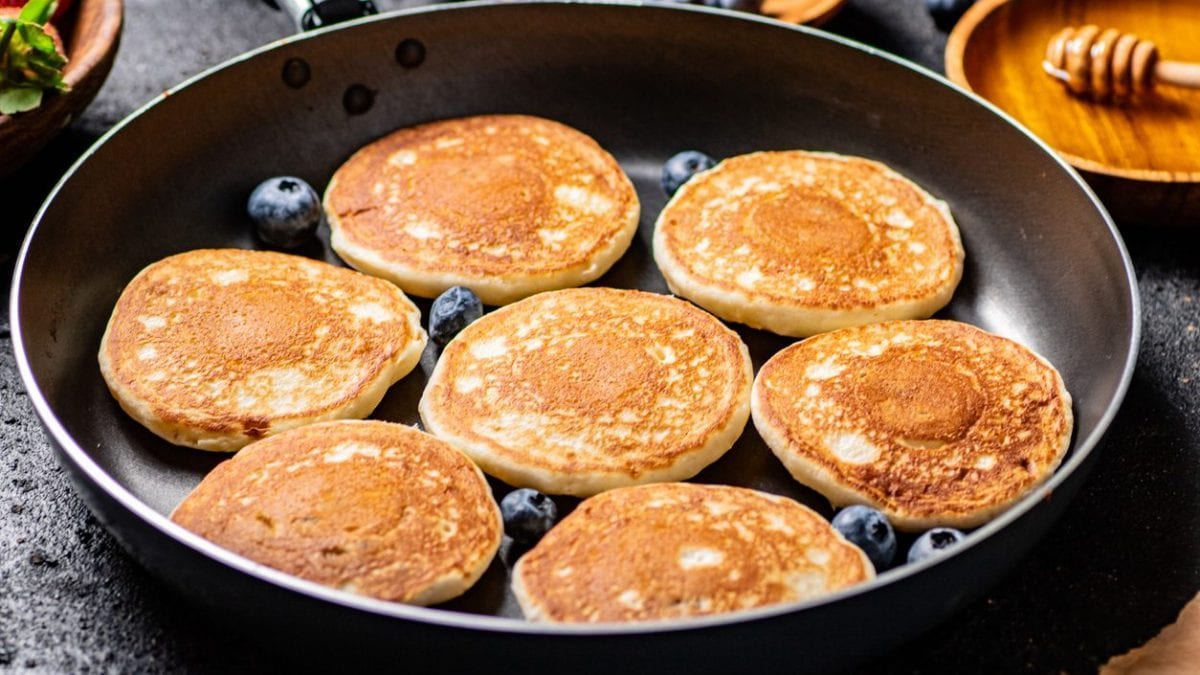
Pancakes are the quintessential American breakfast staple, sweet yet neutral enough to be filled with any kind of topping or sauce. These tall, fluffy pancakes are incredibly easy to make at home, whether basic or in one of the many variations. But don't let their simplicity fool you: the key to pancakes is that they're soft and spongy, with a batter porous enough to allow syrups and fillings to soak through. How do you get pancakes with the perfect consistency? Here are all the rules you need to follow to make perfect pancakes, plus some tips for substituting or avoiding some ingredients from the traditional recipe.
4 Rules to Obtain Soft and Spongy Pancakes
Making pancakes seems very easy, but in reality, as with all seemingly simple recipes, they require a certain amount of attention, especially at certain stages: in this case, what you need to pay most attention to is the order in which you mix the ingredients, the choice and heat of the pan, and the way you cook the pancakes.
1. Pay Attention to The Order of The Ingredients

Pancake batter is quite simple, but like all batters, it can be too runny or too thick, both of which can compromise the final result of your star-spangled pancakes. To avoid this mistake, it's essential to mix the ingredients in the right order: in a bowl, sift all the dry ingredients (flour, baking powder, sugar, salt, and a pinch of baking soda to make them fluffier) and in another bowl, combine all the wet ingredients (milk, melted butter, and eggs). If you have enough time, you can beat the egg whites separately: adding them to the batter will make it even softer. Then, combine the two groups of ingredients a little at a time, stirring constantly, until you obtain an elastic and relatively smooth batter. Don't worry if you still see lumps; just let the batter rest and they won't be a problem.
2. Choose the Right Pan

Not all pans are suitable for cooking pancakes: the right one, which won't ruin the pancakes, must be strictly nonstick and large enough to cook more than one pancake at a time. You should never grease it (the butter is already present in the batter, that's enough), and it must be perfectly hot before pouring in a spoonful of batter.
3. Cooking

Perfect pancakes also depend on perfect cooking. First of all, as we've already mentioned, the pan needs to be heated, but how much? Simply leave it on low heat for a few minutes, then remove it from the heat and add a ladle of batter for each pancake you need to cook, then return it to the heat, which now needs to be a little higher. Cook your pancakes for 1-2 minutes and be careful when, and especially how much, you flip them because this is one of the easiest mistakes to make: they should only be flipped once, when bubbles form on the surface and the edges begin to brown, using a flat spatula. Flipping them multiple times is a bad idea because you risk breaking the batter if it's not ready to be moved and also resulting in uneven cooking of the pancake.
4. Stack The Cooked Pancakes

The most classic image of pancakes is seeing them stacked on top of each other to form a small tower: it's not just an aesthetic issue but also a way to keep them fluffy and, above all, piping hot. Pancakes cool quickly, and stacking them one on top of the other as they cook helps keep them warm with their own heat.
Pancake Variations and Substitute Ingredients
Once you understand all the rules for making pancakes, you can start to vary their composition, not only with the filling (where there's only one rule: go wild) but also with the ingredients. In addition to customizing your pancakes by adding a wide variety of ingredients to the batter, from fruits like apples to cocoa, you can also vary them by substituting or eliminating a whole series of ingredients, from milk to eggs to butter. These are excellent alternatives if you want pancakes but don't have all the ingredients on hand, or have intolerances or are following a specific diet.


;Resize,width=767;)
;Resize,width=767;)
