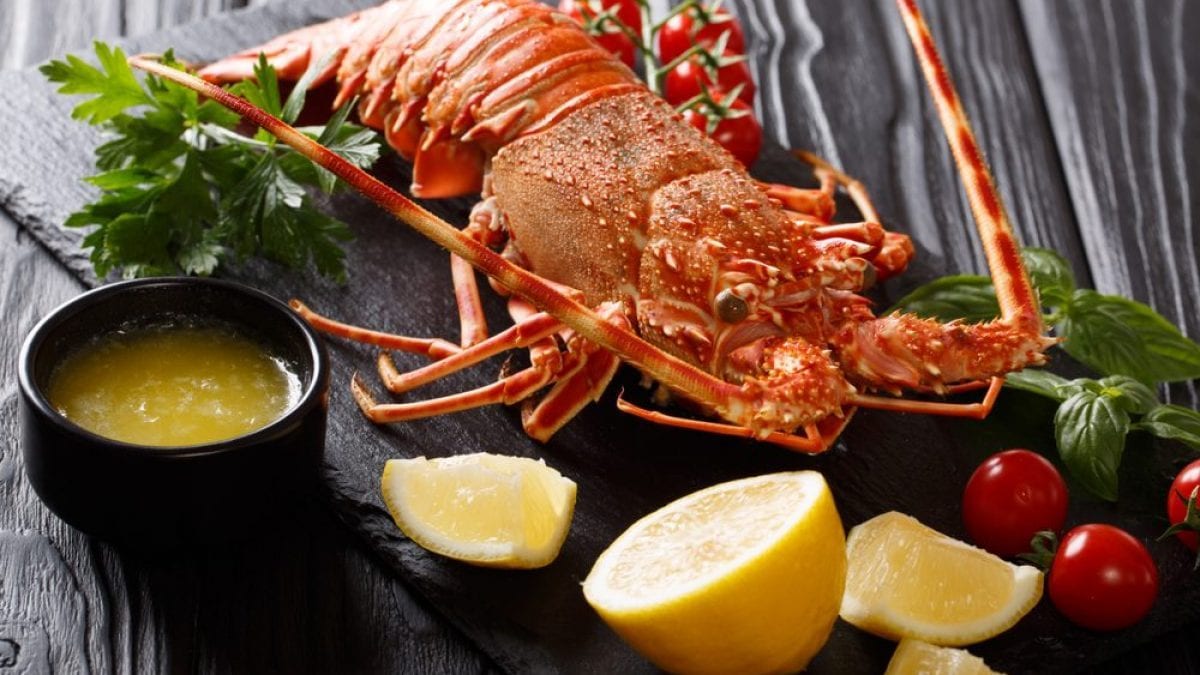
Among the most luxurious foods in the world is the lobster, one of the most prized crustaceans that is included on holidays' menus, and special occasions, just like the crayfish. These are two decapod crustaceans that are often confused, but which actually have numerous differences: the lobster (Palinurus elephas) belongs to the Palinurus genus and does not have claws (which the crayfish does have), but is characterized by two very long, two-colored antennae, which it uses to navigate and defend itself. It has a robust, spiny body and the color of its carapace varies from bright red to red-brown, where small white spots may appear: its white, delicate meat, with a sweetish aftertaste, is an "object of desire," which is especially appreciated in natural recipes, simply boiled and seasoned with oil or butter, lemon and aromatic herbs, or in first courses such as risotto and pasta. The price is high: a fresh lobster costs on average 80 dollars per kg. An investment that must be made in the best possible way, to avoid being disappointed.
How to Recognize a Fresh Lobster
Let's start by saying that lobsters aren't commonly found at every fishmonger's: they're a product intended for a niche audience or restaurants, and you can also find them frozen, which you can keep in your home freezer until you're ready to use them. When you buy them from a fishmonger, they're generally sold alive (just like when they're found in restaurant aquariums), a practice that's increasingly being questioned, but which until now has been justified by the idea of better preservation of the meat's organoleptic properties. But how do you distinguish a good raw material from one that isn't? Here's what to look for.
1. What the Fishmonger Looks Like

Before even looking at the lobster itself, it's essential to observe how the crustaceans are kept in this state of captivity, from the moment they are caught until they arrive on the table. The crustaceans must be placed in dedicated tanks, with salt water that reproduces their natural habitat: they must be able to move, therefore not overcrowded, and be intact, without amputated limbs or damaged antennae. We advise you to be wary of places where crustaceans are displayed alive on ice and with their claws tied (in the case of lobsters): in the U.S. there is no coherent legislation on the treatment of these animals – rather there is a regulatory vacuum – but if in nature they live in temperate and deep waters it can easily be understood that these are not optimal conditions, suffering what can be defined as mistreatment , as well explained by the association Crustacean Compassion Campaign which calls for a stop to the sale of these specimens while alive, to their remaining on display on ice and to their being boiled while conscious, as multiple scientific studies demonstrate that they experience suffering, just like octopuses.
2. Vitality

That said, a lobster's vitality is one of the criteria for determining its quality. This means that when picked up, it becomes responsive: it moves its antennae, legs, and the rest of its body, responding to stimuli. If it appears apathetic or helpless, it's likely been subjected to high levels of stress or is being held longer than necessary, compromising its condition.
In the U.S., it's not illegal to buy live lobsters, but there's growing concern for animal welfare, and more and more people are avoiding boiling them alive. Requesting a quick death is seen as a responsible, unproblematic choice. The simplest solution: explicitly ask the fishmonger to kill it before giving it to you. Many do so without a problem, with a quick and professional blow, after stunning it with low temperatures. It's normal, not unusual, and you don't have to justify yourself.
3. Smell

When it comes to fresh fish, smell is always a key indicator. Lobster has a delicate, salty, clean aroma reminiscent of the sea. It should never give off strong, acidic, or ammonia-like scents.
4. External Appearance

We said that the lobster must be intact and show no signs of damage, neither on the carapace nor on the antennae. The shell must be well hydrated, with the ventral part taut and not flabby (a sign that internal decomposition may be underway) and the eyes dark, shiny, and swollen.
5. Dimensions and Weight

Lobsters can reach truly remarkable sizes, weighing up to 8 kilos, especially those that inhabit the Western Atlantic Ocean. The common lobster found in the Eastern Atlantic Ocean and the Mediterranean is smaller, and medium-small specimens are preferred in cooking —about 800 grams for two people —because their young flesh is more tender and delicate, compared to the more fibrous flesh of adults. Like eels, lobsters also exhibit what is known as sexual dysmorphism, with females being more valuable, smaller in size, and having a broader, hairier tail to accommodate the eggs.
;Resize,width=767;)
