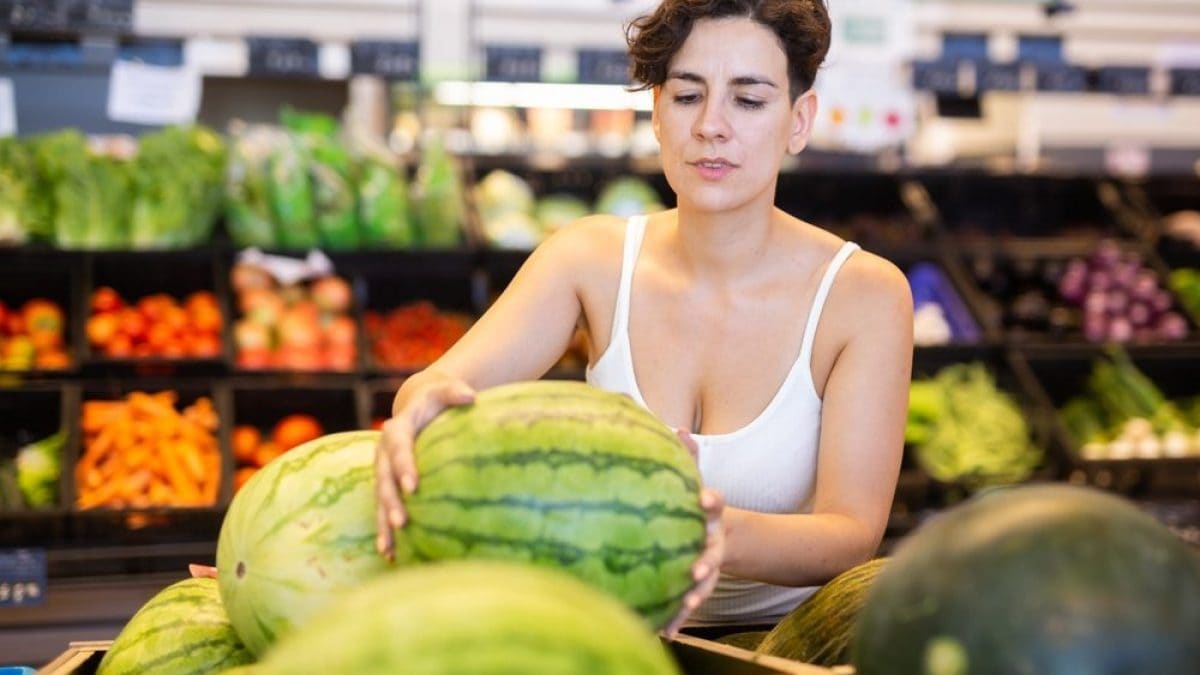
Refreshing at the end of a summer lunch or dinner, but also a snack on hot days or the star of sweet and savory recipes. Watermelon is a real treat during the summer, thanks to its juicy, sugary flesh. Its only flaw? It's not so easy to choose when you buy it: often, once you get home, you discover that the inside is pale, floury, and not very sweet. And the rule of waiting a few days to eat it doesn't work: watermelon is a non-climacteric fruit, so once picked, its state doesn't change, except to deteriorate. To avoid disappointment, however, there are a few tricks you can use to help you determine if the watermelon in front of you is ripe, by sharpening your eyesight and hearing. Here's how.
1. The Yellow Spot
The first step, which all experts agree on, is to look at the watermelon's lightest area: this is where the watermelon rests while growing in the field and, not exposed to direct sunlight, does not color. If the spot is a creamy yellow or deep yellow, it's a sign that the fruit is ripe and flavorful; conversely, if it's white or a dull green-yellow, it may have been picked too early, potentially resulting in a bland appearance.
2. The Sound
Another popular trick is to listen to the sound the watermelon makes when you tap it gently with your knuckles. Pick it up, lean your ear close, and make a knocking motion: if you hear a deep, hollow sound from behind, a bit like a drum, popular belief holds that it's a sign of ripeness. However, if it's muffled, less boomy, the fruit may be too ripe or still immature. Of course, this isn't an exact science, but more of a traditional peasant art. But beware: not all vendors appreciate it.

3. The Peel
The rind carries valuable clues: for example, be wary of a watermelon that's too shiny, because as it ripens, the sheen that gives it shine will fade. The "perfect" watermelon tends to be dark green and opaque. Also look for fine streaks, those rough brown lines that crisscross each other and seem to have ruined the fruit: in reality, their presence is a positive sign, because it indicates that it has undergone extensive pollination by bees, which generally translates into a sweeter watermelon. Intercept the stem: it doesn't necessarily have to be there, but if it's still attached, it should be curled and dry, while if it's green and "fresh," the fruit hasn't reached peak ripeness.
4. The Weight
When you're undecided between two watermelons of the same size, go for the heavier one. The logic is simple: the heavier it is, the more water it contains, meaning the pulp has formed properly and the fruit will be juicy, dense, and firm. An unripe watermelon may be lighter precisely because its pulp is less developed.

5. The Shape
Finally, also consider the shape of the watermelon, although this is the least indicative factor, since it also depends on the varieties, of which there are truly numerous throughout the world. When watermelons are round and symmetrical, they are generally considered better, as they indicate uniform growth. Those that are too elongated or irregular may have some healthy parts and others less so, due to having received uneven light and water.
;Resize,width=767;)
