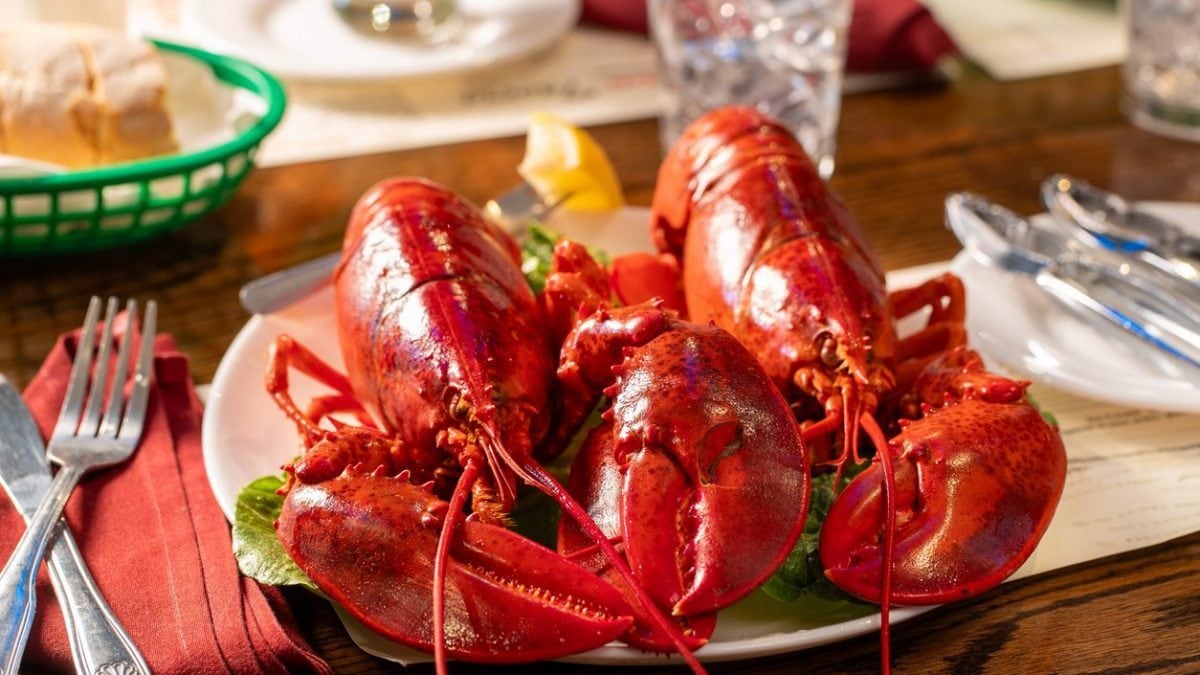
A ban on cooking live lobsters: this is the decision of the British government, which recognizes these animals as sentient beings and therefore capable of feeling pain. This measure is part of a broader government plan to implement measures against animal abuse and represents a significant step toward their protection. This decision, unfortunately, has not yet been adopted in all countries, but it is already in place in countries such as Austria and Switzerland, while in the U.S. the first tentative steps are beginning to be taken.
Mollusks and Crustaceans Are Sentient Beings
It seems strange to have to specify this, because it's one of those decisions that should be a given, as if dying by being thrown into a pot of boiling water wasn't sufficient justification to put an end to this atrocity. Yet there are those who continue to do so. Not anymore, however, in England, where a measure banning the boiling of alive lobsters was approved a few days ago. The government has declared that alternative guidelines will be published since "boiling in water is not an acceptable killing method."
The decision is based on a law introduced in 2022 that recognizes invertebrates, including octopuses, crabs and lobsters, as having the capacity to experience emotions: according to the Guardian, a study conducted by experts from the London School of Economics stated that there is "strong scientific evidence that decapod crustaceans and cephalopod mollusks are sentient." This means that throwing them alive into boiling water causes them excruciating suffering, as we can easily imagine (and which, fortunately, we cannot experience). "When living, conscious animals are immersed in boiling water, they endure several minutes of excruciating pain. This is torture and entirely avoidable," said Ben Sturgeon, chief executive of the charity Crustacean Compassion, who welcomed the plan with great enthusiasm.

What Are The Alternatives?
Clearly, it's not a question of stopping eating lobsters and crabs, but simply of ensuring they have a more dignified and less painful death. There are, in fact, other methods that can be used, in restaurants or at home. Electroshock, for example, is considered the best method, even recommended by most veterinary associations around the world: with this method, lobsters lose consciousness in half a second and die in five seconds, while crabs take about ten seconds. Another solution—also taking into account the high cost of an electric stunning machine—is to hit the animal with a sharp blow to the head, thus causing a quick and painless death.
The Situation in The U.S. and The Rest of The World
Fortunately, England is not the first country to adopt a similar measure. Nations such as Switzerland, Norway, Austria, and New Zealand have already banned the boiling of lobsters alive or mandated that these animals be stunned or killed in a quicker and less agonizing manner.
In the United States, the picture is a lot less uniform. There’s no federal law that explicitly bans boiling lobsters alive, and the main federal humane-slaughter statute applies to certain livestock in slaughter plants—not to crustaceans. Instead, animal-welfare rules around lobsters tend to fall into a patchwork of state animal-cruelty laws and local policies, many of which weren’t written with invertebrates (or standard food-prep practices) in mind. That said, the conversation is shifting: U.S. animal-welfare groups and some chefs have pushed for quicker, less stressful handling and dispatch, and some kitchens now voluntarily stun or kill lobsters swiftly before cooking—using methods like a rapid knife dispatch or commercial electrical stunning systems—rather than keeping them alive on ice for long periods or dropping them straight into boiling water.

More recently in the U.S., the push for stronger crustacean welfare has been driven less by a single national coalition and more by high-profile advocacy campaigns and lawsuits. For example, PETA has taken legal action in Maine, arguing that steaming or boiling lobsters alive can violate the state’s animal-cruelty laws and seeking to stop the practice at large public events like the Maine Lobster Festival. At the same time, the broader legal landscape here remains patchy: there’s no federal humane-slaughter rule that covers crustaceans (the Humane Methods of Slaughter Act focuses on “livestock”), so most protections—if they apply at all—tend to hinge on how individual states define and enforce cruelty standards. In practice, U.S. advocates have been calling for changes similar to those debated abroad—like ending prolonged storage on ice, discouraging the retail sale of live crustaceans without clear handling guidance, and promoting faster, less painful killing methods—but the movement is still unfolding state by state rather than through one unified national policy.
;Resize,width=767;)
