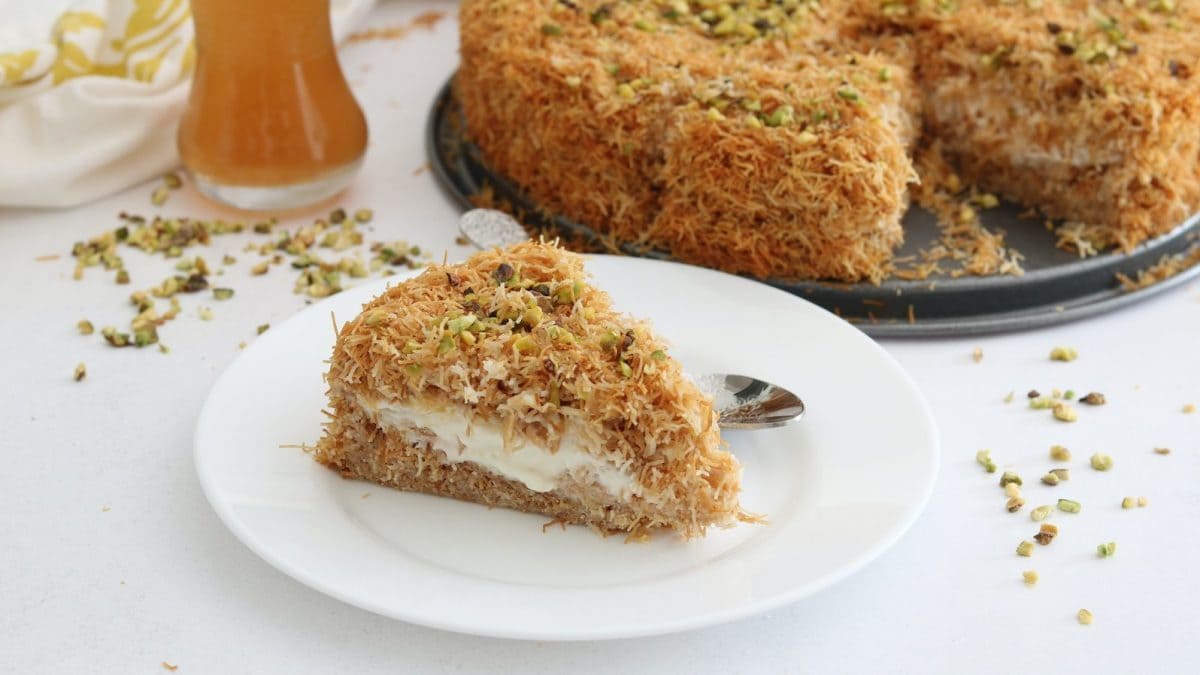
Kunafa pronounced in English as koo-NAH-fah is a typical Middle Eastern dessert made from fried kataifi dough, soaked in syrup and filled with a layer of sweet cheese, fresh fruit, or, as in our version, milk cream flavored with orange blossom essence. Also known as knafeh, it is typically prepared during Ramadan and eaten during Iftar, the breaking of the daily fast.
This is a filled cake characterized by the irresistible contrast between its ultra-crunchy exterior and its soft, creamy center. Extremely easy to make at home, it is assembled inside a ring mold approximately 24 cm in diameter and, once ready and covered in syrup, is finally sprinkled with chopped pistachios. It's perfect as a dessert after a dinner party, but also as a special snack, paired with a spiced infusion.
Is Kunafa Lebanese or Palestinian? Kunafa's Origins
Kunafa is best understood as a Levantine dessert shared across the eastern Mediterranean, but the version most people recognize today is especially closely tied to Nablus, in Palestine. Britannica notes that the famous cheese-filled style is associated with Nablus and with the use of Nabulsi cheese, which helped define the dessert’s modern identity. At the same time, kunafa spread widely across the region over centuries, so Lebanon, Syria, Jordan, Egypt, and Turkey all developed their own versions and strong traditions around it.
What Type of Cheese is in Kunafa?
The traditional cheese used in kunafa is Nabulsi cheese, a semi-soft, slightly salty cheese from Palestine, especially associated with the city of Nablus. It’s prized for its ability to melt smoothly without becoming too runny, giving kunafa its signature stretchy, creamy texture. In other regions, similar cheeses are often used as substitutes, such as Akkawi cheese (common in Lebanon) or even mozzarella when Middle Eastern cheeses aren’t available, usually soaked first to reduce saltiness.
Do You Serve Kunafa Hot or Cold?
Excellent enjoyed while still slightly warm, it's even more delicious after a few hours of refrigeration. For this reason, we recommend wrapping it in advance and letting it cool completely before enjoying it.
Ingredients
How to Make Kunafa

Collect the milk, cornstarch and cream in a saucepan.
Collect the milk, cornstarch and cream in a saucepan.

Bring to a boil and cook, stirring continuously, until you obtain a smooth, thick cream. Remove from the heat, add the orange blossom aroma or rose water and let cool completely.
Bring to a boil and cook, stirring continuously, until you obtain a smooth, thick cream. Remove from the heat, add the orange blossom aroma or rose water and let cool completely.

Meanwhile, break up the kataifi dough, bought ready-made and fried.
Meanwhile, break up the kataifi dough, bought ready-made and fried.

Melt the butter in a saucepan, let it cool for a few moments, then pour it into the bowl with the kataifi dough and mix thoroughly to distribute it.
Melt the butter in a saucepan, let it cool for a few moments, then pour it into the bowl with the kataifi dough and mix thoroughly to distribute it.

Butter a springform pan with a diameter of approximately 24-26 cm.
Butter a springform pan with a diameter of approximately 24-26 cm.

Pour half of the kataifi dough onto the bottom of the mold.
Pour half of the kataifi dough onto the bottom of the mold.

Compact it and create an even layer using the back of a spoon.
Compact it and create an even layer using the back of a spoon.

At this point, fill with the milk cream, distributing it in an even layer.
At this point, fill with the milk cream, distributing it in an even layer.

Cover the filling with the remaining kataifi dough.
Cover the filling with the remaining kataifi dough.

Once all the filling is covered, cook the kunafa in a preheated static oven at 375°F/190°C for 40 minutes.
Once all the filling is covered, cook the kunafa in a preheated static oven at 375°F/190°C for 40 minutes.

Just before taking the cake out of the oven, prepare the syrup: collect the water and sugar in a saucepan, then melt the latter over low heat. At this point, add the lemon juice and bring everything to a boil, until you obtain a thin syrup.
Just before taking the cake out of the oven, prepare the syrup: collect the water and sugar in a saucepan, then melt the latter over low heat. At this point, add the lemon juice and bring everything to a boil, until you obtain a thin syrup.

Once ready, take the kunafa out of the oven and pour the syrup over the entire surface while it is still hot.
Once ready, take the kunafa out of the oven and pour the syrup over the entire surface while it is still hot.

Finally, complete the whole thing with chopped pistachios. Let the cake cool completely before removing the removable ring from the pan.
Finally, complete the whole thing with chopped pistachios. Let the cake cool completely before removing the removable ring from the pan.

The kunafa is ready to be served. Enjoy!
The kunafa is ready to be served. Enjoy!
Storage & Reheating Instructions
Kunafa can be stored at room temperature, covered with plastic wrap, for up to 2 days. If it gets too hot, we recommend storing it in the refrigerator.
To reheat kunafa properly, the goal is to restore its crisp exterior while keeping the cheese soft and melty. The best method is to use the oven: place it in a preheated oven at 325–350°F (160–180°C) for about 10–15 minutes, loosely covered with foil to prevent over-browning, then uncover for the last few minutes to re-crisp the top. Avoid the microwave if possible, as it tends to make the pastry soft and soggy. If you only have a small portion, you can also reheat it in a skillet over low heat, covering it with a lid to warm the cheese while keeping the base slightly crisp.
;Resize,width=767;)
