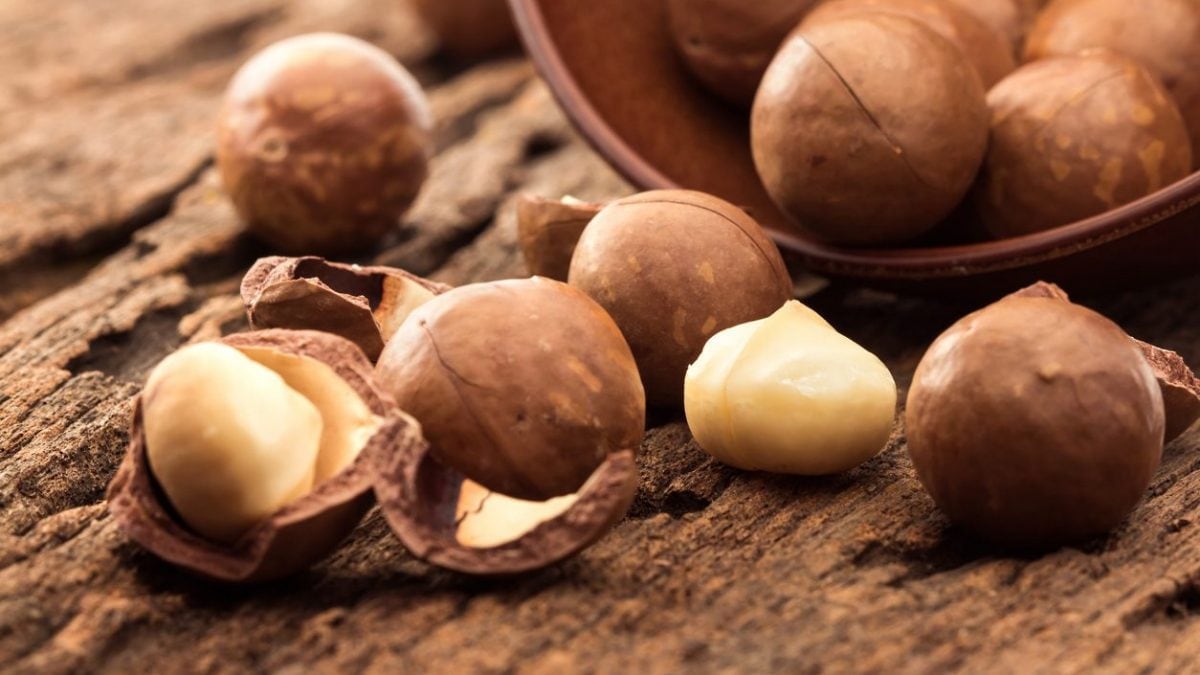
They have a delicate, sweet flavor, with a crunchy yet buttery texture that makes them incredibly delicious: we're talking about macadamia nuts. The name doesn't refer to their place of origin (there's no specific town or city for Macadamia), but derives from John MacAdam, a Scottish-Australian chemist and politician who lived in the 19th century, to whom a collection of plants was dedicated by his friend and colleague Ferdinand von Mueller, director of the Royal Botanic Gardens in Melbourne.
These nuts are the fruits of some perennial tropical trees belonging to the Macadamia genus, which in turn is part of the Proteaceae family, in particular Macadamia integrifolia and Macadamia tetraphylla, the two species of which the nuts are edible. They are medium-height plants (up to 15 metres) with elongated, shiny dark green leaves, divided into clusters, and white and pink flowers. They grow in the forests of Queensland, Australia, and were already appreciated as a food by the Aborigines before spreading across the border in the 19th century. Today, in fact, they are grown in many other areas that share the same warm and humid climate, such as Hawaii, Brazil, Costa Rica and nearby New Zealand, while still remaining one of the most traded Australian products in the world.
What is called a nut is actually the seed, spherical and ivory-colored, enclosed in a dark brown, leathery shell: it is eaten as a snack, but is also very versatile in the kitchen. Its nutritional properties are very interesting, as it is a source of fiber, monounsaturated fats, vitamins, mineral salts, and antioxidants. Let's discover its benefits and possible contraindications.
Properties and Benefits
Macadamia nuts share many of the characteristics of tree nuts and oilseeds: they are highly caloric foods (751 kcal per 100 grams), to be eaten in moderation (the recommended portion is 30g), but at the same time rich in properties, because their composition includes substances known to be beneficial to the body, such as phytosterols, natural compounds that help lower bad cholesterol in the blood, and monounsaturated fatty acids which represent more than 80% of total lipids, also useful for cardiovascular health.

Not to mention their fiber content, minerals —especially potassium, magnesium, phosphorus, calcium, and selenium—and B vitamins, C, and E. In addition to being good for the heart, they are also beneficial for the intestines, the nervous system, and overall metabolic function. Let's take a closer look at the main benefits.
1. Support Heart Health
Monounsaturated fats, particularly oleic acid, can help balance blood cholesterol levels, reducing the so-called “bad” cholesterol (LDL) and maintaining the “good” cholesterol (HDL), leading to a lower risk of cardiovascular diseases, such as stroke or atherosclerosis.
2. Antioxidant Activity
Macadamia nuts are considered powerful natural antioxidants, thanks to their content of ascorbic acid (vitamin C), tocopherols (vitamin E) and selenium, which help counteract oxidative stress, as well as contributing to heart health.

3. Bowel Regularity
The fiber content promotes digestive health, aiding intestinal motility and thus helping with constipation. Due to the fiber content, these nuts have a low glycemic index, slowing the absorption of sugar into the blood and thus preventing glycemic attacks.
4. Body Weight Control
Despite their high calorie content, introducing macadamia nuts into your diet in the right quantities, for example as a snack, proves effective for weight control, as the fibre and the balance between fats, proteins and carbohydrates give a long-lasting feeling of satiety.
5. Metabolic and Nervous Support
The micronutrients present, such as vitamin B1 (thiamine) and essential minerals, such as magnesium, play key functions in energy metabolism and in supporting the nervous system, useful for the cognitive system and for improving mood.

Contraindications
There are no specific contraindications to eating these nuts, but it's helpful to know a little more about them to ensure safe eating. First of all, those allergic to tree nuts and dried fruit may experience the same reactions, so it's advisable to consult your doctor. Secondly, as we've seen, they're a very high-calorie food: overindulging in them in an unbalanced diet is a no-no, as excessive consumption could contribute to weight gain. Last but not least, macadamia nuts are considered toxic to dogs and cats and can cause vomiting, tremors, weakness, and loss of appetite. It's recommended to consult a vet if your pet accidentally ingests them without waiting for symptoms to appear.
How to Use Them in The Kitchen
Macadamia nuts are easily found in supermarkets shelled and ready to eat, or, more rarely, in their shells, with packages equipped with a special pointed tool called a chiavetta (because it resembles a shell) with which to cut the shell and open them. They are the most expensive nuts (between 20 and 50 dollars per kilo), as they come from countries quite far from the U.S., such as Hawaii and Australia, and are considered valuable for their delicate, sweet flavor and buttery consistency.

Besides being a snack or light bite, they are used across the board in both savory and sweet dishes, much like cashews and hazelnuts, with which they share a very low saltiness. They are therefore used as a garnish for vegetable soups or in raw pestos to season pasta or canapés, as well as an ingredient in granola or in baked goods, pairing very well with chocolate or coffee. It is also available in a creamy jar, commonly known as "macadamia nut butter," very similar to peanut butter —and can be made homemade—due to its dense consistency and its uses, such as a cake filling or spread on toast, perhaps with slices of banana and blueberries, for a tasty and energy-giving breakfast.
;Resize,width=767;)
