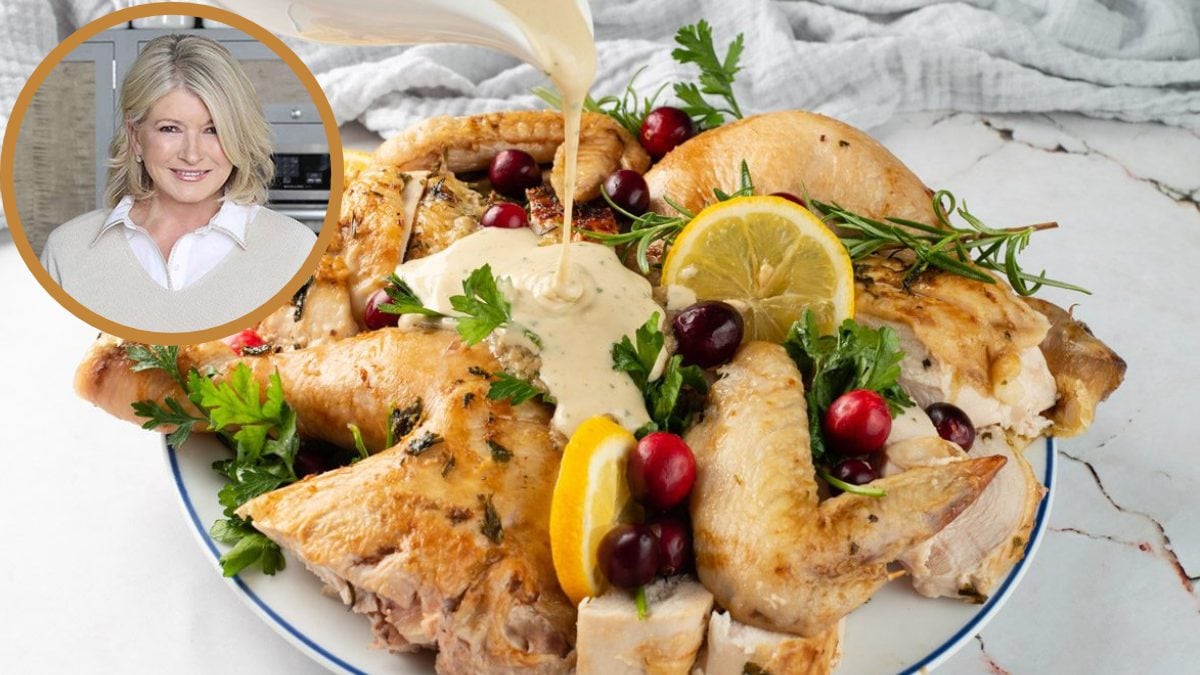
Martha Stewart’s Perfect Turkey Roast is a classic holiday centerpiece featuring a large, golden-brown turkey basted with melted butter and dry white wine. The signature technique involves covering the turkey breast with butter-and-wine-soaked cheesecloth during the first stage of roasting, helping protect the meat while it cooks. The finished turkey is served with a rich homemade gravy made from the flavorful pan drippings and giblet stock, making it a beautiful choice for Thanksgiving, Christmas, and other festive family dinners.
Why Everyone Will Love This Recipe
This roast turkey delivers crisp, beautifully browned skin and flavorful meat, complemented by a silky homemade gravy. Butter adds richness, white wine contributes depth, and the cheesecloth helps keep the breast moist during roasting. The recipe also makes use of the giblets and neck to prepare a flavorful stock, bringing extra depth to the gravy. Although it takes time, the result is a traditional holiday meal worth gathering around the table for.
What Is the Dish?
Roast turkey is one of the most recognizable dishes associated with American Thanksgiving, a holiday tradition that developed over centuries and became firmly established in the United States during the 19th century. Whole roasted poultry has a much longer history in European cooking, where large birds were often prepared for celebrations and important gatherings. Over time, turkey became especially popular for American holiday meals because its size made it ideal for feeding a crowd.
Martha Stewart’s approach emphasizes careful roasting, frequent basting, and a flavorful homemade gravy. The butter and white wine provide moisture and flavor, while the cheesecloth acts as a protective covering during the early stages of cooking. Removing it toward the end allows the skin to brown more directly. Another important feature is the gravy, which incorporates the caramelized bits left in the roasting pan, the turkey drippings, and giblet stock. Fun fact: the browned bits at the bottom of a roasting pan are known in French cooking as fond—a concentrated source of flavor that becomes the foundation of an excellent pan sauce.
Cooking Tips
- Choose a suitably sized roasting pan: A heavy metal pan with a sturdy roasting rack helps the turkey cook evenly and makes collecting the drippings easier.
- Dry the turkey thoroughly: Pat the skin dry with paper towels before applying the butter to encourage browning.
- Prepare the cheesecloth properly: Soak it thoroughly in the butter-and-wine mixture and keep it moist during the initial roasting stage.
- Baste carefully: Use a pastry brush to avoid tearing the skin as it becomes delicate and browned.
- Monitor the pan juices: If the roasting pan becomes too full, carefully remove some liquid and reserve it for the gravy.
- Use a thermometer: For food safety, the turkey must reach 165°F (74°C) in the thickest part of the breast, the innermost thigh, and the innermost wing. If stuffing the bird, the center of the stuffing must also reach 165°F.
- Allow the turkey to rest: Resting for about 30 minutes helps the juices redistribute and makes carving easier.
Frequently Asked Questions
How Long Does It Take to Roast a 20-Pound Turkey?
A 20–21-pound turkey may take around 4–5 hours, depending on the oven, whether it is stuffed, and the bird's shape. Use a meat thermometer rather than cooking time alone to determine when it is done.
Why Does Martha Stewart Use Cheesecloth?
The butter-and-wine-soaked cheesecloth helps protect the breast during the early stages of roasting and keeps it coated with flavorful moisture. Removing it later allows the skin to brown.
Can I Roast the Turkey Without Stuffing It?
Yes. An unstuffed turkey is often easier to cook evenly and can be ready sooner. You can bake the stuffing separately in a buttered casserole dish.
Can I Prepare the Turkey the Day Before?
You can prepare the giblet stock, measure the ingredients, and prepare the stuffing ahead of time. Keep the raw turkey refrigerated until you're ready to roast it, and avoid leaving it at room temperature for extended periods.
What Wine Is Best for Turkey Gravy?
A dry red or white wine works well. Choose one with balanced acidity and avoid very sweet wines, which can make the gravy taste overly sweet.
How Do I Keep Turkey Breast Meat Moist?
Avoid overcooking, baste carefully, and allow the turkey to rest before carving. The cheesecloth helps protect the breast, but measuring the internal temperature is the most reliable way to prevent dry meat.
How to Store
Remove leftover turkey meat from the bones and refrigerate it in airtight containers within 2 hours of cooking. Store cooked turkey and gravy in the refrigerator for up to 3–4 days. For reheating, place sliced turkey in an oven-safe dish with a little gravy or stock. Cover with foil and heat at 325°F (165°C) until the meat reaches 165°F (74°C). Reheat gravy separately, stirring occasionally until steaming hot.
How to Freeze
Freeze leftover turkey meat and gravy separately or together in airtight, freezer-safe containers for up to 3 months for the best quality. Remove as much air as possible to prevent freezer burn. Thaw overnight in the refrigerator and reheat until the turkey reaches 165°F (74°C). If you have leftover stuffing, freeze it separately for easier reheating and serving.
Ingredients
For the Roast Turkey
- 1 fresh whole turkey (20–21 pounds), giblets and neck removed and reserved
- 1 + ½ cups unsalted butter, melted
- 4 tbsps unsalted butter, at room temperature
- 1 (750 ml) bottle dry white wine
- 2 tsps salt
- 2 tsps freshly ground black pepper
- Turkey stuffing, as needed
- Giblet stock, for gravy
For the Gravy
- Reserved turkey pan juices
- 1 cup dry red wine or white wine, or water
- Giblet stock, as needed
- Salt and freshly ground black pepper, to taste
Equipment
- Large roasting pan and roasting rack
- Cheesecloth, approximately 17 inches square when folded into four layers
- Pastry brush
- Kitchen string and toothpicks
- Instant-read meat thermometer
- Wooden spoon and gravy boat
How to Make Martha Stewart's Turkey Roast
- Remove the giblets and neck from the turkey cavity and reserve them for the stock. Pat the turkey dry with paper towels. Keep it refrigerated until you are ready to roast it, rather than leaving it at room temperature for hours.
- Position an oven rack on the lowest level and preheat the oven to 450°F (232°C).
- In a bowl, combine the melted butter and dry white wine. Fold a large piece of cheesecloth into four layers, cutting it into a square approximately 17 inches across. Immerse the cheesecloth in the butter-and-wine mixture until thoroughly saturated.
- Place the turkey breast-side up on a roasting rack inside a heavy metal roasting pan. Fold the wing tips underneath the bird.
- Season the cavity with ½ teaspoon each of salt and black pepper. If using stuffing, fill the main and neck cavities loosely without packing it tightly. Secure the legs loosely with kitchen string and tuck the neck flap underneath, securing it with toothpicks if necessary.
- Rub the outside of the turkey with the softened butter and season with the remaining salt and pepper. Food safety note: If you stuff the turkey, cook until the center of the stuffing reaches 165°F (74°C). Baking extra stuffing separately is an easier way to control its cooking time.
- Lift the cheesecloth from the butter-and-wine mixture and squeeze it gently, leaving it very damp. Spread it over the turkey breast and down the sides, covering part of the leg area if possible.
- Place the turkey in the oven and roast at 450°F for 30 minutes.
- After 30 minutes, use a pastry brush to baste the cheesecloth and any exposed parts of the turkey with the butter-and-wine mixture.
- Reduce the oven temperature to 350°F (177°C) and continue roasting for approximately 2½ hours, basting every 30 minutes. Keep an eye on the pan juices; if there is too much liquid, carefully remove some and reserve it for the gravy.
- After approximately 3 hours of total roasting, carefully remove and discard the cheesecloth. Rotate the roasting pan so the turkey breast faces the back of the oven, then baste the bird with the pan juices.
- Continue roasting for approximately another hour, basting after 30 minutes. If the pan juices are insufficient, use some of the remaining butter-and-wine mixture.
- Begin checking the turkey's internal temperature before the expected finish time. The turkey is ready when the breast, innermost thigh, and innermost wing reach 165°F (74°C). If the bird is not fully cooked, return it to the oven and continue roasting, checking periodically.
- Transfer the cooked turkey to a serving platter and let it rest for approximately 30 minutes before carving. This gives the juices time to redistribute and allows you to prepare the gravy.
- Pour the pan juices into a heatproof measuring cup. Let them stand for approximately 10 minutes, until the fat rises to the surface, then skim off the excess fat.
- Place the roasting pan over medium-high heat. Add 1 cup of dry red wine, white wine, or water. Use a wooden spoon to scrape up the browned bits from the bottom of the pan.
- Add the giblet stock, stir well, and bring the mixture to a boil. Cook until the liquid has reduced by approximately half, about 10 minutes.
- Add the defatted pan juices and continue cooking over medium-high heat for another 10 minutes, until the gravy has reduced and developed a rich flavor. Season to taste with salt and pepper, then strain into a warm gravy boat.
- Carve the rested turkey and arrange the slices on a serving platter. Serve with the warm gravy and your favorite holiday sides, such as classic stuffing, mashed potatoes, and roasted vegetables.


