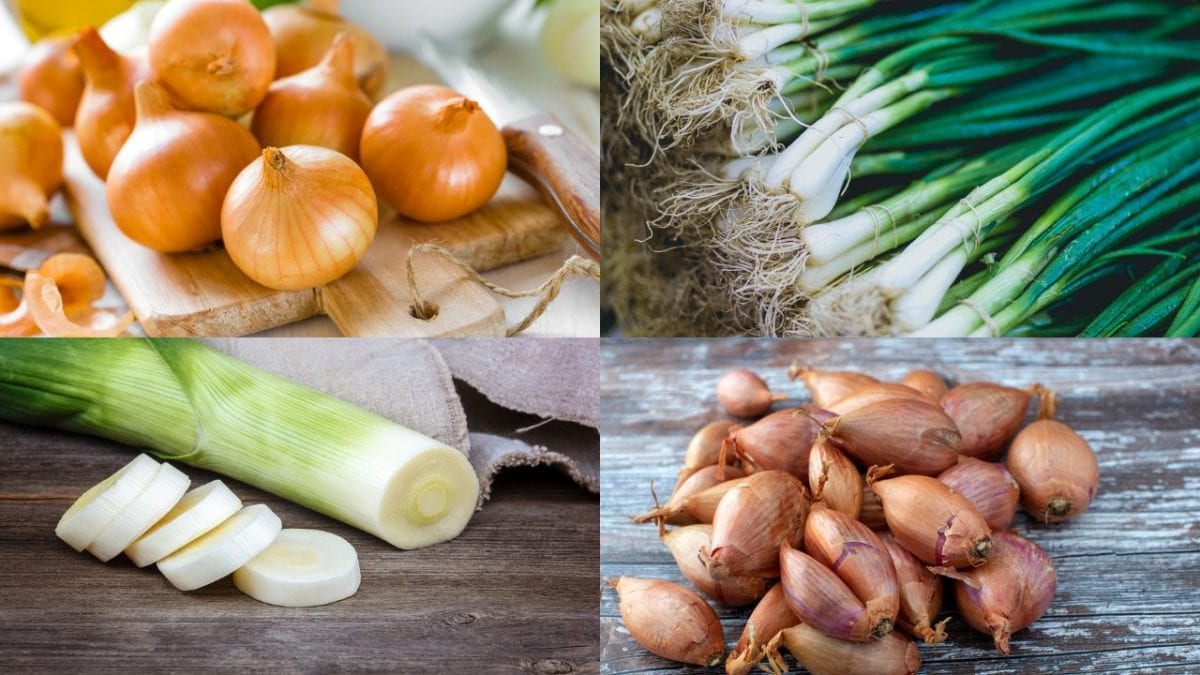
When we cook, knowing and distinguishing ingredients is the first step to learning how to use them correctly, making the most of their flavor and properties. How many times have you wondered what the difference is between a leek and a spring onion? And why does a leek, despite having a completely different appearance, taste similar to an onion? While they share some characteristics, these four ingredients are very different not only in aroma and flavor, but also in use, digestibility, and versatility. Today, we'll finally clear up these doubts, revealing everything you need to know about the differences between onions, spring onions, shallots, and leeks, so you can use them wisely.
Although they all belong to the Liliaceae family, onions and spring onions are not the same thing, just like shallots and leeks, which have very different flavors and aromas. Here's how to tell them apart in detail:
Onion

A quintessential humble ingredient, everything and the opposite has been said about the onion, but it cannot be denied that it is a cornerstone of both local and international cuisine. White, red, or golden, the onion can be enjoyed cooked or raw. Cutting it can make you cry, and there are a few simple tricks to make it easier to digest. The important thing is to always have it on hand for every type of recipe: from classic soffritto to delicious meatballs, from soups, jams, and omelettes.
Spring Onion
Spring onions are the bulb of the onion that has not yet fully matured, meaning they have not yet completed their life cycle. Commercially available varieties include white and red spring onions: the former have a more intense, pungent flavor and a stronger aroma than the latter, which is sweeter. Widely used in Asian cuisine, spring onions can be used cooked, alongside or instead of onions, or raw, added at the last minute to enhance soups, ramen, and tartare.

Leek
The leek, a diuretic and low-calorie vegetable, is the onion's cousin and is distinguished by its elongated, cylindrical shape, green leaves, and white flowers. Once the roots and tough leaf tips have been removed (which can be recycled into broths and soups), leeks can be used instead of or alongside onions, perfect for sautés and stocks, but also in more elaborate recipes. Their flavor is bold and pungent, which makes the leek, a typically winter vegetable, ideal for risottos, soups, omelettes, savory pies, and flans.

Shallot
Increasingly popular in our kitchens, the shallot represents a sort of "third way" between garlic and onion, and is undoubtedly a very close relative of both. Like the onion, the shallot is grown for its bulb, although the leaves, similar to those of chives, can also be used in cooking. The shallot's flavor is delicate and more aromatic than that of the onion (which is also more easily digestible) and is certainly less pungent than garlic. Various varieties are available on the market: pink, gray, yellow, and the most common red-brown shallot, with a slightly more elongated bulb. The shallot can be used both raw and cooked: it is ideal for risottos, main dishes, legume soups, and as a base for sauces, such as béarnaise sauce.

;Resize,width=767;)
