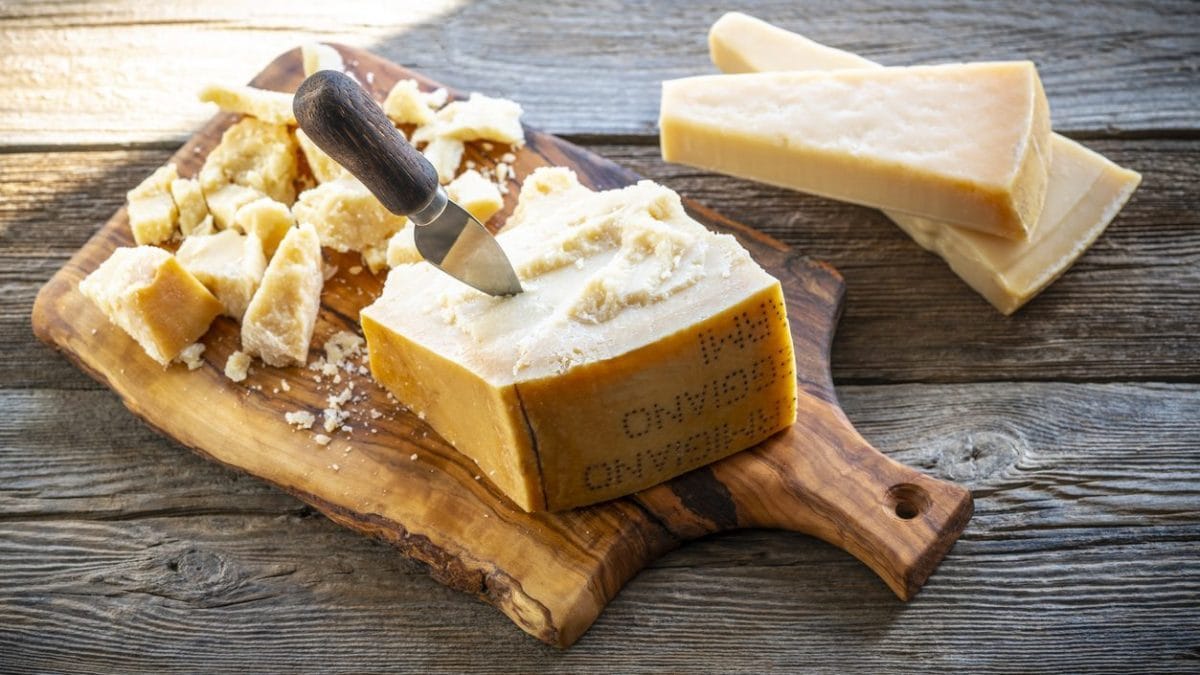
If there's one cheese that more than any other has succeeded in becoming a symbol of Made in Italy gastronomic excellence, it's Parmigiano Reggiano DOP, so much so that numerous attempts have been made to imitate it (see parmesan). This product has roots in the Middle Ages, when Benedictine and Cistercian monks reclaimed vast marshy areas of the Po Valley and introduced large-scale cattle farming where previously sheep had predominated, as they were cheaper for farmers to maintain. From its very beginning, therefore, it was a sought-after food, marketed in large forms (though not as large as today) that allowed for long-term preservation and, therefore, export, traveling throughout Europe since the Renaissance. Parmigiano Reggiano is now flying all over the world: in the first months of 2025, foreign sales surpassed domestic ones for the first time, and in the future, thanks to a deal with a well-known talent agency, it could even conquer Hollywood with starring roles. In the meantime, let's rewind and discover how, when, and why it all began.
Parmigiano Reggiano's Story Began a Long Time Ago
When looking for the origins of a cult product, there are not always specific coordinates: in the case of Parmigiano Reggiano, for example, there is no symbolic date and place like 1135 and the Chiaravalle Abbey of Grana Padano, but both cheeses share the same background that led to their birth. We are still in the 12th century, the areas of the Po Valley are those of Emilia around Parma and the Benedictine and Cistercian monks are carrying out major redevelopment works of the land to be used for grazing and agriculture, with the abbeys becoming the center of an economic revolution, as well as being the spiritual reference of the community. The production of hard cheeses in that area was already known in Etruscan and Roman times, as demonstrated by various historical documents, including the writings of the poet Martial, where there is mention of cheeses arriving as far as the port of Luni, in Liguria, where they were branded with the symbol of the moon before embarking for Rome. What changed with the reclamation of the land by the monks was the progressive conversion to cattle breeding, which only entities with capital to invest, like the abbeys, could afford: cows required large pastures to feed themselves, while the farmers' plots were smaller and primarily intended for subsistence. Cow's milk, therefore, began to be produced in large quantities in the granges (monastery farms) and needed to be preserved: the production of fresh cheeses and butter was not enough. The monks, who knew a thing or two about “culinary” experimentation – they macerated, cooked and distilled plants and herbs for food and medicinal purposes – perfected this technique of processing milk inside large copper cauldrons which resulted in a paste with very little water residue, which has remained (almost) unchanged to the present day.

Parmigiano Reggiano's Evolution
Thanks to Giovanni Boccaccio we know for certain that the name “Parmigiano” was already widespread in 1351, when it is mentioned in the classic Decameron: “And there was a mountain all of grated Parmesan cheese, on which lived people who did nothing else but make macaroni and ravioli and cook them in capon broth, and then they threw them down, and whoever caught more, had more”. This is part of the description of the Land of Bengodi, an imaginary land of abundance that makes us understand how this product was synonymous with prosperity and wealth and that, in terms of use, it was already appreciated in the grated version and in combination with pasta. The first official act regarding the denomination was issued on 7 August 1612 by Ranuccio I Farnese, Duke of Parma, who was concerned with protecting “Parmigiano” from other similar products: something that was taken up and strengthened in July 1934, when the representatives of the dairies of Parma, Reggio, Modena and Mantua (on the right bank of the Po) joined together in the Consortium: in 1996 Parmigiano Reggiano became a European PDO, with its own specifications which indicate the rules and parameters of its production. Over the centuries, this cheese has not always been the same: for example, until the 1960s, the forms were smaller and lighter than the current minimum 30 kg (the average is 40 kg) and the rind was black (a characteristic that remains in other dairy products such as Bella Lodi or some Sardinian pecorino cheeses) as it was coated in a mixture of grape seed oil and charcoal powder – known as black smoke – to prevent the inside from drying out excessively, retaining moisture.

Parmigiano Reggiano, a Starred Ingredient
The areas dedicated to the production of Parmigiano Reggiano DOP are those of the provinces of Parma, Reggio Emilia, Modena, Bologna to the left of the Reno River, and Mantua to the right of the Po. Its distinctive color is straw yellow, gradually deepening depending on the maturation period (from a minimum of 12 months, continuing for 24, 36, 40 months and beyond), and various types are distinguished. The flavor also changes with aging: younger wheels are generally sweeter, while those that mature become more flavorful. However, bitter and spicy flavors are also involved, as well as that umami flavor that tickles the taste buds typical of Asian dishes. In the kitchen, Parmigiano Reggiano is a versatile ingredient, loved even by Michelin-starred chefs. With one, in particular, the stories are significantly intertwined for both. In 1993, chef Massimo Bottura, owner of the Osteria Francescana in Modena, created one of his most famous dishes, the celebrated Five Seasonings of Parmigiano Reggiano, featuring different consistencies and temperatures. In May 2012, a double earthquake devastated several areas of Emilia-Romagna, causing not only human losses but also economic damage: Parmigiano Reggiano production was at risk of coming to a halt, with thousands of head of cattle killed and just as many wheels damaged, unsellable. Bottura invented a recipe, Riso Cacio e Pepe, which became a way to use the cheese that no longer conforms to marketing standards: he transformed it into a real appeal to purchase the damaged wheels (as many as 360,000), which were purchased within a year, contributing to the salvation of the brand. Another famous name who frequents the Emilian region, its specialities and raw materials is that of chef Bruno Barbieri, who presents Parmigiano Reggiano in the guise of fondue together with his much-loved tortellini.

Abbess Giovanna, an Important Female Figure
Among the many men mentioned so far, a woman also appears in the history of Parmigiano Reggiano (but we imagine there are many more): she is Giovanna Piacenza, abbess of the monastery of San Paolo (now deconsecrated) in Parma in the early sixteenth century, at the age of 28. Cultured, courageous and authoritative, she is remembered above all for having commissioned Correggio‘s famous fresco in the so-called Camera della Abbess or Camera di San Paolo in 1519, considered a Renaissance masterpiece. Her role, however, was no less important in the production of the typical cheese: the female monasteries, in fact, were not only places of seclusion, but also took care of land, livestock and agricultural income. Parmigiano, as we have seen, was a product of great value, and the dairy was managed by the nun with great expertise and entrepreneurial spirit, becoming one of the best known.

