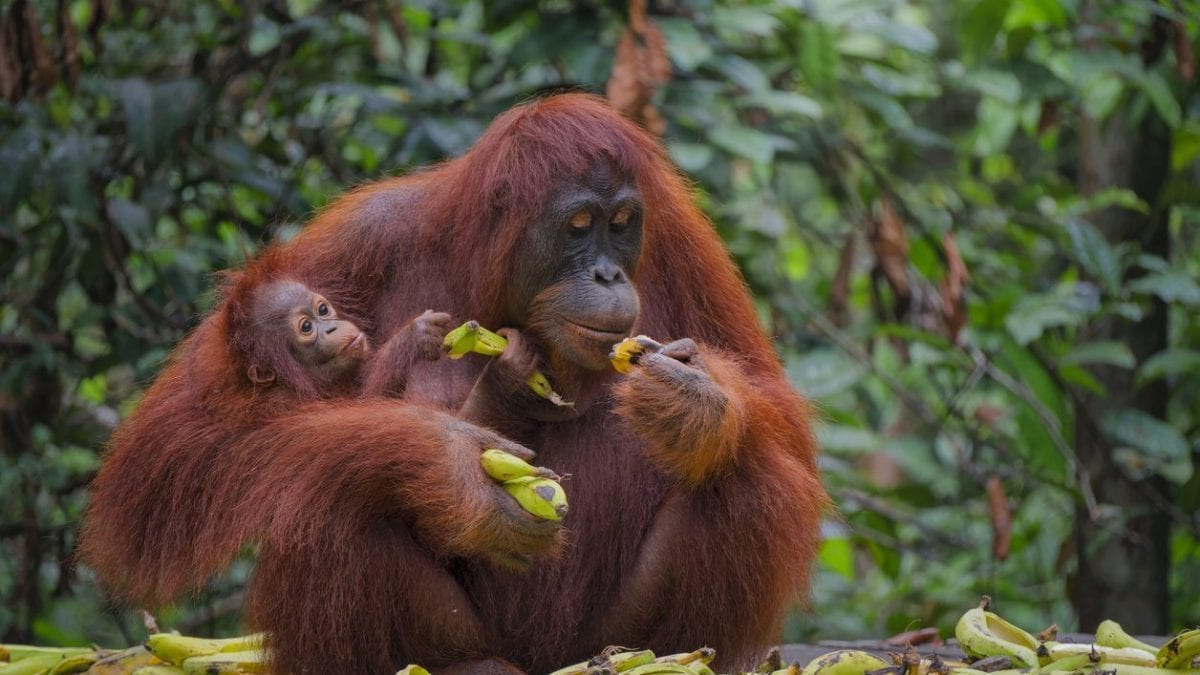
If no one had taught us how to eat, we probably wouldn't have survived this long (or at least not eight billion of us). But fortunately, there are those who, from generation to generation, have passed down to us the information necessary to avoid eating raw chicken or moldy jams. And, strange as it may seem, we're not the only living beings to do so: in fact, according to recent research, this passed down knowledge is a common practice even among orangutans. They, in fact, are able to catalogue hundreds of different edible foods and pass this knowledge on to their young: a fundamental step for preserving the species and surviving in an environment, like that of the forest, full of potentially harmful foods.
What The Researchers Discovered
The research, published in Nature Human Behavior, starts from a specific premise: given that an orangutan's diet is incredibly vast, can an individual discover everything on their own, through trial and error? Or does it need to learn through the behavior of others? To answer this question, the team of experts analyzed 12 years of daily observations of a population of Sumatran orangutans living in the forests of Suaq Balimbing, Indonesia. To better understand how they construct their diet, however, it would have been necessary to isolate a young orangutan from any type of interaction with its peers. Fortunately, to avoid inflicting such cruelty on a young orangutan, the researchers chose another approach: simulation.

Using data collected from previous research, they created virtual orangutans and fed them hundreds of behavioral cues to make the simulation as realistic as possible. In some cases, the team eliminated three essential behaviors from their routines: directly observing another individual while eating, being close to other orangutans while foraging, and being accompanied to areas rich in food. The results were clear: orangutans who were able to interact and socialize with others developed a very rich diet, with approximately 220 different edible foods. Conversely, those deprived of certain types of interactions built up a much smaller catalog, failing to achieve a complete adult diet.
Food is Not an Instinct, But Culture
Beyond the results themselves, the research shows how, for primates as well as for us humans, food is first and foremost knowledge. When we are born, we don't already know what's edible and what's inedible, what we should avoid, what's good for us, or which foods we should eat with caution: this is all information we learn from others. In this sense, social interaction becomes crucial to our survival: we would probably all eat that particular mushroom if no one told us it was poisonous, or a raw egg if we didn't know there was a risk of poisoning.

This research highlights that, for orangutans as much as for us, food is not just mere nourishment but also sharing, of gestures and knowledge. Our diet is based on centuries of discoveries, tests, experiments, but, above all, on knowledge passed down from generation to generation. The study demonstrates that eating is a profoundly social act, even before it is biological: even a species as intelligent and adaptable as the orangutan would not be able to construct a complete diet if it were not for others.
;Resize,width=767;)
