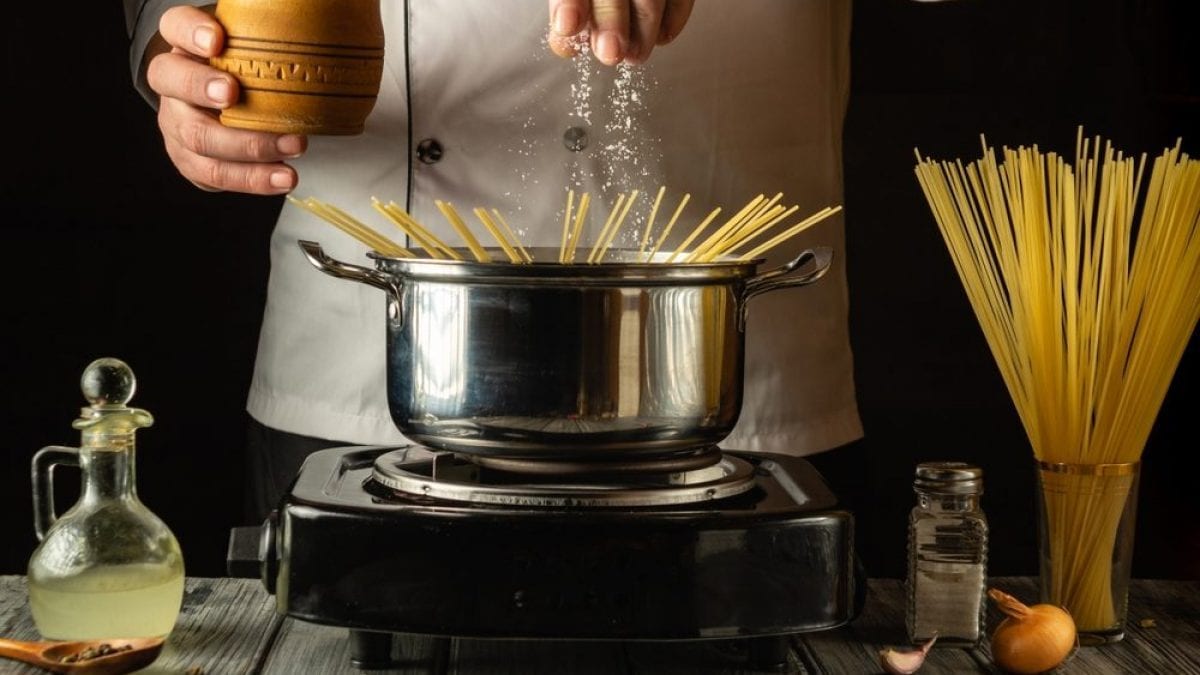
Cooking pasta perfectly is one of those things that can truly put us on edge: just a few seconds more or less and it's overcooked or too al dente. Not to mention salt: a constant battle between those who say it should be added before boiling and those who say it should be added after, those who use coarse salt and those who use fine salt. In short, such a seemingly simple gesture actually hides many pitfalls.
Luckily, however, there is science that often tells us exactly how we should behave in the kitchen: now, a team of experts has discovered the precise amount of salt to add and has also told us that it plays a very important role in cooking.
How Was the Study Carried Out?
To conduct the research, the team of scientists – led by Andrea Scotti – used the Diamond light source, a circular particle accelerator in the United Kingdom, to observe the scattering of X-rays on the pasta and discover its internal structure. As Scotti himself told The Conversation, the team then traveled to ISIS and the Institute Laue Langevin – two neutron analysis centers in the United Kingdom and France – where they studied the internal microstructure of spaghetti, both regular and gluten-free, using neutrons. The results showed how the two types of pasta – specifically, in this case, Barilla n°5 and gluten-free – behave during cooking and also how salt affects their structure.
The Role and Quantity of Salt in Traditional Pasta
It's well known that salt adds flavor to pasta, but, as Scotti states, this ingredient "also significantly influences the microstructure of spaghetti. When traditional pasta is boiled in salted water, the gluten maintains its structure and the starch granules deteriorate less during cooking."

So, yes, salt is essential for maintaining the pasta's optimal structure, but this, as you might imagine, doesn't mean that the more salt there is, the better the pasta will hold together. Cooking is all about perfect balance, and this is no different: "The optimal salt level is seven grams per liter of water." This is slightly less than the amount we've always used—10 grams per liter—and it's best to stick to it because "when the salt concentration was doubled, the internal order broke down more quickly and the structure within the starch granules was significantly altered by the cooking process."
The Importance of Gluten and Its Relationship With Salt
The research didn't stop at traditional pasta, but also studied the structure of gluten-free alternatives, which are increasingly deserving of attention. The researchers analyzed the role of gluten in the structure of pasta, which "acts as a solid scaffolding that holds the starch granules in place even during boiling, giving the pasta its consistency and slow digestion." These starch granules, however, in the gluten-free version, tend to swell and collapse more easily: this is why less-than-optimal cooking can make its consistency stickier.

And it is precisely this structural fragility that makes salt management difficult: in fact, if, as explained above, too much salt tends to break down the structure within the starch more easily, in a pasta where this structure is already weak, adding salt only makes things even worse. "Even small amounts of salt were unable to compensate for the absence of gluten. The artificial compounds in processed starches, used by companies to replace gluten, degraded rapidly," adds Scotti, underlining how cooking times can also influence this degradation, which occurs to an even greater extent "when gluten-free spaghetti has been cooked too long, for example for 13 minutes instead of 11″. And speaking of cooking time, 11 minutes is precisely the perfect time, according to scientists, for gluten-free pasta, while traditional pasta should cook for no more than 10 minutes.
Discoveries for The Evolution of Gluten-Free Pasta
The results of the study are particularly interesting not only for obtaining perfectly cooked pasta, but the analysis of the internal structure could lead to improvements in gluten-free versions: the hope, for the authors, is to obtain a pasta, in light of their findings, with a structure much more similar to the traditional one.
This structure also affects digestion because "gluten slows the breakdown of starch granules" during this phase: consequently, since gluten-free pasta "based on rice and corn often doesn't have this structure," sugars are released much faster. Thanks to this new research, scientists can therefore identify the ideal ingredients and cooking conditions to recreate the gluten structure as faithfully as possible.
;Resize,width=767;)
