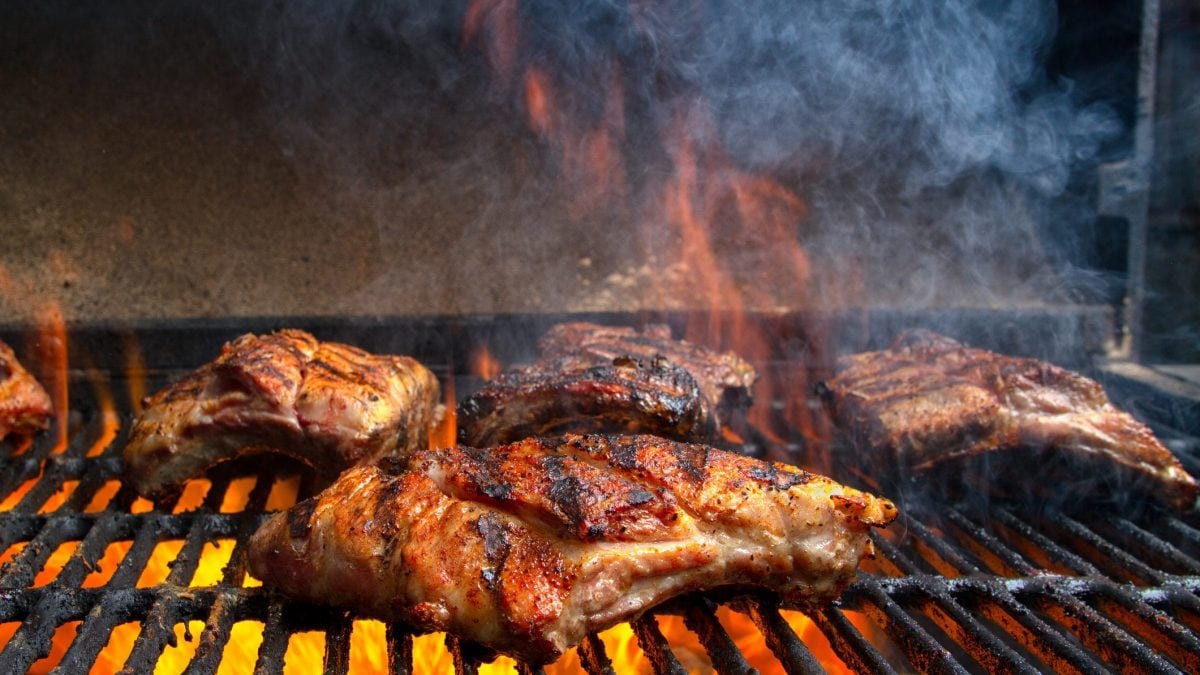
The explosion of TV cooking shows has given us a whole new lexicon to draw from. Who would have dared to utter difficult words like "caramelization of sugars" or "Maillard reaction" a decade ago? No one, we bet. Today, however, they seem obvious: after two hours in front of a barbecue, any guy immediately feels like Gordon Ramsay and starts reeling off strange phrases like the ones above. Next time it happens, especially if that guy is you, don't make a fool of yourself: caramelization and the Maillard reaction are different things.
In a nutshell, the main difference lies in the interactions between the elements: caramelization involves the formation of caramel-like aromatic compounds from the splitting of water molecules in sugar at very high temperatures; the Maillard reaction involves a series of processes that lead to the interaction between sugars and proteins during cooking, giving rise to the brown chemical compounds that give color to foods like grilled steak or bread crusts. Let's take a look at all the differences between the two chemical reactions.
Sugars' Caramelization Vs. Maillard's Reaction: Similarities
Let's get this straight: equating the two reactions isn't a serious mistake because, in reality, the two processes have more than a few similarities. First of all, we're talking about chemical reactions, which isn't a given because food transformations often occur through other processes. The most common sciences we apply in cooking are biology and thermodynamics: the former with all leavened products, the latter with boiling water. Another commonality is the type of chemical reaction and the result obtained: both occur through heat, both lead to a change in the color of the food, a change in consistency, and a change in aroma. Often, these two reactions are sequential because caramelization occurs at higher temperatures than the Maillard reaction.
Sugars' Caramelization Vs. Maillard's Reaction: The Differences
First, let's understand who Maillard is, so we can get this out of the way. A French scientist who lived between the 19th and 20th centuries, Louis Camille Maillard is the chemist who first identified this reaction. This is interesting: humans learned to use fire millions of years ago, but only in the last century have we demonstrated a chemical reaction that had previously only been theorized. The scientist described this reaction in 1912 while attempting to reproduce protein synthesis: essentially, it demonstrates the chemical reaction between an amino acid and a reduction in sugars in foods following cooking. To reduce the discussion to its bare bones, we can also say that, ultimately, the Maillard reaction is just that: a chemical reduction in foods following the use of heat. Unfortunately, however, it's not just that; in fact, the matter is much more complicated than that.

Caramelization is nothing more than a browning process, a technical term that indicates the formation of dark-colored substances. We usually see it with apples: if we peel an apple and don't eat it immediately, we'll see the fruit blacken. This is due to the browning of the apple's sugars. In this case, it's due to the decay of fructose, while in caramelization, it's caused by heat: the sugars caramelize at temperatures above 212°F/100°C, from 320°F/160°C onwards, "creating" a new color and, above all, new aromas.
The process isn't immediate and goes through several stages until it reaches a compound known as hydroxymethylfurfural, which gives the classic caramel aroma, hence the name. This part is very important because, starting from a sugary base, each stage has unique sensory characteristics, which is precisely why great pastry chefs use different types of caramel depending on the recipe they're cooking.
With this "explanation," we can be certain of one thing: when you hear that "proteins caramelize," you're hearing nonsense. It's the sugars that caramelize, not the proteins. In this case, the Maillard reaction comes into play, a much more complex phase because it involves multiple chemical compounds: sugar and proteins.

While the primary factor in the first reaction is temperature, with sugars "melting" at different temperatures, other parameters also play a role in the Maillard reaction, such as the level of acidity, which come into play at various stages. The Maillard reaction is divided into three main phases:
- The first is a reaction that is invisible to the naked eye: there is the interaction between a sugar and a group of amino acids that go on to create a new organic compound which in turn leads to the formation of a third compound;
- The second phase is the most complex, because many reactions occur, influenced, indeed, by temperature. We have the first light coloration and the aroma of the product we are cooking is released, this phase occurs more or less above 285°/140°C;
- finally we have the final phase which condenses the organic products created in "phase 2" and leads to the formation of melanoidin, the organic substance that determines the formation of a color ranging from brown to black.
Let's start by saying that this is a very brief summary of the process, as it's very difficult even for the most expert chemists. In practice, we can say that everything stems from the reaction between amino acids and reducing sugars, which unleash a mixture of molecules responsible for a vast array of flavors and aromas.
What's important to emphasize is that the Maillard reaction is responsible for most of the browning we empirically recognize as "cooked." Today, we all associate it with meat, but in reality, the most immediate and simple Maillard reaction we can recognize occurs in bread: the crust that goes from golden to brown, so fragrant and flavorful, is the result of chemical reactions between sugars, carbohydrates, and proteins that occur in the oven during baking.
What Are The Factors That Influence the Maillard Reaction?
The complexity of this chemical reaction has placed it at the center of numerous studies in the food industry because it is essential to know how to control it during the production and storage of large quantities of food: the more knowledge is gained about the Maillard reaction, the greater the control over the quality of food products. Research has identified a frequency, extent, and course of chemical reactions related to temperature, reaction rate, water activity, and pH, or the acidity of the food:
- The most immediate thing that comes to mind is to aim for high temperatures. We associate this process with barbecues, but this isn't always true. High heat may not guarantee a proper Maillard reaction because the time and speed of the reaction are closely related;
- Water plays a key role in this correlation, blocking or slowing the reaction by lowering the temperature and reducing the reaction rate, thus slowing down the Maillard reaction itself. If the food is full of water, the reactants will move very quickly through the fluid (and the opposite is also true). With lower water activity values, the reactants are more concentrated in a few points, they will be less likely to disperse and therefore we will have a more effective Maillard reaction. Many people, to get around this problem, are convinced that they must place the steak on a griddle or grill as hot as possible, so as to "seal" the meat and therefore the fluids. This is one of the biggest false myths related to cooking meat. Studies have even been conducted on this legend: it has been demonstrated that a piece of meat cooked at a low temperature, therefore boiled in its own fluids that have all escaped, and a piece grilled, "sealing" the meat, have the exact same weight;
- Temperature is, however, of some importance because the Maillard reaction can begin even at 68-77°F/20-25°C in the presence of oxygen, therefore at room temperature; the reaction speed increases around 86°F/30°C and from 86°F/30°C onwards it changes proportionally: for every 50°F/10°C increase, the Maillard reaction is three times faster. It stabilizes between 176°F/80°C and 285°F/140℃, the optimal temperature for obtaining a perfect Maillard reaction, after which the caramelization process begins, that is, the non-enzymatic browning that affects the browning and the color variation of the food during cooking.
We can therefore conclude that the differences between the Maillard reaction and the caramelization of sugars are difficult to identify, but they exist, and they influence the taste and aroma of what we eat. Caramelization of sugars occurs at very high temperatures, while the Maillard reaction is more of a ballet between proteins and sugars during cooking.
What Does it Mean to Caramelize Sugars?
Caramelization is a chemical process that occurs when sugars are heated to high temperatures, usually above 320°F/160°C. Under these conditions, sugar molecules break down and recombine into new molecules, giving rise to a series of compounds that give food a golden brown color, an intense aroma, and a sweet, slightly bitter flavor. It involves only sugars (glucose, fructose, sucrose) and leads to the formation of melanoidins, compounds that give food a golden brown color and a sweet, slightly bitter flavor.
;Resize,width=767;)
