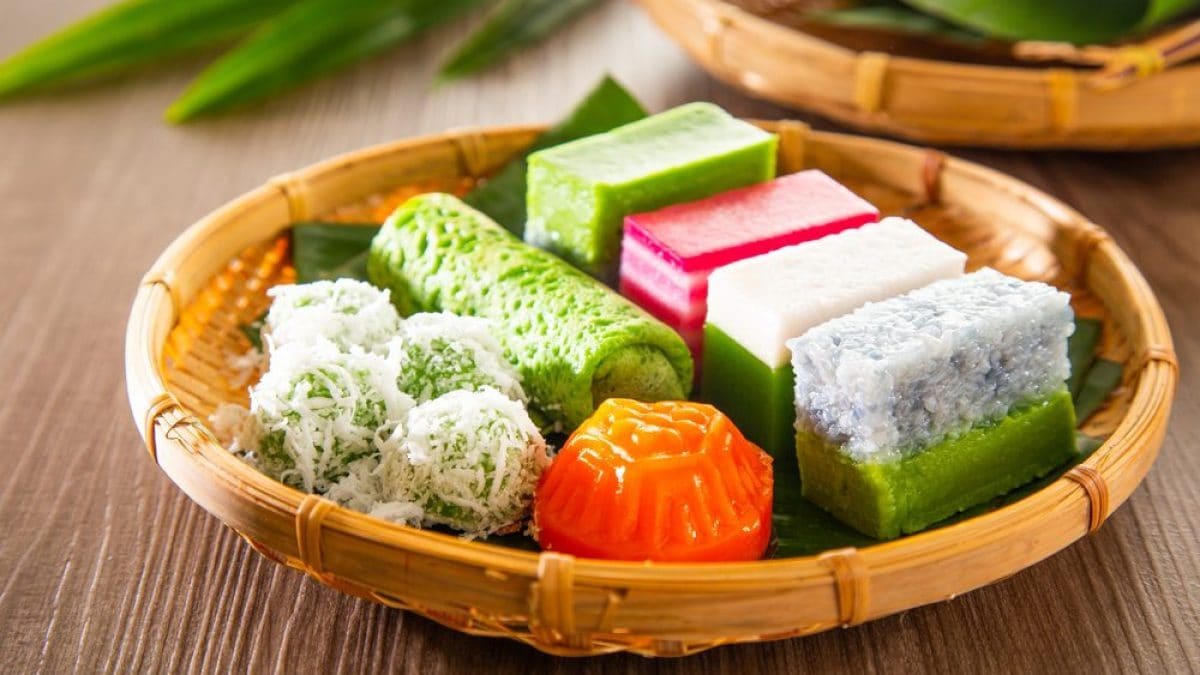
If you think of tea time, you automatically think of Great Britain, where this occasion is the quintessential afternoon snack. But as you know, tea comes from afar, originating in Asia and traveling extensively throughout the world, which is why so many cultures have developed their own tea ceremonies, always accompanied by local specialties. In Southeast Asia, these specialties are called kuih: they are small, single-serving sweets, mainly found in Malaysia, Indonesia, Singapore, China, and Sri Lanka.
There are dozens of different variations of kuih, each personalized by the tastes and flavors of its locale, although some elements are recurring: certain ingredients, such as coconut milk, glutinous rice, tapioca, and palm sugar; the consistency, pudding-like and chewy since they are almost always steamed. And then, the colors. The most immediately noticeable characteristic of any type of kuih is its bright, eye-catching color, which, in most cases, is achieved entirely naturally. Let's discover the most popular, delicious, and unique types of kuih.
1. Kuih Talam

One of Indonesia's most beloved sweets is kuih talam, which gets its name from the traditional tray used to give it its distinctive rectangular shape. Talam is unique because it's much less sweet than other types, as salt is added to the dough, a combination that gives it an extremely balanced flavor. Kuih talam is made up of two layers: a white one made from rice flour and coconut milk, and a colored one whose ingredients vary depending on the desired color: for green, pea and pandan flours (a tropical plant from Southeast Asia) are used, for yellow, sweet potato, for purple, tubers such as yam or taro, and for brown, coconut sugar.
2. Kuih Seri Muka

Very similar to talam, kuih seri muka are typical of Malaysia, where they are part of the country's culinary heritage and, since 2009, have been included in the list of 100 typical national dishes. These Malaysian sweets are made of two layers with a single color combination, a white stripe and a green stripe, and in both cases the main ingredient is coconut milk. Sticky rice is added to make the white layer, while a thick pandan-flavored cream is used for the green layer. This combination, along with the lack of salt, makes the sei muka sweeter than talam. This kuih is almost always vegan.
3. Kuih Lapis

Kuih lapis takes the prize for the most colorful dessert of all: it's typical of Indonesia and features multiple layers (lapis, in Indonesian, actually means layers) that, in the most elaborate versions, can contain all the colors of the rainbow. The mixture is a sort of flavored, steamed rice pudding, then worked to obtain the classic rectangular shape typical of these sweets. The ingredients to stabilize it are sago or palm starch, cassava starch, coconut milk, and sugar, to which a different ingredient is added for each color desired: among those that are always present is green obtained from pandan, while for more unusual colors, food coloring is also used.
4. Ondeh Ondeh

Originating from the island of Java but popular throughout Indonesia, ondeh ondeh are special kuih shaped into small balls. They are made from glutinous rice, pandan, and coconut, to which raw palm sugar is added, which is ideal for mixing and holding the mixture together. This is precisely the characteristic feature of ondeh ondeh: during boiling, the sugar dissolves and creates a semi-liquid center in the ball that is revealed only when eaten. Today, ondeh ondeh is among the most common Indonesian kuih, typically served in groups of five to ten inside banana leaves.
5. Dadar Gulung

Dadar gulung are the most unique of these sweets, as they don't have the classic rectangle or ball shape, but are a sort of crepe served rolled up. The batter is made from rice and coconut milk, flavored (and colored) with the unmistakable pandan leaf, while the inside is filled with a mixture of palm sugar, flaked coconut, and cinnamon. It's a traditional Indonesian recipe, but with slight variations, it's also found in Sri Lanka, Malaysia, and Singapore.
6. Kuih Kosui

Typical of Malaysia, kuih kosui is a small, single-serving steamed rice cake shaped like a pudding or rectangle using various individual molds used to cook the dough. The typical ingredients are rice flour and tapioca, water, and raw palm sugar, which gives it its characteristic brown color (sometimes also available in a green version). The finishing touch is a generous sprinkling of shredded coconut.
7. Kuih Kochi

Kue kochi is a sweet treat found in Javanese, Malaysian, and Singaporean cuisines, easily recognizable by its distinctive small pyramid shape. The shell is made of glutinous rice with added ingredients that give the mixture a light green color, while the inside is filled with a sweet and crunchy coconut and palm sugar filling.
8. Kuih Bengka

Kuih bengka, or bingka, resembles a slice of cake rather than a dessert. This rather hearty Indonesian kuih is actually a soft and moist cake made from tapioca mixed with coconut milk, eggs, water, and sugar. This basic combination has led to many other versions of kuih bingka, adding ingredients like potatoes or pandan to the batter.
9. Pulut Inti

Pulut inti is a unique evolution of an Indonesian dessert known as bee kho, a soft, easy-to-eat ball of glutinous rice mixed only with sugar. Pulut inti uses the same ingredients, but the rice is cooked longer for a crispier texture, and the surface is coated with a mixture of candied coconut and palm sugar. Sometimes, the rice is colored blue-violet with the addition of butterfly pea flowers. It comes in the shape of a triangle wrapped in banana leaves and is traditionally eaten during festivities honoring the Jade Emperor, a key figure in Taoist Buddhism.
10. Bahulu

In Malaysia they are called bahulu, but many have nicknamed them “Malaysian madeleines” due to their obvious resemblance to the shape of the famous French sweets . Malaysian tarts are the quintessential local festive dessert. The tart is a sort of dough similar to sponge cake, it can contain fruit, pandan or chocolate and comes in different shapes: the most common is round and button-shaped, but it is also found rolled and layered.
11. Angku

Angku, or kuih koo, is one of the most unique sweets in Southeast Asia and also holds the highest symbolic value: its shape and the inscriptions decorating it resemble the back of a turtle, an animal revered and consumed for longevity. It is no coincidence that it is a sweet with great ritual significance, consumed especially for new births and the birthdays of the elderly. The casing has a chewy, slippery consistency, made with glutinous rice and various ingredients depending on the desired color: the most common is red, a symbol of happiness, obtained with sweet potato (but orange, green, and yellow are also available). The filling is primarily made with red or mung bean paste, but also jam or chopped peanuts. Angku is distinctive in that it is rounded on the surface but flat at the base, making it easier to grill traditionally.
12. Kuih Tutu

Kuih tutu are a popular street food in Singapore, both delicious and visually stunning. Unlike the more famous, colorful kuih, these are completely white on the outside and shaped like a flower, with a filling placed right in the center of the cake, near the top. The outside is a rice flour dough steamed in special molds, while the filling is made of coconut, raw sugar, and crushed peanuts.
13. Kuih Keria

We conclude our journey through Southeast Asia with the most unique kuih of all: they hail from Malaysia, where they're the most beloved sweet street food, and are called kuih keria. These are actual fried doughnuts, available in two versions: one glazed with regular white sugar and one glazed with palm sugar, which adds a slightly smoky flavor and a hint of caramel with a bitter aftertaste. The doughnut is made with a mixture of sweet potato, flour, baking powder, salt, and oil (but no leavening is required), then shaped into the classic round shape with a hole in the center and fried in hot oil.

