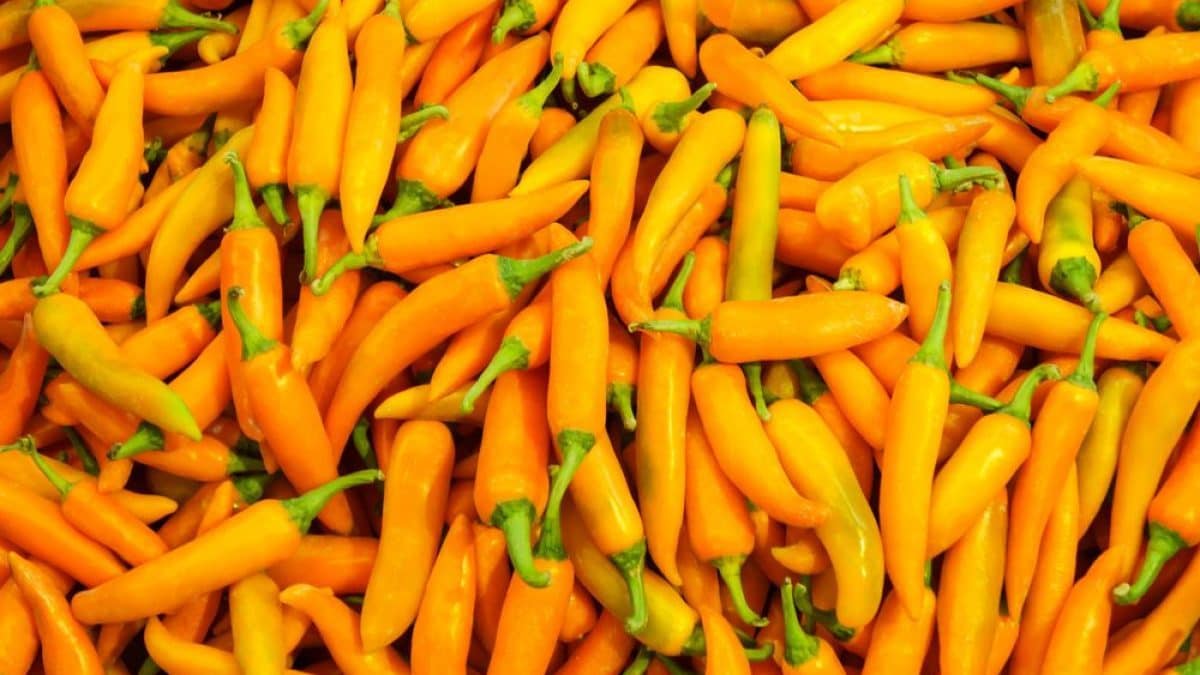
If there's one versatile ingredient that can transform the flavor of a dish, it's chili pepper. Fresh, powdered, or in a creamy paste, it's a true kitchen staple, lending unique aroma and flavor to countless recipes, both creative and traditional, both Italian and international.
There are more than 3000 types of chili peppers in the world, among which yellow chili peppers are included: usually they are alternative chromatic versions of varieties that are also commercially available in red (such as habaneros), with which they share – some more, some less – the positioning on the Scoville scale, that is the official measurement of their spiciness in units called SHU (Scoville Heat Units), developed by the pharmacist Wilbur Scoville in 1912. The classification ranges from 0 to 16,000,000 SHU, where already 350,000 SHU is considered very spicy.
Depending on the degree of ripeness, yellow cultivars have skins with light or pale shades or greenish, up to bright yellow and orange hues.

We've rounded up the five most popular yellow chilies, mixing shapes and origins at various levels of heat, from the mildest to the truly spicy "little devils." So don't let the color fool you: yellow doesn't necessarily mean sweet.
1. Aji Amarillo

It is one of the most widespread and well-known yellow varieties native to South America (especially Peru and Bolivia), also because it is very often found among the ingredients of ceviche, the Peruvian national dish consisting of fish marinated with lime, red onion and chili pepper, of which the preferred variety is chosen depending on the flavor and taste you want. Aji amarillo belongs to the Capsicum baccatum species: it is characterised by its elongated shape, just over 10 cm in size and a firm and crunchy consistency. Its pulp is meaty, juicy and very aromatic, with sweet fruity hints. When fully ripe its color turns orange. The level of spiciness is medium-low, sometimes very low, and ranges between 10,000 and 30,000 SHU, reaching a maximum of 50,000 SHU. It can be found fresh or in paste, worked into a cream, perfect as a condiment also on meat dishes.
2. Aji Lemon

Also called hot lemon, this chili pepper belongs to the Aji family, with which it shares its moderate spiciness levels, which in this case are between 30,000 and 50,000 SHU. It is easily recognized by its oblong shape, small dimensions that do not exceed 5 cm and its beautiful bright yellow color. Obviously, its association with lemon is not a coincidence, because its aroma recalls pleasant citrus notes. Originating from Peru, it is also used in ceviche and in dishes based on raw fish, shellfish such as shrimp and prawns in the form of sauces and fresh for marinades. It also pairs excellently with particularly sweet fruits such as peaches, pineapple and mango.
3. Yellow Habanero

Yellow habanero or golden habanero: a variety with many names that hark back to the one detail that distinguishes it from its famous red brothers, probably among the most iconic chili peppers in the world: its color. Apart from that, in fact, there are no differences: this variety is known as one of the hottest, ranking in the middle of the Scoville scale with 300,000–350,000 SHU. This cultivar belongs to the Capsicum chinense species and is native to Mexico, also very common in Texas, a neighboring US state: it is small in size, with a fruit rich in pulp and a rounded, ribbed shape. It goes without saying that it is a must-have in Mexican and Tex-Mex cuisine, where we find it in hot sauces and compotes or fresh or dried, to “ignite” chili, burritos, and beef and chicken fajitas.
4. Fatalii Yellow

Fatalii yellow is a type of the Capsicum chinense species, grown mainly in the Central African Republic. Its origins, however, are unclear: they are thought to be Caribbean, given that it belongs to the habanero family, but it is possible that once imported to Africa it found particularly favorable climatic conditions, so much so that it became a traditional variety . It is a particularly aromatic cultivar, which combines a very enveloping, citrusy and sweetish scent with a high level of spiciness, reaching 400,000 SHU: the peppers reach 7 cm in length, have an elongated shape with a lumpy texture. As it is not fleshy, fatalii can be dried without problems and used either whole or in powder form as a soffritto or as a flavoring for fish and potato soups. Like Aji lemon, it is particularly suitable in combination with exotic fruit and shellfish.
5. Trinidad Moruga Scorpion Yellow

The red Trinidad Moruga Scorpion is the second hottest chili pepper in the world, as established in the 2023 update of the Scoville Scale. Its yellow version doesn't change the rules of the game: the value is always between 1,500,000 and 2,000,000 SHU. We are therefore talking about a very hot chili pepper that originates from Trinidad and Tobago, a Caribbean country, and was then perfected in Australia. The shape of the fruits is square, particularly irregular, making them similar to miniature peppers, of which they retain the sweetish aroma. In the kitchen, it is used to prepare spicy sauces and jams, to season meat, fish and vegetable dishes, appreciated by true, true enthusiasts.
;Resize,width=767;)
