
Once upon a time, there was a tropical plant known since the time of the Mayans, a president in exile, and an American inventor: this isn't the beginning of a fairy tale, but the story of a unique confectionery product, loved throughout the world, especially by children. It's chewing gum, a "modern" sweet that has actually been known for millennia, albeit in a different form than today. Chewing gum, in fact, responds to one of man's primary needs: the need to chew, so much so that every ancient civilization had its own primordial version of chewing gum.
The distinctive feature of this product, in fact, is that it is the only sweet on the market designed to be chewed and not eaten (although swallowing it doesn't cause any harm, other than promoting tooth decay and having a laxative effect). Today, chewing gum comes in all sorts of flavors, with countless variations on the natural gum-sugar-additive-flavoring formula, but the original chewing gum was flavorless: who invented it? The history of modern chewing gum has its origins in the ancient Mayan custom of chewing their own version of gum, chicle, a custom that would have remained exclusively local if it hadn't been for the two protagonists of our story, two characters who lived at the end of the 19th century: Antonio López de Santa Anna and Thomas Adams.
The Origins of Chewing Gum
The history of chewing gum is centered on Central and North America because modern chewing gum derives from Mexican chicle and because the culture of chewing is very strong in that part of the world. However, it is actually a common trait found in all ancient cultures dating back to the Neolithic era. The cultural tradition of chewing gum appears to have developed through a process of convergent evolution: traces of this habit are present separately in many early civilizations for a variety of reasons, ranging from taste stimulation to oral hygiene.
Each of the earliest precursors to the modern cigarette stemmed from natural growths in their region: a 5,000-year-old gum made from tar and birch bark, with teeth marks, was found in Kierikki, Finland; an even older find in Estonia dates back 10,500 years. Ancient forms of natural gum have also been found in Greece, made from mastic and mastic resin; in China, where ginseng roots were used; in North America, where natives used sugar pine and spruce sap; in India, where betel nut chewing was common; and among the Eskimo population, who used blubber, or whale blubber.
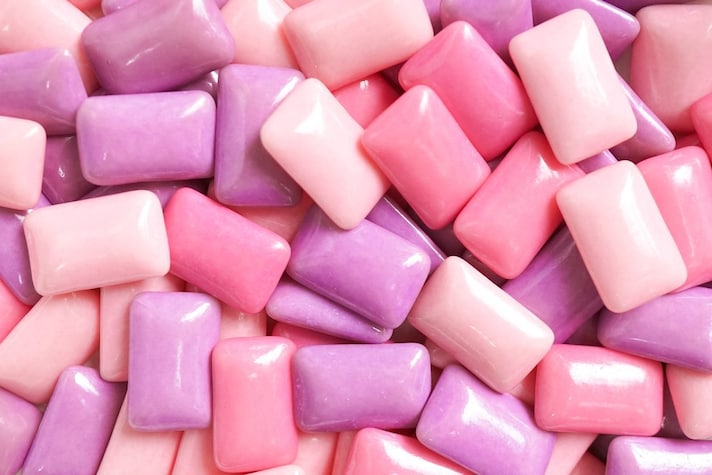
How could we not mention South America, directly responsible for the birth of modern chewing gum? Evidence uncovered regarding the habits of the Maya has highlighted how it was customary among the population to chew a natural gum derived from a tropical plant (Manilkara chicle) native to Central America. This is further evidence of how chewing is part of human primal instincts and how every civilization around the world has attempted to find the best possible solution to satisfy this need, ultimately resulting in modern chewing gum.
The Modern Chewing Gum's History and Evolution
For millennia, the Mayans of Yucatán extracted the latex from certain trees, which they called chicle, to make chewing gum to relieve tension that built up in the jaws, to ward off hunger, or simply to do something, much like chewing coca leaves or tobacco elsewhere, only with less harm and less addiction. Chewing gum would have remained a strictly local habit if it were not for a key figure in the mid-19th century, Antonio López de Santa Anna.
Santa Anna was an important military man and politician: he was the general in charge of the army in the famous Battle of the Alamo against the United States, and then embarked on a political career, ultimately being elected President of Mexico eleven times during his lifetime. It is no coincidence that he went down in history as Generalissimo, but also as (his very modest self-description) "the Napoleon of the West." What does this man have to do with chewing gum? When he wasn't busy being head of state, Santa Anna was in charge of some army, a practice that periodically landed him in prison or exile. It was precisely one of these periods of "misfortune" that linked Santa Anna to chewing gum, specifically the exile that led him to spend a period in the United States. Looking for a way to enrich himself during his forced exile from his homeland, Santa Anna drew inspiration from a habit he had had since childhood: chewing chicle, a gum made from the substance of the chicle tree.

During his exile, he took a supply back to Texas before leaving for New York, but he didn't envision the product being edible. His idea was to process the chicle latex into a much cheaper alternative to rubber, a material with endless industrial and domestic uses. Santa Anna involved inventor and entrepreneur Thomas Adams, the second protagonist of this story, in the project: it was he who implemented the exiled president's idea and actually produced the first chicle pellets, which, however, were a huge commercial failure. Santa Anna soon returned to Mexico to retire, and Adams was left alone with a load of seemingly useless latex. But remember what we said? Thomas Adams was an inventor. The idea came to him while watching a girl chew a type of chewing gum that already existed (derived from the Native American variety), but it was very hard and full of impurities. Here was the epiphany: chicle was more elastic, able to break apart and reassemble itself, and purer, so why not turn it into a chewable food?
So the inventor founded a company, Adams New York Chewing Gum, offering the first chewable balls, almost entirely flavorless, and began selling them in 1871 in a grocery store in Hoboken, New Jersey. The product began to have some success, but the real boom had to wait for the appearance of two other key figures in this story: John Colgan, who in 1875 was the first to think of flavoring Adams' gum with balsam and pepsin powder, and William G. White, who in the late 1880s perfected the formula by replacing the chicle with glucose syrup, creating the first peppermint chewing gum. Adams then also began flavoring his gum, and thus the chewing gum industry was officially born. The Fleer Corporation, founded in 1885, also fits into this panorama. It was a company that worked to create its own distinctive product: this is how the iconic bubble gum was born, the most famous chewing gum, with its fruity aroma, pink color and consistency so elastic that it allows consumers to make the famous “bubbles”.
In the following years, chewing gum exploded in the United States as a veritable fad, but it was still a phenomenon that remained localized to the country where it was invented. It spread throughout the world thanks to the World Wars, particularly the Second, because Ancel Keys included chewing gum in the K-Rations sent to the front: first of all, chewing gum produced saliva and helped soldiers keep their mouths clean, ease tension at the front, and disguise the less-than-savory taste of the food rations. The gum was promptly exchanged by American soldiers with local residents, and the rest is history: chewing gum exploded throughout the world, becoming a global phenomenon.

For nearly 100 years, chewing gum was produced using the same method: only after the war did synthetic butadiene-based rubber arrive, because it was easier and cheaper to produce; this was also the period of greatest consumption, as chewing gum became a true symbol of counterculture and adolescent rebellion. And while it's true that over the last 20 years, sales have declined compared to the past—partly due to the loss of this rebellious allure, and partly because the need to consume this product is less intense, seen more as an occasional "whim"—chewing gum remains an icon today, especially for the nostalgic effect it triggers when thinking back to when chewing it was the natural stress reliever par excellence and the measure of how to "look good."
;Resize,width=767;)
