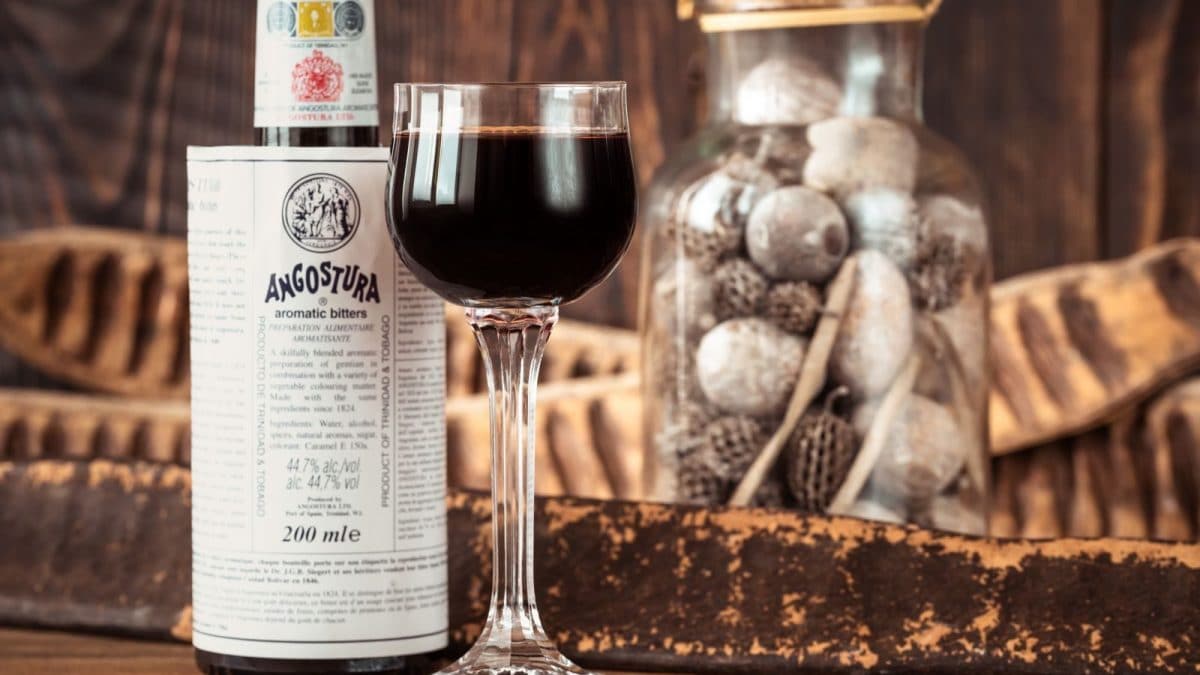
Angostura is a fundamental bitter, an indispensable ingredient for any self-respecting cocktail bar. Named after a town in Venezuela, and like most bitters, it began as a natural medicine before entering the world of mixology. If you've ever sipped an Old Fashioned or a Manhattan, you've likely tasted it without even knowing it, but it's equally likely you remember the iconic bottle. Let's explore all the secrets of Angostura, the most popular bitter in the world.
Is Angostura a Brand or a Bitter?
We talked about packaging because the Angostura bottle is truly iconic and highly recognizable: it's tiny but has an oversized label wrapped around it. So are we looking at a generic liqueur, like limoncello, or is the one we see in bars a blend from a specific company? Angostura is both: a brand and a type of bitters.

The bottle you find in bars with the gigantic label (a typo that the company really liked) is Angostura, a historic brand from Trinidad and Tobago, created in 1824 by Dr. Johann Siegert, the inventor of the original recipe. The company produces Angostura aromatic bitters, and it's that little bottle with the oversized label and red cap that you find in almost every bar. A bit like Cellophane, Scotch, Biro, Maternity, Mop, Kleenex, Post-it, the brand name has also become the name of the product, so today when you say "Angostura," you're probably talking about that type of spicy, slightly bitter bitter, rich in herbs, roots, and spices, but it doesn't necessarily mean it's that brand. In practice, we can say that all Angostura bitters are bitters, but not all bitters are Angostura.
Angostura's History
It all began in 1824, when Johann Siegert, a German military doctor, moved to Venezuela to work with Simón Bolívar‘s army. It was there, in the city of Angostura, now Ciudad Bolívar, that he began experimenting with a blend of herbs with digestive and therapeutic properties to treat soldiers suffering from fever and intestinal problems. After four years of study and research, the first "aromatic bitter" was born to stimulate the appetite and digestion of sick soldiers. It actually seemed to work: in the first half of the 19th century, the city of Angostura was one of the most visited and important trading ports in the world. Many sailors, fascinated by the tales of this miraculous medicine, made special stops during their voyages to cure themselves with this bitter and carry it with them while sailing. Thanks to these unexpected sales, Angostura spread throughout the world.

The brand's true development, however, occurred after Siegert's death, thanks to his sons, who believed more than him in the marketability of the product and founded the company in Trinidad, in the same place where Angostura bitters are still produced today.
A change that occurred in 1870, when the family moved to the Caribbean capital after years in Venezuela: they also spread its iconic bottle with the oversized label, which curled and protruded beyond the glass. A printing error that became a trademark, so much so that today it is an integral part of the product's visual identity. The label, along with the red cap and the amber liquid inside, has made Angostura a global icon.
At the beginning of the 20th century, relations with the United States intensified, even during Prohibition, and with Europe, thanks to the popularity of some classics that required Angostura bitters, especially the aforementioned Old Fashioned and Manhattan, which until the 1970s reigned supreme in Western bars. Its popularity was so great that the Caribbean company became the official supplier to the courts of Prussia, Spain, and England, surviving two world wars and American Prohibition. It suffered a decline in the 1980s, but fortunately, in the last twenty years or so, Angostura bitters have returned to their former glory and have become (arguably) the most famous and best-selling bottle of bitters in the world.
How is Angostura Made
The true formula for Angostura Aromatic Bitters is a closely guarded secret, but what we do know is that it's a concentrated blend of roots, herbs, bark, spices, and alcohol, left to macerate for weeks. The alcohol serves as both a preservative and an aromatic carrier, so much so that just a few drops of this bitters are enough to add flavor to a cocktail—a very complex flavor, at that. Angostura is a very bitter, spicy, almost medicinal bitter, with notes of cinnamon, cloves, tamarind, and citrus. It's precisely this complexity that makes it such a valuable ingredient in mixology.
Starting from this aromatic base and well-known ingredients, many other companies have attempted to replicate the product, some with excellent results. Today, there are numerous excellent Angostura bitters on the market, capable of rivaling the "parent company" without a fight.

Cocktails Ideas and More
If you're wondering how to use it, the answer is: in moderation. Angostura shouldn't be drunk on its own, even though it has admirers around the world. It's a bitter, an aromatic concentrate that serves to balance and complement the flavors of a drink or dish. Yes, it can also be used in cooking, and it was especially popular in North America in the 1960s. In cocktails, it's a classic in the Old Fashioned, where it balances the sweetness of the sugar and the intensity of the bourbon. It's also essential in Manhattans, Pisco Sours (where it's sprinkled on top), and even low-alcohol drinks: try it with soda water and lemon; you'll be surprised.
In the kitchen, you can use it to flavor meats or even desserts. A drop in chocolate batter or custard can add depth and an exotic touch. A few drops can enhance the flavor of sauces, marinades, and stews. Try adding it to your ragù or tomato sauce and you won't regret it.
;Resize,width=767;)
