
Christmas has specific symbols that make the holiday special and, as soon as you see them, immediately immerse you in its magical atmosphere. Often these are sweets, especially biscuits, whose shape has become, over time, thanks to stories, legends, and traditions, a true icon of Christmas: this is the case with candy canes and perhaps even more so with gingerbread men. Gingerbread men are Christmas sweets flavored with ginger and cinnamon, a recipe beloved in the Anglo-Saxon world and now widespread throughout the world, but originally from Northern Europe.
Spicy and crumbly, today they are prepared in a variety of shapes (stars, reindeer, trees, etc.), but the original recipe calls for them to be shaped like a miniature gingerbread man, often with facial features defined by the help of icing. The humanoid appearance of these cookies, partly because it's endearing and partly because it's been heavily promoted by pop culture in films and TV series, has become so famous that gingerbread men are no longer just biscuits but an image that appears everywhere, from tree decorations to prints on sweatshirts. But where did gingerbread men originate, why do they have this shape, and how did they become a global symbol of Christmas around the world?

Because of cinematic narratives, we tend to associate gingerbread men with the U.S., but in reality, the origins of gingerbread men are much older: the man-shaped cookie is English and has noble origins, but it is also intertwined with a series of fairy tales and legends with macabre overtones. Let's discover the history of this delicious and iconic treat.
The Birth of Gingerbread Cookies
Crunchy, crumbly, fragrant, a true delicacy: gingerbread men are the quintessential Christmas cookies, made from spiced shortcrust pastry, brown in color and with the unmistakable aroma of cinnamon and, of course, ginger. The most famous shape is anthropomorphic, but gingerbread dough is actually much older than these cookies: some historians believe the first recipe dates back to 2400 BC, when honey cakes were made in Greece that resembled the flavor and color of ginger, although they still lacked ginger, like many older versions. Gingerbread itself became popular in the Middle Ages, especially at European fairs, as an ingredient in delicious, curiously shaped sweets prepared using special molds. However, the first gingerbread-shaped cookies didn't appear until the second half of the 16th century.

Elizabeth I's Reign, The First Part of The Story
Although the recipe for gingerbread pastry has existed since the Middle Ages, gingerbread men as we know them today originated in a truly vibrant historical and cultural context: the 16th century, the period in which the Renaissance arrived in England, led by William Shakespeare, Thomas More, and Erasmus of Rotterdam. Shakespeare himself was the first author to mention this sweet treat in a work, specifically in the comedy Love's Labour's Lost, in which the English author writes: "If I had a penny in the world, I'd give it to you to buy you gingerbread!"
The cultural renaissance of 16th-century England also included a gastronomic renaissance: from the Americas came unprecedented spices, vegetables, and fruits, all dishes that the "Virgin Queen" offered her guests. Elizabeth I, in fact, was the first to grasp the power of cuisine in the world of diplomacy, so much so that she became famous among the European nobility of the 16th century for her banquets even before her political skills, thanks to elegant, elaborate preparations, luxurious and often "modern" dishes. Gingerbread men were born precisely with this in mind: it was she who asked the court pastry chefs to use simple ingredients and attempt to create "little men" that would represent the foreign nobles and other guests at the queen's court, to be given as symbolic gifts of her hospitality. The pastry chefs took inspiration from a dough that was already widely used, albeit in other forms, that of gingerbread pastry, and modeled it according to the queen's request: the gingerbread men were officially born.

The idea was so popular with all the guests at the palace that they brought gingerbread men back to their courts throughout Europe. It's no coincidence that so many recipes in Northern Europe feature these cookies, the most famous (and successful) of which is probably the Swedish pepparkakor, a very similar dough but traditionally star-shaped. The fame of gingerbread men also spread to the lower social classes: practitioners of folk medicine, often described as "witches" or "wizards" in this era, made gingerbread men for young women to find husbands; the idea was that if men ate the gingerbread man, they would fall madly in love.
The Return of Gingerbread and The Macabre Story of St. Nicholas
With the end of the Tudor reign, gingerbread men also disappeared from circulation and it took 200 to 300 years before they reappeared in European tradition. The first hint of the return of gingerbread dough occurs in the story of Hansel and Gretel, published in 1812 by the Brothers Grimm: the fairy tale contributed to the spread of the tradition especially in Germany, Poland and the Czech Republic, but in this case the story tells of a house built with gingerbread, so in these countries gingerbread houses decorated in the most varied ways began to be made.

The gingerbread man, however, reappeared in European tradition much later, in 1875, when one of the many versions of the stories related to the figure of Saint Nicholas, the patron saint of children who inspired the figure of Santa Claus, was published. The tale, with dark and macabre overtones like all the original tales of this era, tells of an elderly couple who desperately wanted to have a child, so they baked a cookie in human form. To the couple's great amazement, and perhaps with the help of Saint Nicholas who granted their wish, the gingerbread man came to life, but unfortunately soon escaped their control.
During the journey, he repeats a nursery rhyme to both humans and animals: "I ran away from an old woman and an old man. I can run away from everyone, I can run away from you. I can. Run, run, you won't catch me. I am the gingerbread man." The story then branches out into several endings, some with happy endings, with the two old men retrieving their gingerbread boy, while others are decidedly more macabre. The most famous tells of a fox who cunningly captures the protagonist to eat him and narrates the cookie's cries as he dies, a sort of chronicle announcing his end. However, there is an even darker version in which the gingerbread man is eaten by the old couple themselves. Despite the more or less disturbing endings, this tale has greatly contributed to the spread of gingerbread men, especially in Poland, Germany, and the Czech Republic, and especially during the Christmas season, probably due to the involvement of the figure of Saint Nicholas in the story.
Gingerbread Men in Popular Culture
Over time, gingerbread men have become a common tradition shared across many countries, not only in Europe, where they originated, but also here, in the U.S., where the cookies have become a symbol that goes far beyond the recipe itself. It's likely that they arrived in the United States with the colonists, who, upon arriving in the new continent, kept alive many traditions from their homelands: this is evidenced by one of the very first American recipe books, published in 1796 by Amelia Simson.
Here the recipe also undergoes a transformation, replacing the sugar with molasses, a cheaper and more accessible product for Americans at the time (today, both are used in the recipe). What remains unchanged is the mix of ginger and spices such as nutmeg, cinnamon, cardamom, anise, and cloves that make gingerbread dough so recognizable and one of the reasons it is associated with Christmas. According to tradition, ginger has warming properties and is therefore the perfect ingredient for winter, and gingerbread was also considered a delicacy reserved for special occasions.
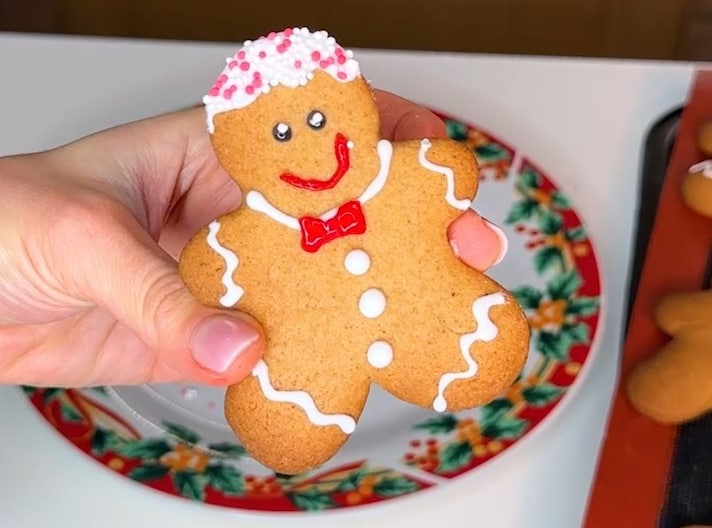
If we also combine this with the tale of Saint Nicholas and the ancient origins of the biscuits, given as a gift by Elizabeth I, it's easy to understand how these little men were very easily associated with Christmas. Pop culture, particularly American pop culture, took care of the rest, transforming a simple traditional biscuit into one of the most recognizable symbols of Christmas: films, TV series, and cartoons have played on the idea of a "sweet" that comes to life, directly inspired by the 19th-century fairy tale, and have transformed the biscuit into a recognizable and beloved image. Gingerbread men thus appear in every sweet shop, becoming tree decorations, garden lights, prints on socks and Christmas T-shirts, and even becoming film characters thanks to the animated film Shrek, where the character of "Gingerbread" is one of the first animated creatures encountered, a symbol of those fleeing an unjust fate.

