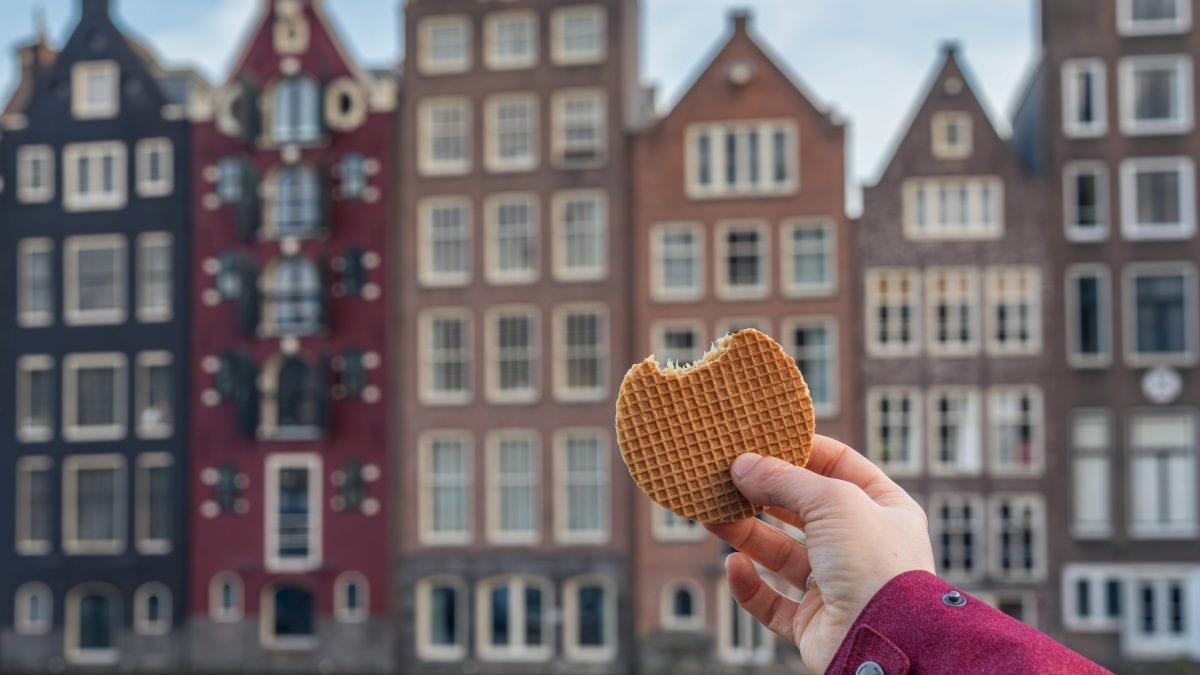
If you've ever wandered the streets of Amsterdam or any of the small, colorful Dutch towns, you've likely come across one of the country's most iconic desserts: stroopwafels. Two thin, golden wafers enclosing a sweet layer of caramel, perfectly fused together, creating a romantic connection that forever unites them. Let's explore their history and ingredients.
A Leftover Dessert That has Become a Symbol of Holland
Colorful streets, canals, vast fields of tulips, magnificent windmills: Holland has incredibly recognizable features and, like any self-respecting country, its own typical dishes. Among these, strolling through the streets or sitting in a café, you can taste the wonderful stroopwafel – literally "syrup waffle" in English – a typical Dutch dessert consisting of delicious caramel encased in a double wafer, very similar to a waffle.
It's not known with certainty when these delicious biscuits were invented, but the most reliable sources claim they first appeared in the early 19th century in the town of Gouda —a village that avid How I Met Your Mother fans will surely remember for the eponymous cheese so beloved by Marshall. The invention is attributed to a baker, Gerard Kamphuisen, who used leftovers from the products made in his bakery, combining them with a sweet syrup. For many years, however, this dessert—which we might call leftover—remained a specialty of the city of Gouda: dozens of bakeries prepared these delightful wafers sweetened with syrup. These small delicacies were particularly popular among the lower social classes who couldn't afford more expensive products: precisely because of their popularity among the less well-off, they were initially also called armenkoeken, literally translated as "poor man's biscuits."

As time passed, they became increasingly popular, so much so that after 1870, stroopwafels spread beyond the city limits, becoming a dessert known and appreciated throughout the country. Their success was also due to the invention of the waffle iron, which allowed the creation of exceptional waffles capable of perfectly enclosing the syrup inside. The decisive leap came in the 20th century when factories dedicated to their production began to emerge: as many as 17 opened in Gouda, four of which are still active today.
How Stroopwafels Are Prepared and Served
Making stroopwafels doesn't require particularly sophisticated ingredients: the wafers are made from flour, eggs, brown sugar, butter, milk, yeast, and often a little cinnamon. This dough is then placed on a hot griddle, which gives these cookies their typical shape. Once baked, while still warm, it is cut in half and drizzled with a mixture of syrup, brown sugar, butter, and cinnamon. It is then left to cool so that the two wafers remain firmly joined.
Even if it is left to cool, the best way to enjoy it is to warm it up slightly: traditionally, in fact, it is served placed on top of a cup of tea or coffee, so that the heat of the drink slightly melts the syrup inside, making the caramel even tastier. With their growing popularity, stroopwafels are now also made with different flavors, such as chocolate, fresh fruit, honey, pistachios or with delicious and creative toppings.

;Resize,width=767;)
