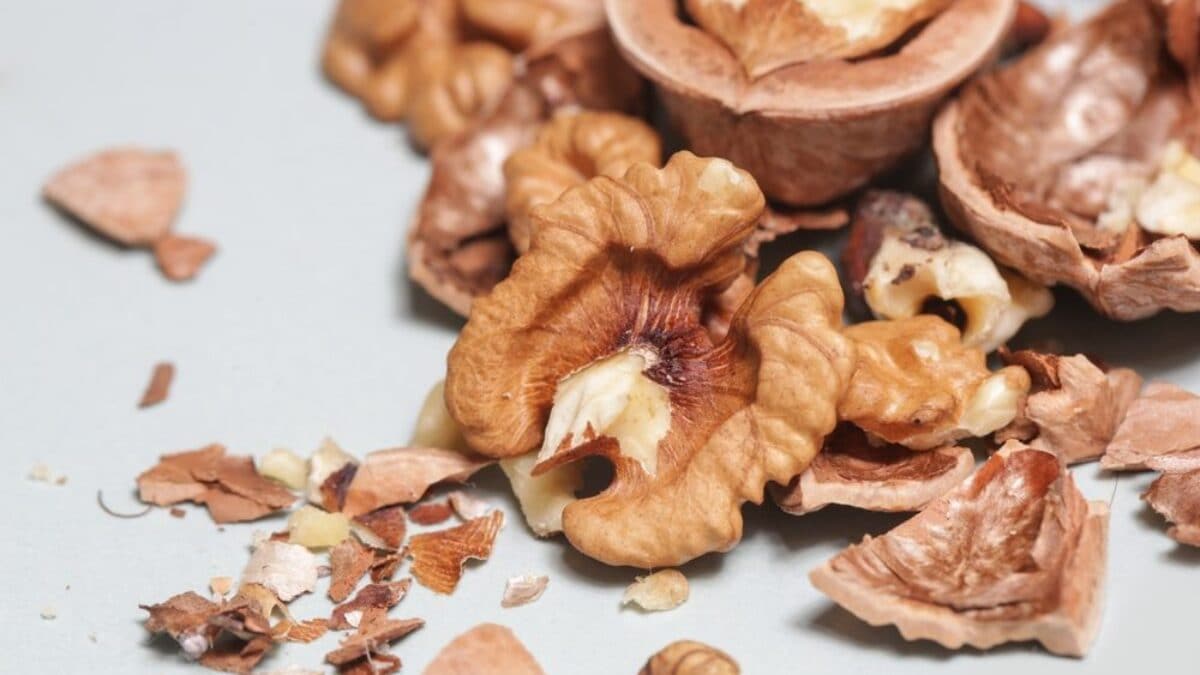
Cracking a walnut seems like a simple gesture: a sharp blow, the shell cracking, and, if you're lucky, the kernel emerging almost intact. But how many times have you destroyed the walnut while trying to crack it, resulting in a mixture of mushy kernel and shell fragments? You need to learn about conditioning, a technique that uses moisture to modify the way the shell and kernel react to cracking. This principle is also used in the food industry, and we can try it at home with a simple trick: briefly immerse walnuts in hot water before cracking them. It's not magic, it's science: what happens when a walnut encounters hot water? And why can moisture make the difference between a whole kernel and a handful of fragments?
What is Conditioning and Why It's Used Before Shelling Walnuts
Walnut conditioning is an ancient traditional technique, now a fully-fledged industrial method, aimed at bringing the nut to a specific moisture level before the shell cracks. The treatment involves controlled exposure to water and/or humidity and, more generally, regulating the nut's water content: the goal is to modify the shell's mechanical properties and create more favorable conditions for subsequent shelling. Several scientific studies demonstrate, in fact, that moisture content significantly influences the fracture behavior of both the shell and the kernel: an adequate humidity level can promote a more controlled cracking of the shell and limit fragmentation of the kernel, thus increasing the amount of whole product that can be recovered.

In other words, conditioning serves to achieve a compromise between two opposing needs: obtaining a shell prone to fracture while simultaneously maintaining the kernel elastic enough to withstand impact without excessively breaking. Conditioning the humidity before mechanical shelling can alter the shell's strength and the kernel's fragility, favoring, under the right conditions, the recovery of a greater quantity of whole kernels (so-called "half" nuts), which have a much higher commercial value than crushed pieces.
How Water and Humidity Affect Walnuts' Shell and Kernel
Industrial conditioning is generally carried out after the walnut has been dried and before shelling, restoring the nut to a controlled moisture content through water, humidified air, or other rehydration methods. The reason is essentially mechanical: during drying, the nut loses water, and its tissues become more rigid and brittle; subsequent exposure to humidity, however, allows the water to gradually penetrate the various components of the nut, altering its deformability and resistance to fracture.
Science itself confirms that moisture content significantly influences the way the shell and kernel fragment during breakage. In the shell, hot water doesn't simply act as a "softener": it modifies the mechanical properties of the shell, producing deformations and changes in its response to stress. The suture, the natural line joining the two halves of the shell, also plays an important role in nut breakage: its structure can influence the way the fracture develops, while variations in humidity alter the mechanical behavior of the shell as a whole.

In the kernel, however, water acts primarily on the viscoelastic properties of the tissues: by increasing the humidity, the kernel tends to become less fragile and more deformable, thus better able to absorb part of the impact energy without shattering. This is precisely the desired advantage of conditioning: to create a difference between the behavior of the shell and that of the kernel, so that the energy applied during shelling causes the shell to ideally break in half and, consequently, the kernel to remain whole. The action of water, however, is not enough to ensure an optimal result: it is essential that the humidity be perfectly controlled. Insufficient treatment leaves the kernel relatively dry and fragile, increasing the risk that the energy of the breakage will produce cracks and fragmentation; conversely, excessive rehydration can negatively alter the behavior of the shell and make the cracking process less efficient.
How Conditioning Helps Crack the Shell But Not the Kernel
The benefit of conditioning becomes particularly evident during shelling. When the nut is subjected to breaking force, the goal is not simply to "break" the nut, but to ensure that the fracture occurs primarily in the shell, avoiding transferring excessive energy to the kernel. Regulating humidity alters this balance: as we've explained, rehydration makes the kernel less fragile and more deformable, allowing it to absorb more of the energy applied during compression or impact. At the same time, the dimensional and mechanical changes induced by water in the shell, especially in the suture area, favor the initiation and propagation of the fracture along the structurally weakest line of the nut.

The desired result is therefore a sort of fracture selectivity: the shell must yield under stress, while the kernel must be sufficiently resistant and deformable to remain, as far as possible, in large, intact pieces. This aspect is particularly important because, from a yield perspective, not all breakages have the same value: obtaining two intact kernel halves is much more valuable, from a commercial standpoint, than producing numerous fragments.
How to Apply the Conditioning Principle at Home
Conditioning is now a fully-fledged industrial process, but that doesn't mean it can't be used at home; in fact, it's a trick that has always been part of home cooking tradition. How? The main mistake to avoid is too much time: soaking walnuts for too long doesn't necessarily lead to better results; on the contrary, they become too watery, compromising the quality of the product. The best way to proceed is to process small batches of walnuts at a time, immersing them in boiling water for about 2-5 minutes. Once drained, let the walnuts cool on a clean cloth and crack them open with a nutcracker, applying gradual pressure. Immersion in hot water can alter the shell's response to cracking and, in some cases, make it easier to extract the kernel, although the result depends on the characteristics of the walnuts and is not always guaranteed.

