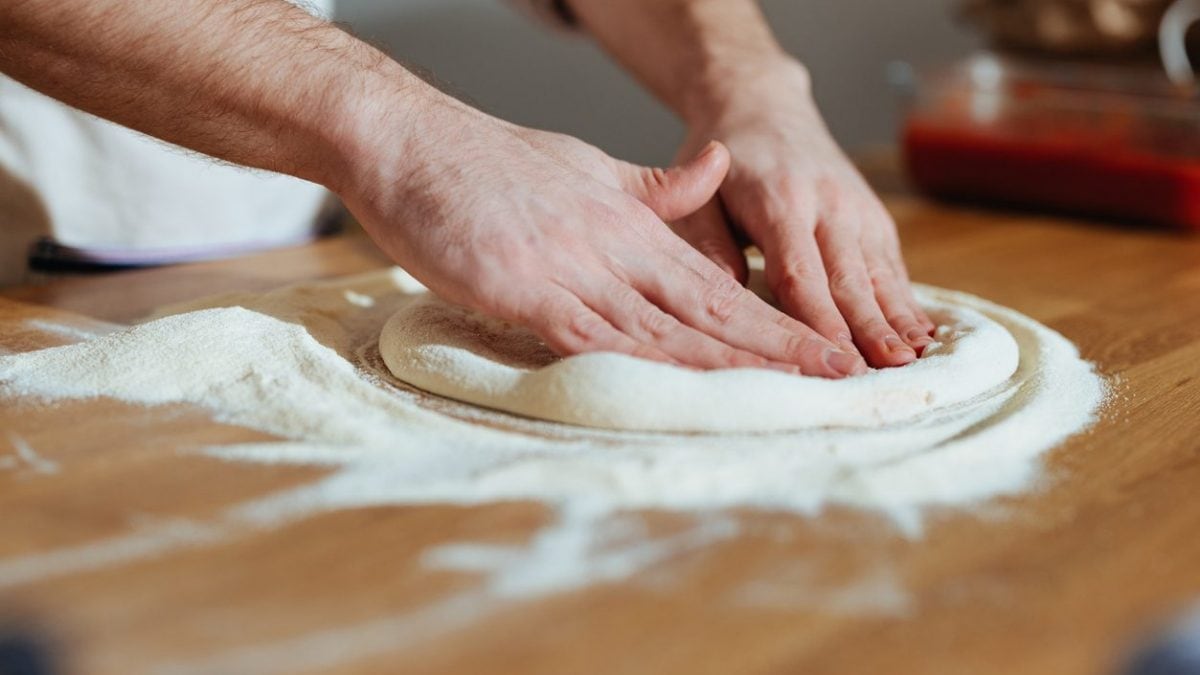
Making pizza is a true art: it requires technique, knowledge of the ingredients, and respect for leavening, maturation, and fermentation times. So, after collapsed dough, burnt pizzas, and wasted time, the thought of leaving everything and going to a pizzeria is strong, and we understand. But can you imagine the joy of making a pizza with your own hands? Watching that dough slowly rise until it becomes a soft, bubbly pile, being able to unleash your creativity with your favorite toppings—even the strangest ones, since no one can judge you—and letting yourself be overwhelmed, as it's cooking, by that aroma that fills the whole house, making your mouth water just thinking about it.
So, if you've been itching to make a pizza at home, we want to give you a little advice on one of the essential steps: rolling out the dough. But it won't be just us doing it, but three expert pizza chefs who have shown us how to roll out the dough for classic round pizza, in a pan, and with a rolling pin, for three different results that will blow your mind with their deliciousness. And we recommend you try them all.
How to Roll Out Classic Neapolitan Pizza
We could spend hours discussing which is the best, but what's certain is that pizza is undoubtedly one of the undisputed symbols of the city of Naples. So, who better than Giuseppe Borrelli, a true Neapolitan and founder of the pizzeria La Pizza Popolare in Milan, to explain how to perfectly roll out the classic round Neapolitan pizza? " Neapolitan pizza must be rolled out strictly by hand," Borrelli tells us, without hesitation.
But anyone who has ever tried making this type of pizza, or perhaps has simply seen someone make it, knows that the secret is all in the position of the hands, which must perform precise movements: "I recommend stretching it with the fingertips, crossing the index fingers and overlapping the hands, with movements that go from the center outwards, bringing all the air towards the edge." In a Neapolitan pizza, the edge, in fact, must absolutely be present, even if not excessively, which is why Borrelli suggests always staying "about a centimeter/centimeter and a half and no more" keeping "the leavening gases inside, but only in the edge: and this is the reason why this type of pizza must be stretched strictly with the hands and not with a rolling pin."

Even before rolling out the dough, however, there's a crucial detail that shouldn't be overlooked: dusting it. Before placing the dough on the work surface, it needs to be floured to prevent it from sticking to the surface, but choosing the right flour is essential. The most classic and well-known 00 flour, in fact, can hide some pitfalls: with this type of flour "you have to be careful because, if there's too much underneath, we risk it burning when we cook it." So, if you're a beginner and don't feel so fearless yet, you can also use "rice flour, which doesn't burn and there's no risk of leaving that bitter taste in the mouth, typical of burnt flour." But Giuseppe gives us one last tip on this matter: if you prefer "a crunchier effect, you can use semolina, which makes the base a little more golden."
In any case, however, the important thing is that there isn't too much flour on the base: a risk that unfortunately can occur with this type of dough. Therefore, it also becomes essential to correctly lift the dough from the container in which we left it to rise: once lifted, you need to turn it over and place the top side on the counter, because since there is water in the dough "the moisture that is created stays underneath and if you place that side in the flour, the risk is that it absorbs too much. However, if you notice that too much flour is stuck to the base, you can give it a few slaps to make it fall and then place it in the pan."
How to Roll Out Pan Pizza
With the round pizza, it only shares the use of hands: otherwise, the stretching of pan pizza has different and quite precise procedures. Federico De Maria, owner of the pizzeria I Vesuviani, Tre Spicchi Gambero Rosso, together with his brother Francesco, explained to us in detail what to do (and not to do) when making a wonderful pan pizza. As we were saying, like the Neapolitan version, pan pizza should also be stretched by hand, with the fingertips to be precise, "as if you were playing a piano," Federico tells us romantically. In this case, however, "we completely press down the edges and evenly distribute the air —which we have created with maturation and leavening —inside the dough." This is also the reason why it should absolutely not be rolled out with a rolling pin because that air that we managed to obtain with so much effort, and even with a little terror, serves to give "that softness, that melting feeling to the bite, making us perceive the crunchiness on the outside, remaining practically ‘empty‘ on the inside".

For dusting, Federico recommends re-milled durum wheat semolina to give the dough that unique crunchiness. He also recommends not using 00 flour "because, having a very, very fine grain, it risks sticking to the dough and causing that bitter taste in the mouth, while the semolina almost completely disappears." He also offers a tip for technique, because you can't just throw in a little semolina and it's done, but you need "plenty of semolina, both on top and under the pizza. This must then be spread out by hand, lifted from the counter and then shaken off entirely—to remove the excess semolina —to finish rolling it out directly on the pan, filling the entire available surface." However, it could happen that, once you've started rolling out the dough, the dough, in the grip of hysterical tantrums, decides it doesn't want to roll out and begins to slowly shrink. In that case, don't force it too much, as you risk tearing it and ruining your hard work. "If the dough shrinks," Federico advises, "roll it out as far as you can, then let it rest for 10 minutes and continue rolling it out, and continue like this until you get the size you want."
How to Roll Out Pizza With a Rolling Pin
This type of pizza is precisely the one that goes against the grain, because if until now we have denigrated the rolling pin by saying that it removes all the air and therefore the pizza doesn't rise, doesn't form a crust, and so on, here we want to restore some dignity to this tool which, even in the world of pizza, is capable of creating an exceptional product. Luca Pezzetta, one of the masters of Roman flatbread pizza, founder of three restaurants in Fiumicino, the Clementina pizzeria, the Ippolito osteria and the Micro Forno bakery, and of a brand new opening in Milan, Futura – Pizzeria Romana, tells us about it.
While each pizza has a different rolling method, the typical Roman pizza "traditionally is rolled out with a rolling pin" because, unlike the ones we mentioned above, "it must be thin and the edge must be pressed well so that it also burns a little, which is also one of the characteristics of this type of pizza." The use of a rolling pin, however, must not affect the quality of the dough in any way. For Luca, however, it is extremely important "to respect the maturation and leavening, in the sense that just because I use a rolling pin does not mean I need to use a less mature or under-leavened dough," so a lot of effort and a watchful eye are required "because one of the most important things is always having a good basic product."

For dusting, Pezzetta agrees with his colleagues and recommends "re-milled semolina because, having a greater resistance to heat, it doesn't burn and doesn't risk leaving a bitter taste, which can happen with flour." Then, after letting the dough rise, place it on the surface covered with semolina and begin rolling it out with a rolling pin, which should be "preferably wooden because it's more porous and manages to give that sort of rough side to the dough, so that the condiments stick well."
Even in this case, if the dough should shrink, it is best to let it rest a bit, even if for Pezzetta this is a sign that there have been "procedures done poorly, because it happens when the dough has excessive strength, because, for example, it has been kneaded too much, or when it has not reached the right maturation, such as to be able to relax and do its job". If you notice it too late, however, calm down and don't panic: "Let it rest a bit, let it relax, so that it loses that excessive strength making it easier to roll out". Continue, therefore, until you obtain a pizza with a thickness of "2-3 millimeters, a sheet of paper essentially", and transfer it "onto an iron baking tray – better if the blue iron one – which, unlike the aluminium one, has a greater heat dissipation and therefore manages to cook the pizza evenly" and go to baking.
Bonus Tip: When Should You Add Toppings?
It doesn't strictly speaking concern the dough, but our experts wanted to offer one final tip on the right time to add the toppings, which we're happy to share. "The toppings should be added right from the start, especially when making homemade pizza because cooking takes longer and we need to avoid drying out the base," explains Pezzetta. To avoid this, De Maria tells us to add "if it's white, just oil, while if it's red, tomato," which, according to Borrelli, "can even be raw —a San Marzano would be perfect, crushed a little with your hands—and cooked directly in the pan."

In any case, everyone agrees on one thing: add mozzarella only halfway through cooking— "just like other slightly more sensitive ingredients that don't tolerate long cooking," Federico points out—because the heat risks making it darken too much, as happens with lasagna. So, Luca concludes, "it's best to cook the tomato base until 50% done, then add a little mozzarella, let it melt, and remove from the oven." And the result will be exceptional, no matter what method you use.
;Resize,width=767;)
