
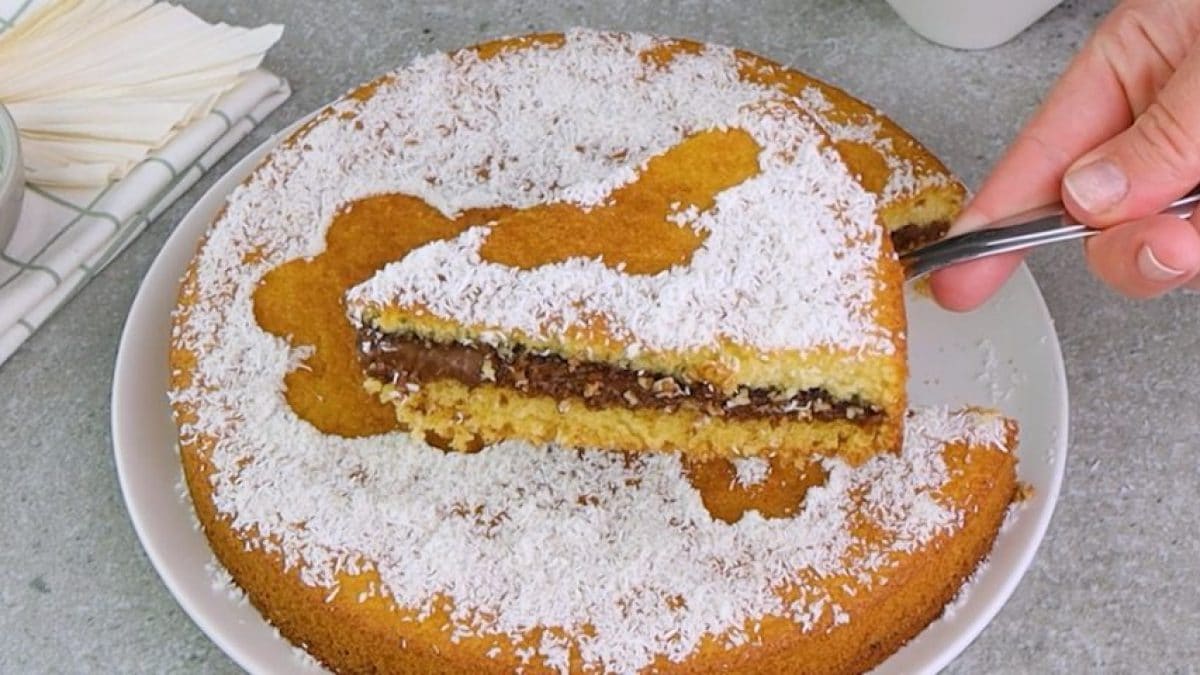
A single slice of this Upside-Down Coconut & Chocolate Cake delivers a toasted coconut and a hazelnut taste. This dish is built from two quick sponge halves, one baked, then slathered with a rich hazelnut cream, topped with the second half, and finished in the oven.
During a cold day, you can enjoy his dessert with afternoon tea, or after dinner. Bakers and chocolate lovers who appreciate a nutty twist will adore this one.
What is Upside-Down Coconut & Chocolate Cake?
This cake is a two-layer sponge constructed like a sandwich. Each half is baked separately in the same pan, then joined with a generous layer of hazelnut cream in the middle. After the final bake and a careful unmolding, the top becomes an “upside-down” decorative surface scattered with coconut grains. This gives it the look and aroma of tropical desserts.
Upside-down cakes historically feature fruit, where the topping is placed in the pan before the batter. But this dessert uses shredded coconut as the decorative topping and layers the cake with hazelnut cream for a European-style twist.
Pro Tips for the Best Upside-Down Coconut & Chocolate Cake
- Use room-temperature eggs, they whip better and produce a lighter sponge.
- Measure flours by spooning into the cup and leveling, or better yet, weigh them.
- Don’t overmix once you add the flours, just mix until just combined to keep the cake tender.
- If your hazelnut cream is very thick, warm it for 10-15 seconds in the microwave so it spreads smoothly.
Frequently Asked Questions
What kind of flour should I use?
All-purpose flour works perfectly well. The recipe also uses coconut flour, which is finely ground dried coconut flour and not shredded coconut. If you only have desiccated coconut, the texture will change and should be treated as a different ingredient.
Can I substitute coconut milk with regular milk?
Yes, whole milk will work, but coconut milk enhances the coconut flavor. If using a non-dairy milk, choose a thicker variety for a similar texture.
My cake sank in the middle, why?
This can be caused by overbeating after adding flour, which deflates the batter, opening the oven repeatedly while baking, or under-baking. So, make sure oven temperature is accurate and follow the bake times, checking for a clean toothpick.
Can I use store-bought hazelnut spread?
Nutella or any hazelnut-chocolate spread is an easy, delicious option. Warm slightly to make spreading easier.
How to Store This Cake
Store at room temperature, covered, for up to 2 days. If your kitchen is warm or your hazelnut layer is perishable, refrigerate in an airtight container for up to 4 days. Let the chilled cake sit 20–30 minutes at room temperature before serving.
Ingredients
How to Make Upside-Down Coconut & Chocolate Cake
;Resize,width=712;)
Mix in vegetable oil and coconut milk. Add in flour, coconut flour, and baking powder, and mix.
Crack the 4 eggs into a bowl and add 140 g sugar. Using an electric mixer, beat until the sugar dissolves.
;Resize,width=712;)
Pour one half of the batter into a cake mold and bake at 180°C/360°F for 20 minutes.
Mix in vegetable oil and coconut milk. Add in flour, coconut flour, and baking powder, and mix.
;Resize,width=712;)
Remove the pan from the oven and spread a generous layer of hazelnut cream over the baked half.
Pour one half of the batter into a cake mold and bake at 180°C/360°F for 20 minutes.
;Resize,width=712;)
Carefully pour the remaining batter over the hazelnut cream, smoothing to cover. Return the cake to the oven and bake another 20 minutes at 180°C/360°F.
Remove the pan from the oven and spread a generous layer of hazelnut cream over the baked half.
;Resize,width=712;)
Unmold the cake, transfer to a serving plate, sprinkle coconut grains, and slice.
Carefully pour the remaining batter over the hazelnut cream, smoothing to cover. Return the cake to the oven and bake another 20 minutes at 180°C/360°F.
;Resize,width=712;)
Unmold the cake, transfer to a serving plate, sprinkle coconut grains, and slice.
;Resize,width=767;)
