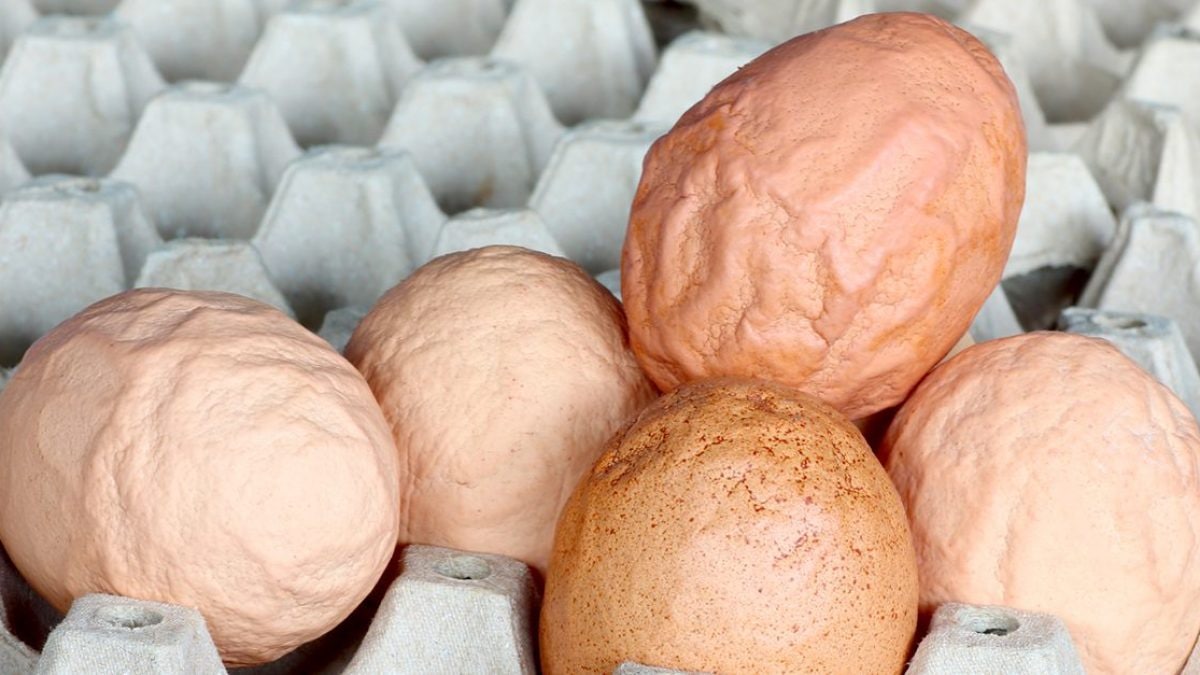
The world of eggs is a multifaceted one, full of unexpected surprises: for example, did you know that there are eggs with shells colored green, blue, or brown? Nothing unusual, just a peculiarity that depends on the breed of chicken that lays them. The same goes for another mutation you might encounter when opening your egg collection: the egg with a wrinkled, lumpy shell. This particular egg isn't easy to find, but it's not so rare that it never appears. What causes the egg to have a shell that isn't as smooth as it should be, but is it all wrinkled, almost dented? And above all, is it safe to eat? Let's find out together.
Why Does It Happen and Is a Wrinkled Egg Edible?
If the egg has a shell with a non-linear surface, with wavy folds and irregular dents, it means that it has undergone double calcification before being expelled by the hen: in practice, the animal unknowingly "interrupted" the egg production process for a brief moment, then production resumed and therefore the egg in question has greater calcification, making the surface irregular, thicker and more robust.

There are various causes that trigger this rapid interruption in egg formation: it may depend on the hen's biology, her age, but above all, it is the result of sudden episodes of stress the animal experiences. Hens are sensitive animals, and anything can be a source of stress, such as a very loud noise (even a simple clap of thunder or the passing of a plane), the sight of a predator, or even sudden changes in temperature between hot and cold. In short, any noise or sudden event that causes a minor shock to the animal can lead to double calcification and, consequently, the formation of a wrinkled egg.
How should you behave in these cases? The exact same way you would with a "normal" egg: the fact that the shell is wrinkled has no impact whatsoever on the yolk and egg, which form at a different stage than the shell and are not affected at all by the casing. For this very reason, even eggs with colored shells have an identical interior to a regular egg. So don't worry, if you encounter a wrinkled egg, you can eat it without any problems and cook it in dozens of tasty recipes just like you would with an egg with a perfectly smooth shell.
;Resize,width=767;)
