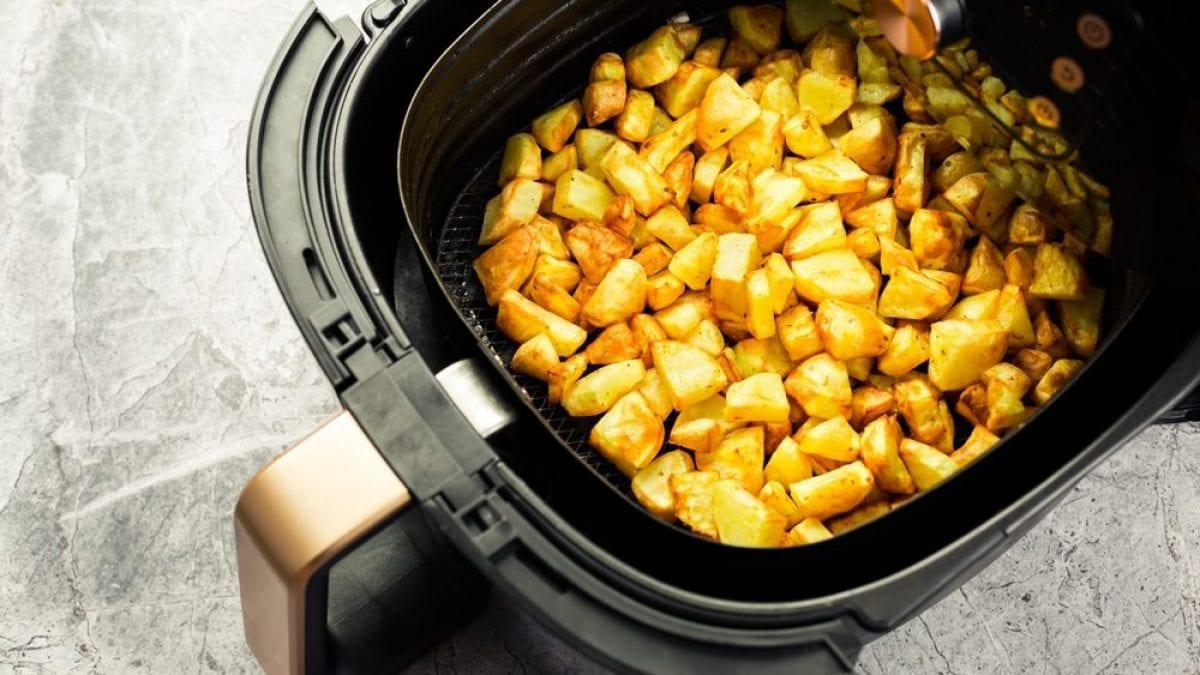
The air fryer is one of the must-have appliances of recent years, an object of desire that began to creep into people's dreams in the two years preceding the lockdown and which has seen a sales boom since 2020 that shows no signs of slowing down. The reason? Without a doubt, the initial credit goes to an excellent marketing strategy, which focused on the fact that you could fry foods without using oil, achieving the same type of cooking as deep-frying, but with healthier options, since no fat was used, or if there was, it was in very small quantities.
As consumers learned to use the air fryer, they increasingly realized that the food they were faced with wasn't exactly like that immersed in liters of oil— crumbly, crunchy, and tasty —but was closer to the result you can achieve in a convection oven, where time and energy consumption are, however, reduced thanks to the smaller size of the chamber. In this way, the air fryer didn't replace the traditional fryer, but established itself as an alternative —but not a replacement—to the home oven, as it proved useful not only for simulating the deliciousness of French fries, as its inventor, Dutchman Fred van der Weij, had hoped, but also for taking advantage of different cooking methods, such as roasting and grilling.
With the evolution of models, in fact, now in the air fryer you can prepare an (almost) endless number of sweet and savory dishes, from chocolate cake to muffins, including vegetables, omelettes, burgers and even pizza. So let's see how it works, what the differences are compared to the oven, how to regulate the oil and how to prevent small inconveniences, such as dry or burnt food.

What is an Air Fryer and How Does It Work?
Air fryers can be defined as mini convection ovens that use hot air as a heat carrier: this is the substantial difference from the traditional fryer, which relies on the transmission of heat through a fluid, namely oil, for cooking. The main elements that make up the air fryer and contribute to its unique characteristics are:
- The cooking chamber: this is where the food is cooked and can be compared to that of a convection oven. Inside is the heating element, usually located at the top—though there are also models with double heating elements at the top and bottom—which serves as the air fryer's heating element: it is therefore the point from which the heat originates. The appliance reaches the desired temperature very quickly, and this is where the fan comes in, the key component that circulates hot, dry air inside the chamber, forming a vortex that envelops the food, creating that attractive crust that makes it crispy (almost) as if it were fried.
- The cooking basket: this is the support that holds the food, an accessory that is inserted into the cooking chamber, like a baking tray or ovenproof dish. It is characterized by its practicality, usually featuring a handle that makes it easy to insert and remove from the fryer without burning yourself. Depending on the model, the basket has a perforated surface that allows any fat to drain away. It can be single or have dividers that allow for multiple cooking operations at once. It can be fixed or rotatable.
- Digital display: Most air fryers now have an LCD screen that allows you to easily set the cooking program, selecting the temperature and timing to monitor the progress, even remotely. More advanced models can be controlled via a smartphone app, even with the help of voice assistants like Alexa.

Air Fryer Vs. Oven
We've seen that the air fryer cooks by convection. This has nothing to do with a static oven, which works by radiation: this means that for foods that perform best in a static mode, such as leavened products like bread, focaccia, sponge cake, or puff pastry, it's better to rely on the traditional method, to avoid unsatisfactory results. The comparison is with a convection oven.
- Energy efficiency: this is the aspect that continues to attract much interest in the air fryer. Both are among the most energy-hungry appliances, and on paper, the air fryer consumes more, given that its power output is between 1200 and 1700 watts, while the electric oven is between 900 and 1500. The fact is that the former significantly reduces cooking times, even by 50%, thus having a smaller impact on the energy bill.
- Timing: The air fryer reaches extremely high temperatures, even 390°F-465°F/200°C-240°C in a matter of seconds, unlike the oven, which requires several minutes. Certain recipes in both situations require preheating, but even in this case, the fryer heats very quickly and the oven takes much longer. To give some practical examples: a whole chicken cooks in the air fryer for approximately 50 minutes, and in the oven for 120. Or meatballs: the former takes just 20 minutes, the latter 40.
- Capacity: Ovens range in size from 50 liters for standard ovens to 35 liters for smaller ones, while air fryers offer a wider variety of options. Models range from 2 to 8 liters depending on the number of people they're designed for, but they're still much smaller and therefore easier and quicker to clean: including the basket and any grill, the process takes no more than 10 minutes. Some ovens are even dishwasher safe, but it's best to read the instructions, as not all materials are dishwasher safe.
Is Oil Necessary or Not?
A myth needs to be dispelled: many air fryer recipes require oil. The good news is that the quantities used are significantly smaller compared to the original version, so much so that they're practically negligible in terms of health, considering we're talking about 1 or 2 teaspoons, no more. Since not all air fryers are the same, the way to use oil varies depending on the model, but most often the recommendation is not to pour it directly into the basket, but to brush the fat evenly over the raw ingredients. Then, there are foods that generally do not require further use, such as, for example, those that have already been pre-fried (such as nuggets or frozen chips), marinated foods (such as chicken wings), as they are already seasoned, and breaded foods, in which a little extra virgin olive oil is found in the mix of breadcrumbs and/or parmesan and herbs, such as in air-fried zucchini.

How to Use the Air Fryer For Great Results
Convenient, practical, versatile: the air fryer has several advantages that have made it a valuable ally in the kitchen, with a popularity on par with that of robots and Thermomixes. However, it is necessary to take some small precautions to avoid ending up with dishes that do not meet expectations. The first thing is to choose the model based on your needs, because there are common mistakes that can be avoided with the right tools: one above all, miscalculating the capacity, with the risk of overfilling or underfilling the basket. This will cause uneven circulation of hot air, resulting in incorrect cooking that leads to dryness or burning of the food or to still-raw parts.
To prevent food from sticking to the basket due to the extremely hot air, you can place a sheet of parchment paper on the bottom (as in our omelette) or use a cooking spray. It's also a good idea to never stack foods (like chicken nuggets) and to shake the basket a couple of times to ensure the heat reaches all sides. It's essential to clean the basket after each use to avoid food or grease residue, and also check the condition of the fan: it's possible for foreign objects to get stuck, causing a malfunction.
;Resize,width=767;)
