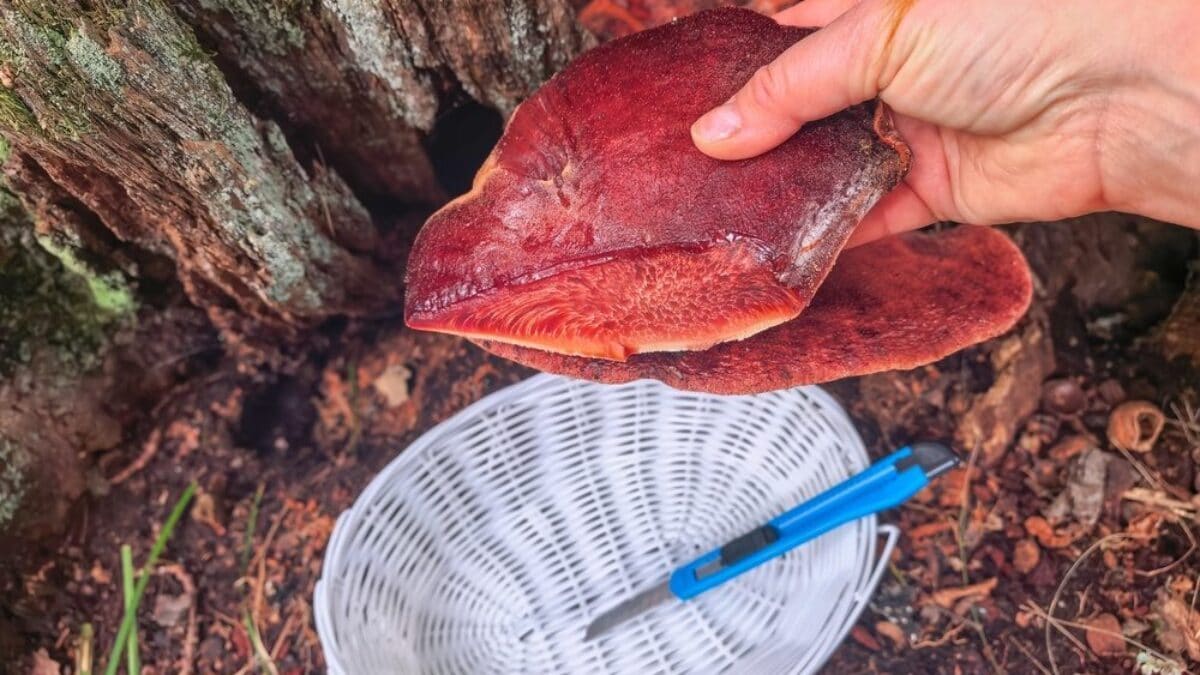
There are countless species of mushrooms, some well-known and more common in appearance, others decidedly unique. Yet you shouldn't always be fooled by their shape: some mushrooms, despite their strange appearance, are edible and even very tasty. The beefsteak mushroom is undoubtedly one of these: its unusual and almost curious appearance immediately catches the eye, distinguishing this mushroom from the more familiar shapes you're used to. This peculiar mushroom grows silently on the wood of trees and almost seems more at home on the trunk than in the undergrowth, where it often remains hidden until its distinctive shape and color make it impossible to ignore.
It is a presence associated primarily with mature forests, where time has left its mark on the trees and created ideal conditions for the life of numerous organisms. But the beefsteak mushroom is not only interesting for its appearance: nature, tradition, and gastronomy meet around this particular species, in a relationship with the forest that has its roots in the culture of wild mushroom picking. Its texture, flavor, and culinary uses have contributed to making it a gastronomic curiosity, especially when picked at the right stage of development. Because yes, the beefsteak mushroom is an edible mushroom, but not in all its life stages: for this reason, before picking it, it is good to know all its specific characteristics.
What is a Beefsteak Mushroom
Beefsteak mushroom, known by its scientific name of Fistulina hepatica, is a truly unique mushroom, impossible to mistake for due to its fleshy appearance and characteristic shape, which resembles a tongue protruding from the trunk. It belongs to the Fistulinaceae family and is a lignicolous species, meaning it is closely linked to wood, where it grows as a parasite and subsequently as a saprotroph, contributing to the progressive degradation of dead wood. Its fruiting body generally appears on the trunk or at the base of mature or felled trees, developing directly from the bark with an initially rounded shape that then tends to widen and take on the appearance of a fleshy shelf.
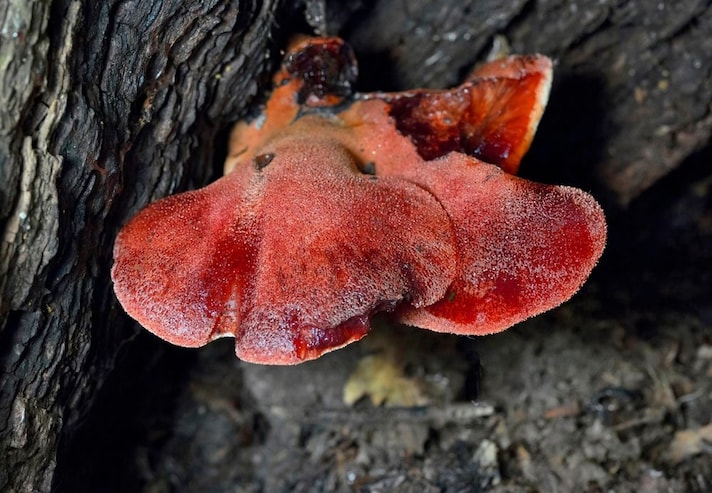
The upper surface is moist and smooth, bright red, orange-red, or red-brown in color, and can darken as it ripens. Its texture is soft and juicy, so much so that when cut, it visually resembles meat. One of its most interesting features is the color of its pulp, which, when cut, can leak a reddish liquid, further contributing to its characteristic resemblance to a piece of meat. The lower surface is also unusual: instead of the classic gills, it features a unique hymenophore, made up of clearly separated, non-fused cylindrical tubes that end in small pores from which the spores emerge. In terms of habitat, Fistulina hepatica is primarily associated with broadleaf forests, particularly oaks, which are one of its most typical hosts, but it can also grow on chestnut trees and other hardwoods. However, it should be looked for not at the base of the trees like a classic mushroom, but on the trunk itself. Large trees in particular, bark wounds, cavities, and areas of damaged wood can provide favorable conditions for the fungus to thrive. Oxtongue tends to appear on old or weakened trees and can also grow near the crown and exposed roots.
From an ecological perspective, it plays an important role in wood transformation, contributing to the decomposition of organic matter and natural turnover within the forest ecosystem. Its appearance is generally concentrated between late summer and autumn, although fruiting can vary depending on the season and humidity conditions. In chestnut and oak groves, therefore, encountering an oxtongue means encountering one of the most characteristic inhabitants of mature wood: an unusual-looking fungus, with a biology closely linked to trees, capable of transforming a seemingly immobile trunk into a small hub of ecological activity.
"Young" Beefsteak Mushroom's Flavor, Consistency and Characteristics
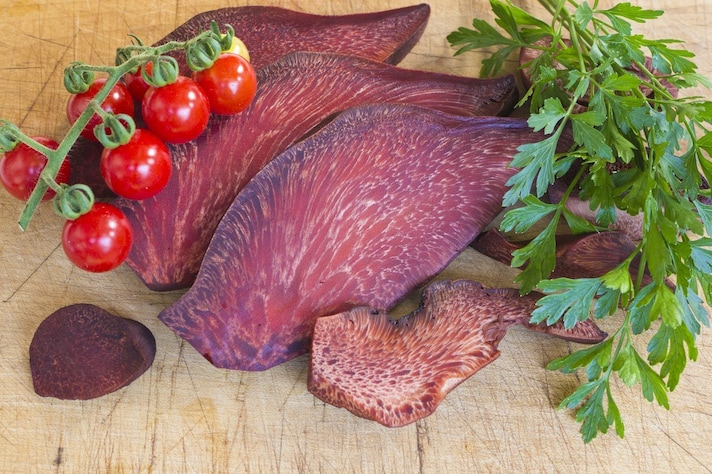
The beefsteak mushroom is not only ecologically important, but it is also edible, albeit with some caution. The best-to-eat mushrooms are the young, developing ones: not that it becomes dangerous as it ages, it's simply less tasty. When still developing, in fact, it has a soft, firm, and very meaty consistency, with moist, juicy flesh that, even at the first cut, displays its characteristic pinkish-red color, sometimes interspersed with lighter veins. It is precisely this unusual texture, unlike the more fibrous or dry texture of many other woody species, that gives rise to the curious comparison with meat and the common name "beefsteak."
Flavor-wise, young beefsteak is distinguished by a delicate yet distinctive flavor, generally described as tart, fresh, and slightly fruity, with a hint vaguely reminiscent of marinated meat or certain tart fruits. The aromatic intensity is not particularly aggressive and tends to be more pleasant when the mushroom is eaten while still young, before the flesh loses its softness and becomes progressively tougher. Consistency is, in fact, one of the key aspects in understanding its gastronomic quality: as it grows, the fruiting body tends to become thicker and less tender, while in young specimens, the flesh is juicier, more elastic, and easier to work with, characteristics that favor its use in cooking.
How to Eat Beefsteak Mushroom
To best appreciate its organoleptic characteristics, therefore, young specimens generally offer the best balance between tenderness, juiciness, and intense flavor: a still-soft flesh, a recognizable but not necessarily dominant acidity, and a structure that highlights the uniqueness of this mushroom, halfway, at least in appearance and texture, between the world of mushrooms and that of meat. As it matures, however, the flesh tends to become more fibrous and leathery, losing the soft, meaty consistency that characterizes the finest specimens from a gastronomic standpoint.
One of the most interesting features of this mushroom is its ability to be eaten raw, a traditional practice associated primarily with young, fresh specimens. In this case, the mushroom is generally carefully cleaned, the tough outer layer and the lower surface removed, and then thinly sliced. The pulp, naturally acidic due to its high vitamin C content, is simply seasoned with a drizzle of extra virgin olive oil, salt, and a pinch of pepper.
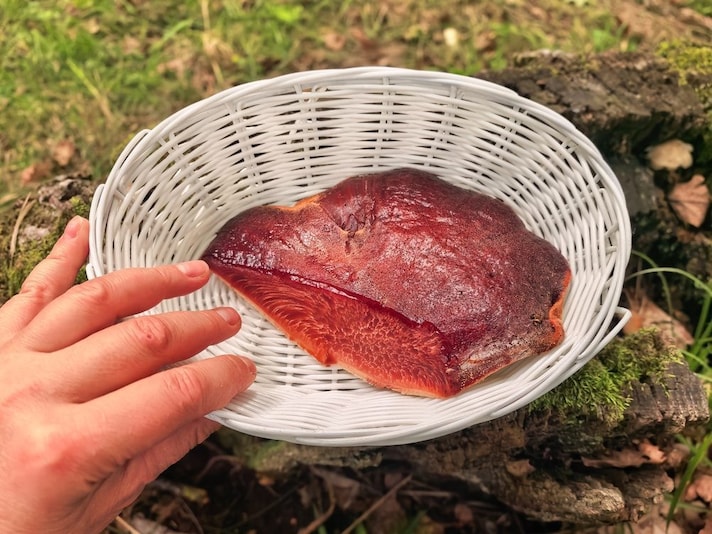
Beefsteak mushroom is also suitable for cooking, which changes its consistency, making it firmer and intensifying some of its aromatic characteristics: it can be sautéed, grilled, fried, or breaded, as well as used in various mushroom-based preparations. As with all wild mushrooms intended for consumption, consumption must be preceded by correct identification of the species and a careful evaluation of the specimen's condition: the edibility of beefsteak mushroom does not, in fact, preclude the normal precautions necessary when collecting and consuming wild mushrooms.
How to Collect and Store Wild Beefsteak Mushroom
Harvesting beefsteak mushroom, like any other wild mushroom intended for consumption, requires special care. The first and most important precaution is the certain identification of the species: the characteristic appearance of beefsteak mushroom can facilitate recognition, but relying solely on photographs, images found online, or simple similarity to a description is not enough. If there is even the slightest doubt about the identity of a mushroom, it is best not to consume it and instead have it examined by a qualified mycologist or by the appropriate mycological services of the local health authorities. Professional inspection is particularly important for wild mushrooms, because edibility cannot be determined based on a single characteristic, but requires an evaluation of the specimen's morphological characteristics as a whole.
Harvesting must also be done with care, choosing fresh, intact, and healthy specimens, avoiding those that are deteriorated, moldy, or infected with larvae. Naturally, any local regulations governing quantities, times, and methods of harvesting must be respected. Once harvested, mushrooms should be placed in rigid, well-ventilated containers, such as traditional baskets, avoiding plastic bags, where humidity and heat can promote rapid deterioration. It is also good practice not to overcrowd specimens and to protect them from crushing and impact during transport. At home, mushrooms should be cleaned carefully and stored in the refrigerator for quick consumption; if you wish to freeze them, it is essential to pre-cook or blanch them first to prevent them from losing their texture and flavor as they thaw. Refrigeration slows deterioration, but does not make an old or spoiled mushroom edible again. Therefore, it is important to pay attention to the texture, odor, and general condition of the specimen and discard any that show obvious signs of deterioration.
When it comes to consumption, it's essential to follow the recommendations of health authorities and experts, especially when considering raw preparations. Just because a species is traditionally eaten raw doesn't mean any specimen collected in the wild can be eaten without precautions, or that you can eat it in abundance without moderation. Safety therefore begins in the forest, but continues all the way to the kitchen: correctly identifying the species, collecting healthy specimens, transporting them in suitable conditions, storing them properly, and, if in doubt, having them examined by a mycologist are essential steps to approaching the consumption of wild mushrooms with the necessary awareness. Knowledge of the species and adherence to correct harvesting and consumption practices are not only a guarantee of food safety (essential, given that many toxic and poisonous mushrooms exist), but also a tool for engaging in a responsible relationship with the forest, avoiding indiscriminate harvesting and preserving the balance of the natural environment in which these organisms play a vital role.

