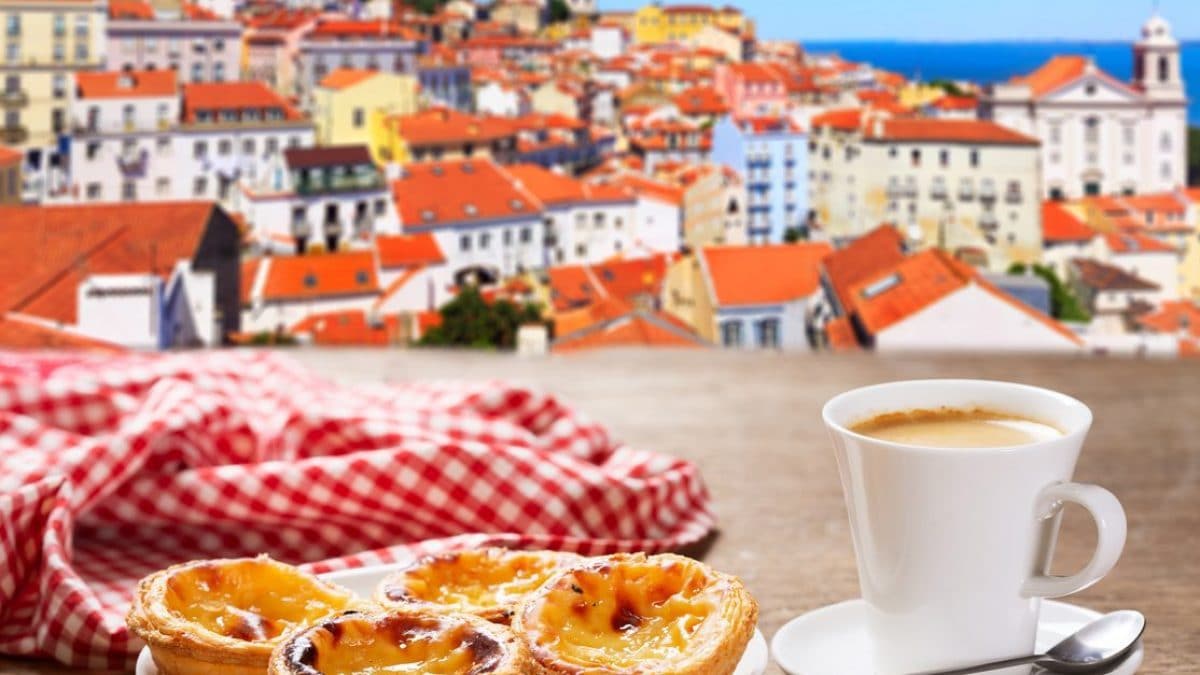
Some say Lisbon is best explored with a cup in hand. But not just any cup: we're talking about bica, the Portuguese espresso that's as much a part of Lisbon's daily life as fado, the ocean, and the yellow trams. Behind this little café lies a curious story, made up of customs, linguistic anecdotes, and a taste that smacks of Mediterranean tradition with a local twist.
What is Bica, Portugal's Espresso
Those visiting Portugal for the first time may be surprised when, upon ordering a coffee, they're asked, "Uma bica?" In reality, there's nothing strange about it: bica is essentially the Portuguese equivalent of the Italian espresso, but with some substantial differences. The coffee is slightly longer and less intense, with a smoother and more balanced flavor, often the result of a different (less dark) roast and a lighter blend. The result is an espresso that's enjoyable to drink even without sugar—although many still prefer to add it.
According to a widespread (but unconfirmed) story, the word "bica" is an acronym for "Beba isto com açúcar," meaning "drink this with sugar." It was supposedly the slogan used in 1905 by a famous Lisbon café, A Brasileira, to persuade customers to try a stronger-than-usual coffee with more bitter notes. Legend has it that the term later entered common parlance, becoming synonymous with espresso. True or not, the story has the charm of those popular inventions that cling to culture like the aroma of coffee clings to the walls of a café.

Where Was Bica Born and When Is It Drunk?
The birthplace of bica is Lisbon, where coffee is much more than a break: just like in Italy, it's a social act, a daily gesture charged with meaning. It was in the capital that this term began to be used, while in northern Portugal, especially in Porto, the same drink was called "cimbalino," derived from the Italian La Cimbali coffee machine used in bars at the time. This detail underscores the importance of Italy in the spread of espresso coffee in Portugal.
In Lisbon, bica is consumed at practically all hours of the day. In the morning, on the go while standing at the bar; after lunch, as a digestif; in the afternoon, with a pastel de nata on the side. It's a drink that marks the day naturally and unhurriedly, even if it often lasts only a few seconds. It's almost always served in a piping hot cup, with sugar on the side (which many stir, even just out of habit), and accompanied by a small glass of water, especially in the more traditional cafés.

Bica's Variations
Despite being a "simple" drink, bica has several variations, each with its own logic. Among the most common are:
- Bica cheia, or a “full” bica, that is, longer: similar to a long coffee.
- Bica curta, the most concentrated version, similar to an Italian ristretto.
- Garoto, half a bica with a little hot milk: the equivalent of a macchiato.
- Galão, or a latte in a glass;
- Pingado, a bica with a drop of cold milk: basically the cold macchiato, but with less milk.
- Abatanado, similar to American coffee: an espresso diluted with hot water.
- Carioca, a lighter bica, that is, with less coffee.
Each name speaks to a habit, a personal taste, a cultural nuance. And, as often happens with coffee, ordering the right drink is also a way to make yourself known, to say: "I live here, I'm not just passing through."

