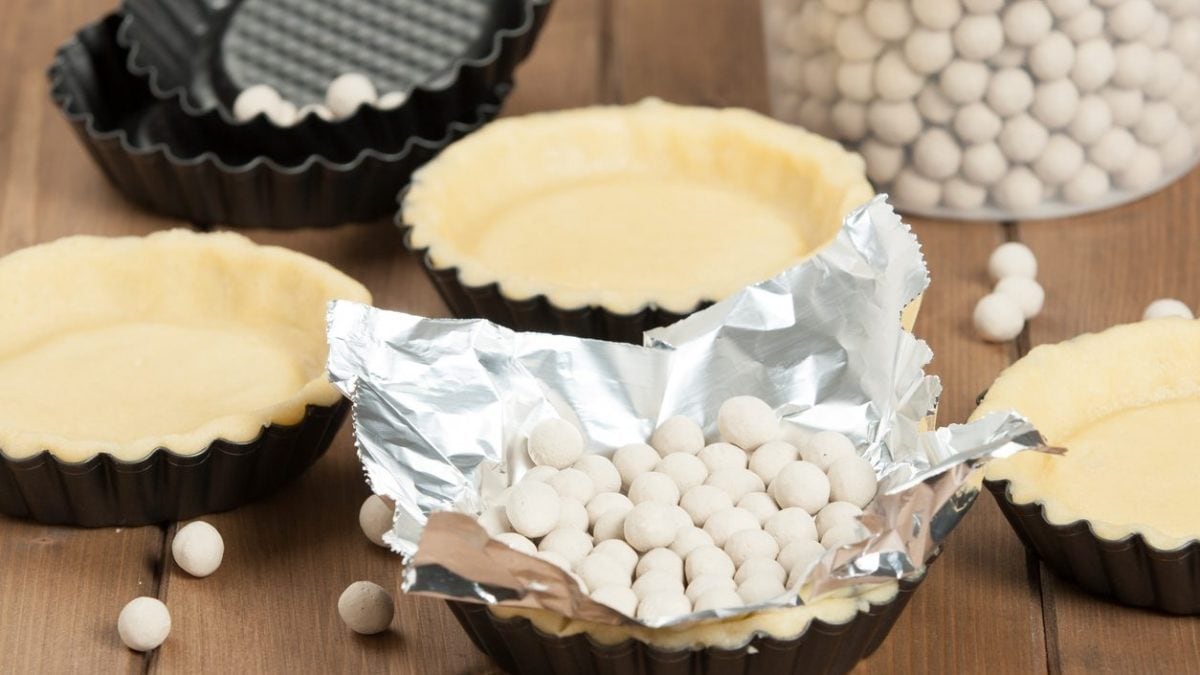
Anyone who tries their hand at making tarts and savory pies knows it: sometimes the crust remains undercooked, even falling apart when unmolding. This happens especially when you have a very rich, creamy filling that requires a base capable of supporting it. Blind baking was created precisely to avoid these problems and achieve perfect crusts, covering the surface with ceramic or legume weights to prevent shortcrust pastry, brisée, or puff pastry from swelling while baking. In short, it's a simple yet valuable technique, suitable for both sweet and savory, that improves the outcome of many recipes: let's see what it is and how to do it.
What is Blind Baking?
Blind baking is a technique used to bake only the crust to prepare pies, tarts, tartlets, or savory pies whose fillings don't require baking or are very moist. This method uses shortcrust pastry, brisée, and even puff pastry, which tend to swell during baking. This method leaves them flat, crumbly, firm, and evenly cooked, ready to be filled with jams, marmalades, and creams, from pastry cream to Chantilly cream, and even those made with ricotta, cheese, or vegetables.
How It's Made
The process is very simple: to prevent the crust from swelling in the oven, once it has been rolled out in the pan, it is necessary to cover it over the entire surface with weights. Easy to find online, in specialty cake shops and in some well-stocked supermarkets, the most suitable for this purpose are smooth, round ceramic spheres, the size of a chickpea, which ensure uniform heat distribution. Otherwise, dried legumes become excellent allies , such as those chickpeas and beans you have had at home for a long time and can no longer use in recipes, and which in this case you use for recycling. Once used, in fact, you can store them in a bag and use them several times. How do you do it? First, make sure your crust has been made in the best possible way. After lining the pan, preferably lightly greased to prevent sticking, prick the dough with the prongs of a fork. The small holes act as vents for the heat generated during baking and regulate humidity. Cover with a sheet of parchment paper the size of your pan, ensuring it adheres perfectly: we recommend wetting the parchment paper, crumpling it, and wringing it out well before placing it in place. This is where the weights (ceramic spheres or legumes) come in, and should be distributed over the entire surface in a single layer or slightly overlapping.
Depending on the preparation, you can blind cook in two different ways:
- Fully: If using shortcrust pastry or brisée, bake at 338°F/170°C for approximately 20 minutes, while for puff pastry, bake at 355-390°F/180-200°C for approximately 15 minutes. After this time, remove from the oven, remove the weights and paper, and bake for a few more minutes until the crust is golden brown, being careful not to brown the edges too much. Let cool completely, then fill.
- Partially: This is recommended when you're working with very moist fillings that require prolonged, gentle cooking. In this case, the first stage, which allows the base to cook on its own without being undercooked, remains unchanged, while the second stage occurs alongside the filling, requiring the time indicated in the recipe.

When is It Important to Blind Bake Your Shortcrust Pastry Bases?
Blind baking is probably the method you'll use most often, as the dough is a true all-purpose tool, whether savory or classic pastry. Blind baking is helpful when making tarts or tartlets that need to be filled with cold creams, such as custard, Chantilly cream, or crème anglaise, but it's also helpful when making fillings that lose water during baking, such as pumpkin pie. It's a great addition to poking with a fork, especially when the filling is abundant (and therefore heavy), like in our delicious and spectacular lemon meringue pie. Keep in mind that shortcrust pastry, with its main ingredient being butter, must always be used thoroughly chilled. So, once the dough is ready, let it rest in the refrigerator for at least an hour before rolling it out and then lining the pan, handling it as little as possible. This isn't necessary for savory pies made with seed oil. Finally, blind baking becomes a “clever” trick when you have to prepare a cake with raw filling in advance, since the shortcrust pastry can be frozen: cook the base, freeze it – it lasts 2-3 months – and then take it out of the freezer when needed.
;Resize,width=767;)
