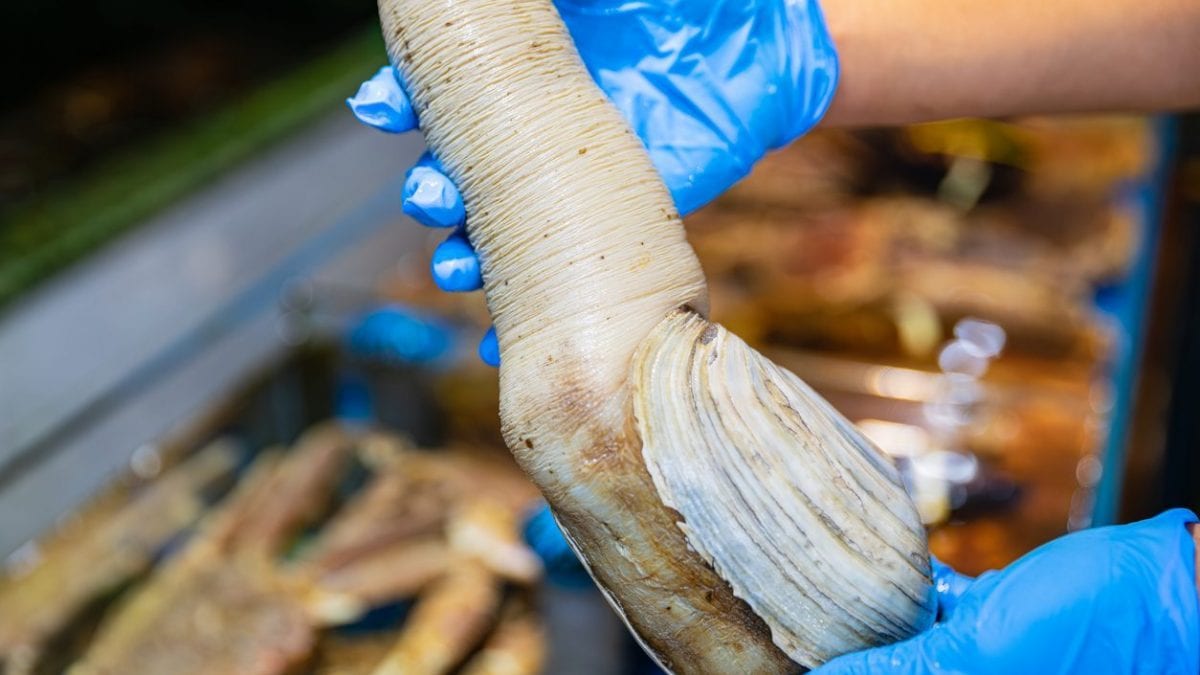
Reading its name and seeing its appearance, you might think you're looking at a legendary sea monster on a par with the kraken, but it's actually a very real and even edible mollusk. It's the geoduck —pronounced guui-dak because it's a name that comes from the Nisqually Native Americans of Washington State—a gigantic mollusk that rightfully ranks among the strangest animals in the world. And also among the longest-lived: this enormous clam with a proboscis is a giant, capable of living more than 150 years (the record-holding specimen is said to have lived to be 168), also because it manages to hide so deeply under the sand that fishing it is extremely difficult.

Typical of the coasts of Canada and North America, this mollusk is edible and quite delicious, so much so that it's often enjoyed raw, for example in sushi or sashimi. The only problem? Because it's very rare and very difficult to extract from the ocean floor, it's decidedly expensive: its price can even exceed 95 dollars per kilo. Here's everything you need to know about the characteristics and uses of geoduck.
What is Geoduck? Its Habitat and Characteristics
The geoduck, whose scientific name is Panopea generique, is a very particular giant mollusk that, due to its truly singular appearance, is also commonly known as the "proboscis clam." A simple look at the image is enough to understand the reason for this nickname: this bivalve mollusk is characterized by a protuberance that resembles a trunk, and it is precisely this that allows it to remain stable on the sandy bottom without having to move. It is no coincidence that the name geoduck, in the Native American language, means precisely "he who digs deep."
The peculiarities of this giant mollusk don't end there. The geoduck is known for its impressive size: the shell alone can measure up to 40 cm, but if you add the proboscis protuberance, the mollusk can reach one meter in length and a kilo in weight; some particularly old specimens have been found, measuring a full seven meters in length and weighing over five kilos. Another characteristic of the geoduck, in fact, is its longevity: the mollusk is one of the longest-lived animals in the world, easily exceeding 100 years of age, with the oldest specimen ever found (on the coast of Canada) reaching nearly 170 years of age.

This isn't a big surprise, considering its lifestyle. The geoduck thrives on the coasts of Canada, Alaska, and the northern United States. It prefers clayey sand and usually lives between 20 centimeters and 3 meters underground (depending on its size), allowing it to easily extract its proboscis from the ground. The mollusk, in fact, doesn't like to move and can spend its entire life in the same place where it was born, feeding by using its suction proboscis to suck up any planktonic microorganisms, which are then conveyed to the gills, where they are filtered and digested.
Given all these characteristics, you'll understand that catching geoduck is no easy feat. Those seeking them are practically forced to dig with their bare hands or a shovel; some even use a water jet pump to loosen the sand, making it easier to reach the mussel. Furthermore, geoduck fishing is heavily regulated to preserve the species, to the point of having a maximum annual catch quota, which is also set far from the breeding season and only for specimens that meet a specific size standard, which is not excessive.

Still with a view to conservation, special farms have been established for the past fifty years or so where they are essentially "cultivated": left to grow in the sand for several years before being harvested. All this makes geoduck a decidedly unusual product, extremely rare to find for sale and also very expensive: the price can exceed 95 dollars per kilo, and the market linked to the trade of this giant mollusk (mainly concentrated in the East) is estimated at eighty million dollars a year.
How to Eat Geoduck
In light of everything we've told you, you'll understand that geoduck is not an easy raw material to find on the market, perhaps precisely for this reason, it is considered a particularly valuable ingredient. Beyond its considerable size, what makes the mollusk a delicacy are its organoleptic characteristics: the flavor is sweet but strongly marine, the texture is crunchy, especially that of the siphon, while the rest is softer and more fibrous. Precisely for this reason in the East, where it is more easily found on the table, it is a highly sought-after ingredient, especially in China, Japan, and Hong Kong, where it is generally served raw, in sushi, sashimi, carpaccio, ceviche, or salad.

Cooked geoduck is less common, but it does appear in some recipes. The trunk is usually cooked quickly to avoid ruining its texture and flavor, so it's fried or sautéed in a pan or wok, but always pounded first to tenderize the meat. The body, with its softer texture and more intense flavor, is usually grilled and then served on skewers, or added as an ingredient in seafood soups.
;Resize,width=767;)
