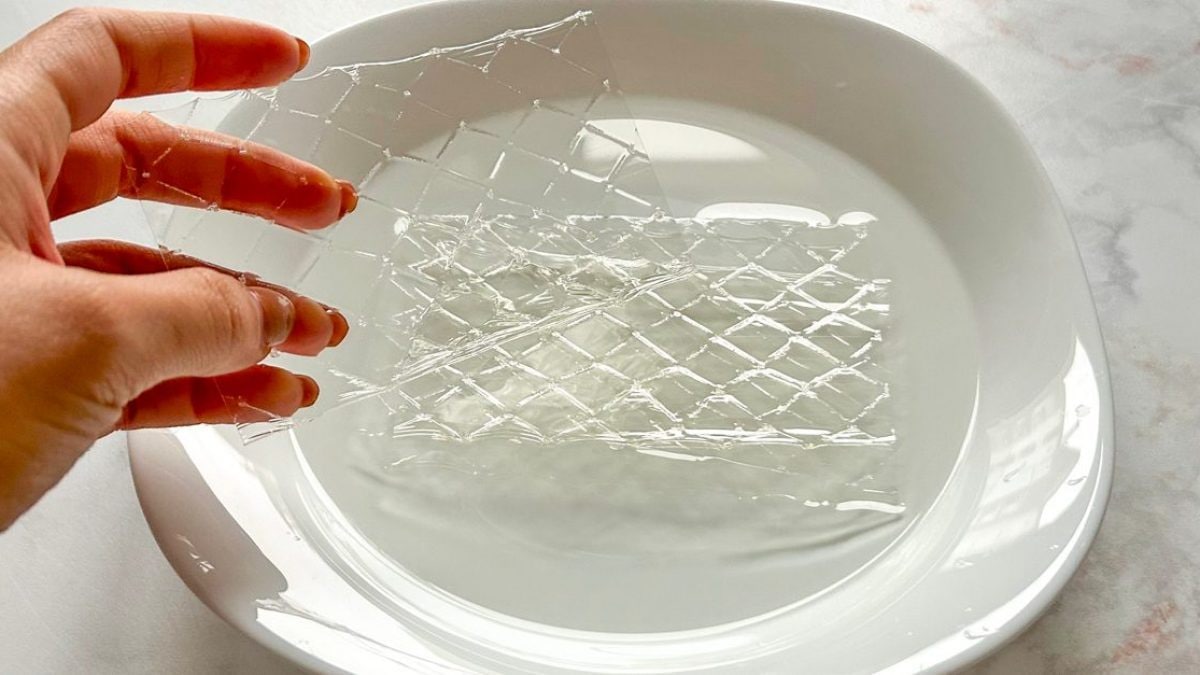
Bavarian cream, panna cotta, cheesecake, but also semifreddo and aspic straight from the 1980s: they are all preparations united by the use of an ingredient that gives the right consistency: isinglass (or fish glue). You can buy it at the supermarket in rigid sheets or in powder form. A natural thickener that has its pros and cons: being of animal origin, in fact, it cannot be consumed by everyone. Let's take a closer look at it.
What is Fish Glue?
Commonly known as gelatin sheets, fish glue (isinglass) is one of the most widely used gelling agents in cooking (but also in cosmetics, pharmaceuticals, and industrial applications), used in sweet and savory recipes, and to make gummy candies. It is tasteless and odorless. It is obtained from the long cooking of pork rind, bones, skin, and cartilage from pigs and cattle. We are therefore talking about animal collagen made entirely of proteins.
What does fish have to do with it? The name comes from the past, when the main ingredient was the dried bladder of certain fish species, particularly sturgeon, common in Russia, but no longer used due to its difficulty in obtaining and high production costs. From this, it can be deduced that this jelly is not suitable for those following a vegetarian or vegan diet.
Isinglass Typologies and Bloom
Those unfamiliar with the world of pastry making probably won't know that there are several types of isinglass: in addition to the distinction between the consistency of thin, rigid sheets that need to be rehydrated —the most commonly used at home, easy to buy at the supermarket—and powdered form, it's important not to underestimate the difference in isinglass' ability to gel. Much like the strength of flour, some gelatins have a higher solidifying power than others.
The calculations are performed using a specific instrument, the Bloom gelometer, where Bloom is the unit of measurement for a gel's solidity. As per definition: the Bloom degree is the weight in grams that, when placed on a 12.7 mm diameter piston, the gel surface can support before subsiding by 4 mm. This gives us a general division into three types of gelatin:
- Low Bloom: 120 to 150 degrees, average 130, with the sheets in question being called Bronze;
- Medium Bloom: between 160 and 180 degrees, with Silver sheets;
- High Bloom: between 200 and 230 degrees, i.e. Gold sheets.
Overall, Bloom Index values range between 3 and 300: products with very high ratings are intended for professionals —for example, those who compete in cooking competitions or for video and photo shoots, where the structure needs to be very resistant for display—rather than for home use. Furthermore, the Bloom Index is rarely indicated on packaging or technical data sheets: it's more likely that you'll need to look for the acronyms Gold, Silver, and Bronze.

How to Use Gelatin
Gelatin is used to thicken a mixture, helping it maintain a certain shape. Depending on the quantities specified in the recipe, you can obtain softer or firmer textures, which is precisely why it's important to respect the proportions with respect to the other ingredients. And here's a question: what if my recipe calls for 10 grams of 200 Bloom gelatin, and I have 120? Don't worry, because there's a very simple mathematical conversion formula you can put into practice. Just do this:
- Multiply the weight of the gelatin by the required Bloom: in this case 10×200 which equals 2000.
- Divide the result by the Bloom of your gelatin, 120, so 2000:120 which equals 16.66 grams (which you can round up to 16.7), which is the weight you need.
Once you have the right amount, proceed in two steps:
- The first is to immerse the sheets in cold water to soften them. You can use a large bowl to hold the sheets whole, or a smaller container, after shredding them with scissors. There's no specific amount of water, but the advice is to use plenty, at least five times the weight of the gelatin, so for every 10 grams of fish glue, use 50 grams of water. Some brands have specific instructions. When the gelatin softens—after about 10 minutes—squeeze it well with your hands.
- The second step involves combining the fish glue with a hot, but not boiling, liquid (often milk or cream in pastry making, or broth in savory recipes) and melting it completely over low heat in a saucepan, stirring constantly. Make sure there are no lumps: if there are any, strain them through a sieve. If the lumps are large, something has gone wrong and it's best to repeat the process with new gelatin. At this point, dilute the hot gelatin with a few spoonfuls of the mixture/cream to which you will add it (to avoid thermal shock), then transfer the mixture from the saucepan to the bowl of cream and mix until evenly incorporated. Once the finished preparation, whether it's a cheesecake or a semifreddo, transfer to the refrigerator for a few hours.
What about powdered gelatin? Then place it in a small bowl with water and wait 10 minutes (as we do in our chocolate bavarian cream and panna cotta) or directly into the mixture, as 85°F/30°C is enough to dissolve it. 1 gram of powdered gelatin corresponds to 1 gram of sheet gelatin.

Can Isinglass Be Substituted With a Plant-Based Alternative?
We have seen that it is a gelling agent of animal origin and in recent years there has been a tendency to avoid it, looking for valid cruelty-free substitutes. From this point of view, the alternative that works best is agar agar, 100% vegetable, as it is obtained from the processing of a particular red algae (Gelidium), it is now popular on the shelves, especially in powder or flakes and can be converted with a quick calculation. It melts at 195°F/90°C and is thermoreversible, so the gelled compound returns to a liquid state several times when heated. What changes in the result? It tends to solidify less, leaving softer and less elastic consistencies and the appearance is opaque, while fish glue is shiny and transparent, remaining the most suitable for coatings and mirror glazes. In the kitchen, starches are also known as thickeners, in particular corn starch, useful for firming without weighing down creams (such as custard), panna cotta and puddings.
;Resize,width=767;)
