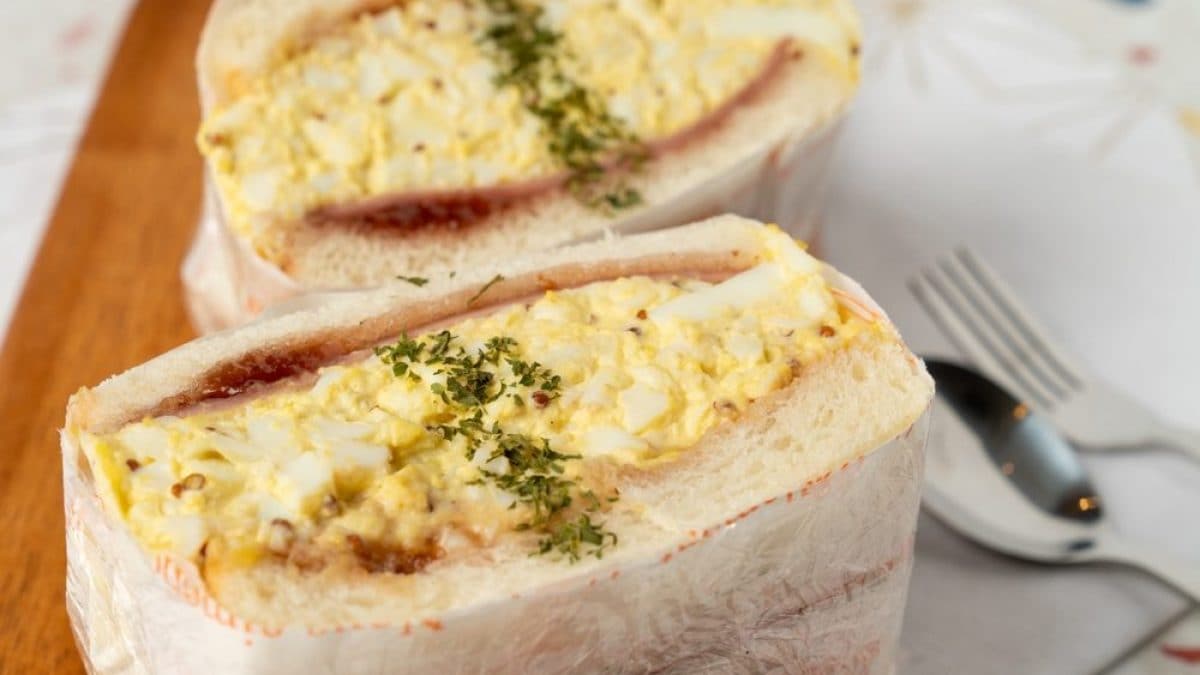
You know those dishes that at first glance seem "banal" but then you discover they're surprising? Just as in American cuisine there are iconic dishes that, despite starting with very few ingredients—think macaroni and cheese or deviled eggs —manage to unleash a surprising richness of flavor, we also find similar examples in Japan. One of the most iconic is the tamago sando, a sandwich that on paper seems almost ordinary, but which reveals all its elegance and depth at the first bite. It's two slices of soft white bread sandwiching a velvety, golden egg yolk cream. A sandwich so simple and balanced that it wins over not only the Tokyo salaryman on his lunch break, but also tourists and just about everyone. In Japan, you'll find it everywhere: from the brightly lit refrigerators of konbini, the legendary ubiquitous convenience stores open 24/7, to the trendy izakaya that serve it like a small work of art.
What is Tamago Sando?
Often featured as the star of cherry blossom picnics or in the meals of Japanese anime favorites, tamago sando is the iconic sandwich of the Land of the Rising Sun and a true delight that is bound to please everyone. The name comes from tamago (egg) and sando (a Japanese abbreviation of the English word sandwich). This seemingly basic sandwich consists of very soft bread (usually shokupan), hard-boiled eggs, and the famous Japanese Kewpie mayonnaise, which is smoother and more acidic than its Western counterpart. Unlike our classic American sandwich, the eggs are mashed and made creamy, while in more refined restaurants, the filling becomes a dense and delicate mousse.

The preparation is simple but leaves no room for shortcuts or alternatives. Like some iconic dishes (such as carbonara), tamago sando also has very specific rules to follow. The essential base must be shokupan, a Japanese sandwich bread baked in a mold, tall and soft. The eggs are cooked until they reach the perfect consistency: the yolk is firm but slightly creamy (neither too firm nor too raw), which is then mixed with mayonnaise, salt, and a splash of milk or cream to lighten the consistency.
How a Sandwich Can Conquer Everyone
Just three ingredients for a dish everyone agrees on—that's the strength of tamago sando. Essentially, we're talking about the quintessential Japanese comfort food, similar to onigiri. It's cheap, found everywhere, filling without weighing you down, and has a flavor that appeals to both children and adults. In kombini, it's an absolute bestseller: it's cheap, can be eaten in two bites, and is always fresh. In bistros and kissaten (high-end bars), the same sandwich becomes a tasting dish: cut with millimeter precision into two triangles and enriched with eggs and high-quality mayonnaise.

It's obviously not a "light" or low-calorie sandwich, but it's not a particularly indulgent treat either. The eggs, though quite high in calories, are rich in protein and micronutrients, while the bread provides carbohydrates for instant energy. Mayonnaise adds fat, of course, but in moderate quantities. So, we're talking about a small, compact sandwich that's often eaten in Japan as a quick snack or a protein-rich snack.
;Resize,width=767;)
