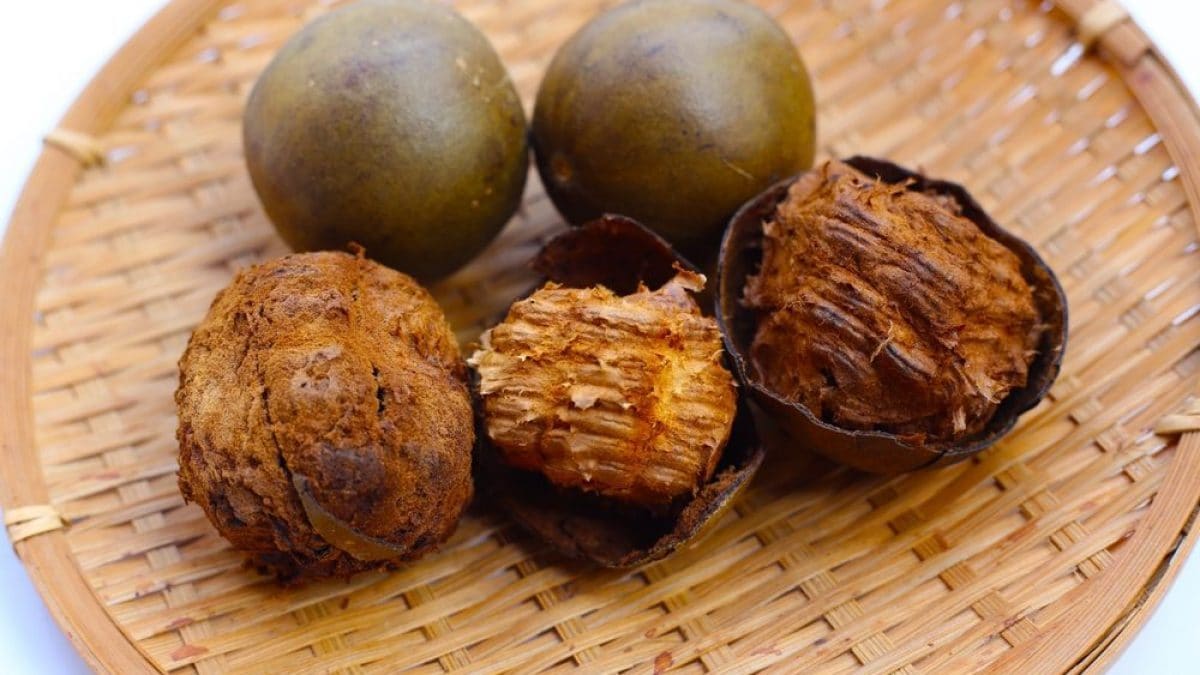
It's not new, but it's new to us. Monk fruit, known in China as luo han guo, has become an increasingly common presence in drinks, industrial sweets, and "no added sugar" products in recent years. It's especially common in modern versions of coffee, cappuccino, and instant beverages, where it promises sweetness without behaving like sugar.
Behind the label, however, there is no artificial flavoring or lab-grown molecule: there is a real fruit, with a specific agricultural history and a technological transformation that explains why today it is treated more like a functional ingredient than a traditional food.
What is Monk Fruit, Really?
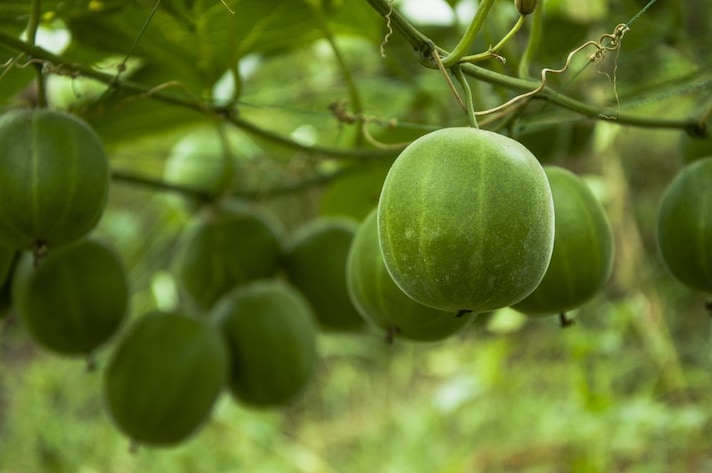
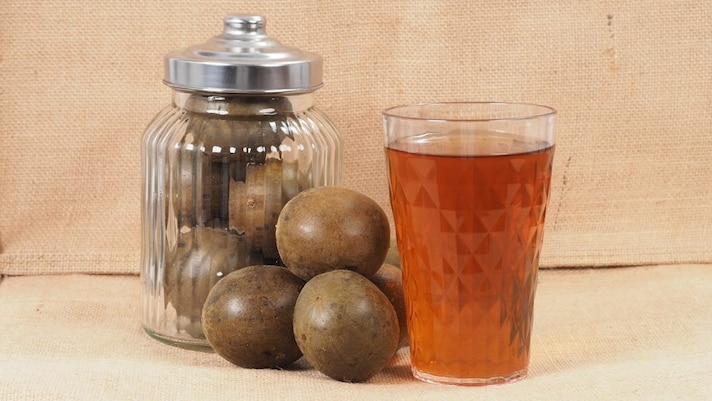
Monk fruit is the fruit of Siraitia grosvenorii, a climbing plant native to southern China, belonging to the Cucurbitaceae family. In local tradition, it is dried and used primarily to prepare beverages. In the modern supply chain, however, it is not the fruit itself that is used, but rather its extracts, obtained to obtain a highly concentrated sweetness that is more easily standardized for the food industry.
The sweetness of monk fruit does not depend on sugars such as glucose or fructose, but on a class of compounds called mogrosides, in particular Mogroside V. These are molecules that interact with sweet taste receptors and produce an intense perception even at minimal doses. This is why monk fruit is classified among the “high-intensity” sweeteners like stevia.
How Sweet is Monk Fruit?
There is no single, absolute value, because perceived sweetness depends on the concentration and the type of food in which it is used. However, most scientific sources agree on a fairly clear range: Mogroside V is often described as about 200–300 times sweeter than sucrose, with studies even reporting higher values under specific sensory testing conditions. In practice, this means that monk fruit is not used “like sugar”: it is dosed in very small quantities, and the balance of the final product depends more on the formulation than on the simple addition of sweetness.
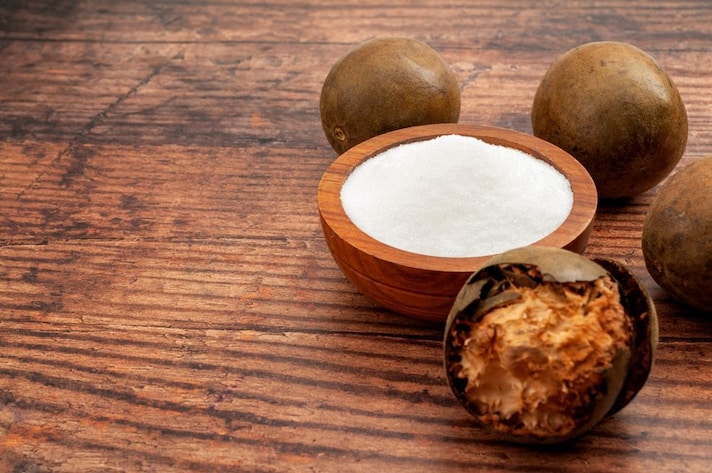
Those who try it for the first time often notice that the sweetness doesn't quite match that of sucrose. It can be more "sharp" and, depending on the quality of the extract, it can leave a slightly fruity or herbaceous aftertaste. This is also why many commercial products don't contain pure monk fruit, but combine it with other ingredients that make the sweetness rounder and more similar to traditional sugar. It's common to find monk fruit mixed with erythritol or other polyols on the shelves. This isn't just a marketing ploy: it adds body and volume, because the pure extract is so concentrated that it "disappears" from the recipe's structure. Blends allow for more intuitive use, often with dosages declared "1:1" compared to sugar, although the results can vary greatly between different brands.
How to Use Monk Fruit in The Kitchen
Monk fruit works well when sugar is used almost exclusively as a sweetener. The reason is simple: mogrosides have a very high sweetening power, but they don't behave like sucrose physically. They don't form useful crystals, they don't retain water in the same way, and they don't participate in the reactions that give color and aroma to traditional sweets.
This makes it particularly suitable for "fluid" preparations, where the structure is already guaranteed by other elements (water, fats, proteins, or thickeners). This is the case with coffee, tea, cold drinks, smoothies, yogurt, light creams, thickened puddings, and industrial ice creams, where the sweetness must be precise and clean, without the need for caramelization.
However, its limitations begin to show in classic pastry making and leavened products. Here, sugar is not simply a sweet flavoring, but becomes a structural ingredient. It contributes to the consistency of doughs, the stability of whipped creams (such as meringues and sponge cakes), the final softness, and preservation. It also participates in the Maillard reaction and caramelization, responsible for golden crusts, toasted aromas, and the typical "baked" notes of biscuits and cakes.
In these contexts, completely replacing sugar with monk fruit often leads to products that are less colorful, less fragrant, and have a drier or less stable texture. For this reason, it is more often used as a carrier, or in blends: for example, combined with polyols like erythritol or with small amounts of real sugar, to maintain some of the technological functions without sacrificing the overall reduction in sucrose.
In short: monk fruit is excellent for sweetening, much less for "building" a dessert. It's an effective ingredient when the recipe is already structurally solid, but becomes complicated when sugar is one of the physical pillars of the preparation.
Security and Regulation: U.S. Vs. Europe
In the United States, several ingredients derived from monk fruit have been notified as GRAS (Generally Recognized As Safe) by the FDA, facilitating their use in a wide range of products. In Europe, the situation is more complex: regulations can vary depending on the type of extract and the intended use. In general, a distinction is made between traditional, non-concentrated preparations and purified ingredients intended to function as high-intensity sweeteners. For European consumers, this has a practical impact: monk fruit may appear on labels, but not always in forms equivalent to those available on the American market.
How to Choose and Use It Without Mistakes
Monk fruit is an interesting ingredient because it offers intense sweetness in small quantities and can replace sugar in various industrial and household products. At the same time, it shouldn't be interpreted as a "vegetable twin" of sucrose: it behaves differently and requires a different approach. More than a revolution, it's a technical ingredient that is carving out a niche, especially where sweetness must be controlled and standardized. Here are some tips for choosing and using it best:
- check if it is a pure extract or a mixture (often with erythritol);
- evaluate the transparency of the label: percentages and ingredients count more than the prominent name;
- start with minimal doses: the excess is immediately noticeable and covers the aromas;
- use it especially in drinks, creams, yogurt and cold preparations, where the “structural function” of sugar is not needed.

