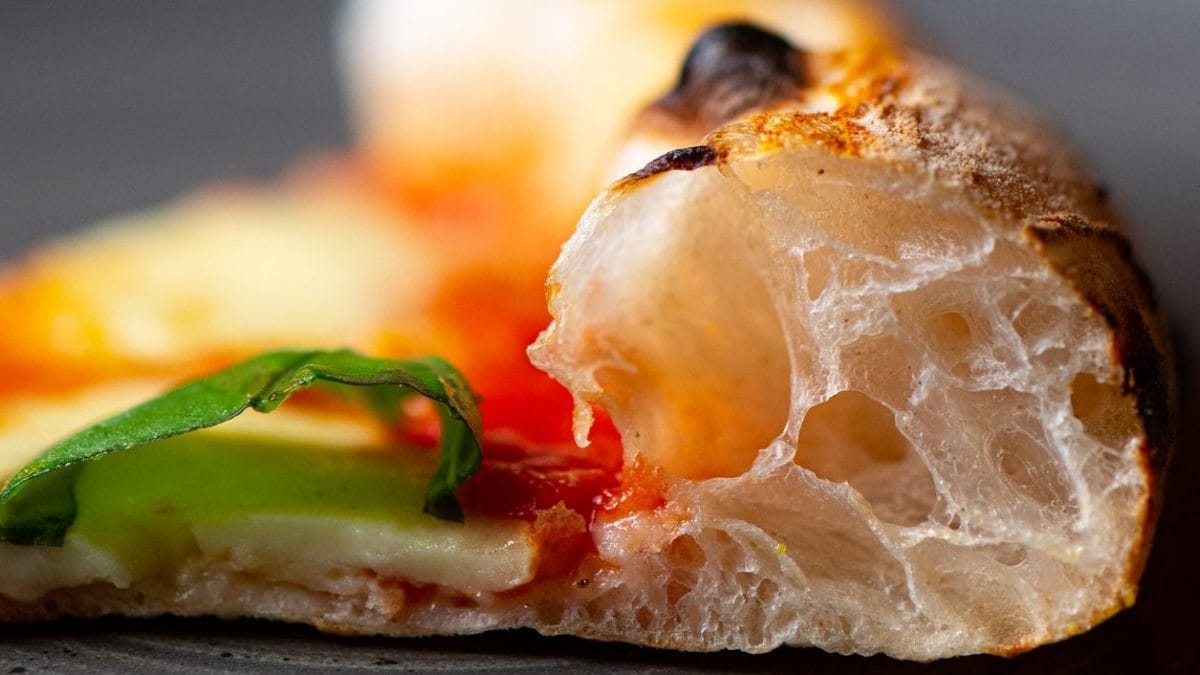
If we were asked what happiness tastes like, we would undoubtedly answer "pizza": a dish par excellence, a symbol of Italian gastronomic tradition but loved and replicated throughout the world. In recent years, thanks also to the constant rise of contemporary pizza, pizza has acquired a new light: visually more beautiful, colorful, with a crust that almost acts as a fortress for the toppings and with particular attention to the use of quality products. And if pizza chefs take greater care, so too do customers, who take into consideration various aspects to understand whether they are dealing with a good pizza or not. One of these is certainly the alveolation: those small and large bubbles that hide from our eyes only to emerge into the open, in all their splendor, when the crust is cut, so beautiful that they very often become the subjects of our lightning-fast photo shoots at the table. Of course, however, the alveolation is not merely a matter of aesthetics, and in this article we explain what characteristics it must have to distinguish a quality pizza.
Before delving into the details, let's start with a general definition of alveolation: it's the quantity and size of the air bubbles present in pizza dough. It's a characteristic that begins during the dough's leavening phase, when all the ingredients are combined and the yeast begins to do its job: feeding on the sugars in the flour, it produces carbon dioxide, which, expanding, becomes trapped in the gluten network, forming these air bubbles and giving the dough greater volume. Let's take a look at all the details on how it forms and how to achieve good alveolation.
How to Obtain Alveolation and How to Regulate It
As we mentioned, the air bubbles are a consequence of the work done by the yeast which, by consuming the sugars in the flour, produces carbon dioxide. The air bubbles that are created are obviously not always the same, and the result can vary based on certain characteristics of both the ingredients used and the processing method.
1. Flour Strength

Let's start immediately with one of the basic ingredients of a dough: flour, which is divided into various types based on its strength (indicated by the W value). Without going into too much detail on the characteristics that distinguish them, you just need to know that flours are divided into weak, medium, strong, and special strong, and the strength indicates the ability to absorb water and retain carbon dioxide, thanks to the presence of the proteins present within them: gliadin and glutenin, which form gluten.
When these two proteins come into contact with water —and also thanks to the work done during kneading —the so-called gluten mesh is created, a sort of elastic network. This, if it has a good balance between toughness and extensibility, will allow the dough to gain volume, thanks to the expansion of the carbon dioxide, without breaking and with the consequent formation of larger and more irregular alveoli. A dough that is too tough, and therefore too hard, will tend to limit the action of the gas, which will not be able to develop good alveoli; conversely, a dough that is too extensible will not be able to retain the carbon dioxide and will end up collapsing.
In any case, it all depends on the type of product we want to obtain: for example, if we want to make a pizza with a canotto shape, where the crust has large air pockets, it is best to use a dough that is more extensible; while a focaccia will require a slightly firmer dough to develop a smaller, more uniform and compact air pocket.
2. Dough Hydration

You've probably already heard about the percentage of hydration in a dough, which is simply the amount of water used in proportion to the amount of flour: for example, if 600 grams of water are used for 1 kg of flour, we will have a dough with a hydration of 60%. The percentage of water to use, however, obviously varies based on the strength of the flour, which, as we've said, indicates its ability to absorb liquid: a dough with greater hydration will create more air pockets, and it therefore goes without saying that, in this case, I will need to use a flour with a higher strength.
3. Rising Times

The alveoli are formed thanks to the action of the yeast, this is well known: but does the more yeast I use, the larger my alveoli will be? Yes, but it's important to clarify. More than the quantity of yeast, the length of time in which the fermentation process takes place is important: if, as we said, the yeast, by consuming the sugars, produces carbon dioxide which creates these bubbles, we must allow time for this process to occur. If I use a large quantity of yeast but stop the leavening too early, the gas will not have had time to form all the alveoli I want; similarly, however, if I let the dough rise too much, it could collapse, resulting in a dough that has lost its structure, becoming sticky and difficult to work with.
4. Kneading the Dough

Another important aspect is how you work the dough before it rises. If you've ever made a homemade pizza, you've probably heard of dough folding to reinforce the dough. Without going into specifics, it's important to know that the different folds you make on your dough serve both to make the gluten mesh more resistant and therefore, as we mentioned earlier, better able to retain carbon dioxide, and to remove all gases from the dough, thus allowing the yeast to perform a better and more active fermentation, thus ensuring the formation of air pockets.
5. Cooking The Pizza

The creation of a beautiful honeycomb structure continues even after we have shaped the dough, when it is ready for baking. In fact, the heat of the oven – whether electric, gas or wood-fired – causes the honeycombs to develop for two reasons:
- The first is that the carbon dioxide contained within the dough will tend to escape due to the heat and, again, an elastic but stable gluten mesh will allow it to expand but not escape and therefore prevent the bubbles from breaking.
- but the carbon dioxide will also tend to escape due to the action of the water present in the dough which, passing into a gaseous state, will begin to occupy a greater volume, causing the dough to swell.
So, Does a Good Pizza Have to Have Lots of Cavities?
The answer is no. It all depends on the type of product we're eating or preparing: a classic Neapolitan pizza will have few air pockets in the crust, while a pizza a canotto will have more and larger air pockets, or a focaccia will have very small and compact air pockets. This obviously doesn't mean one product is better than another, but simply that they're different products with their own specific characteristics.
;Resize,width=767;)
