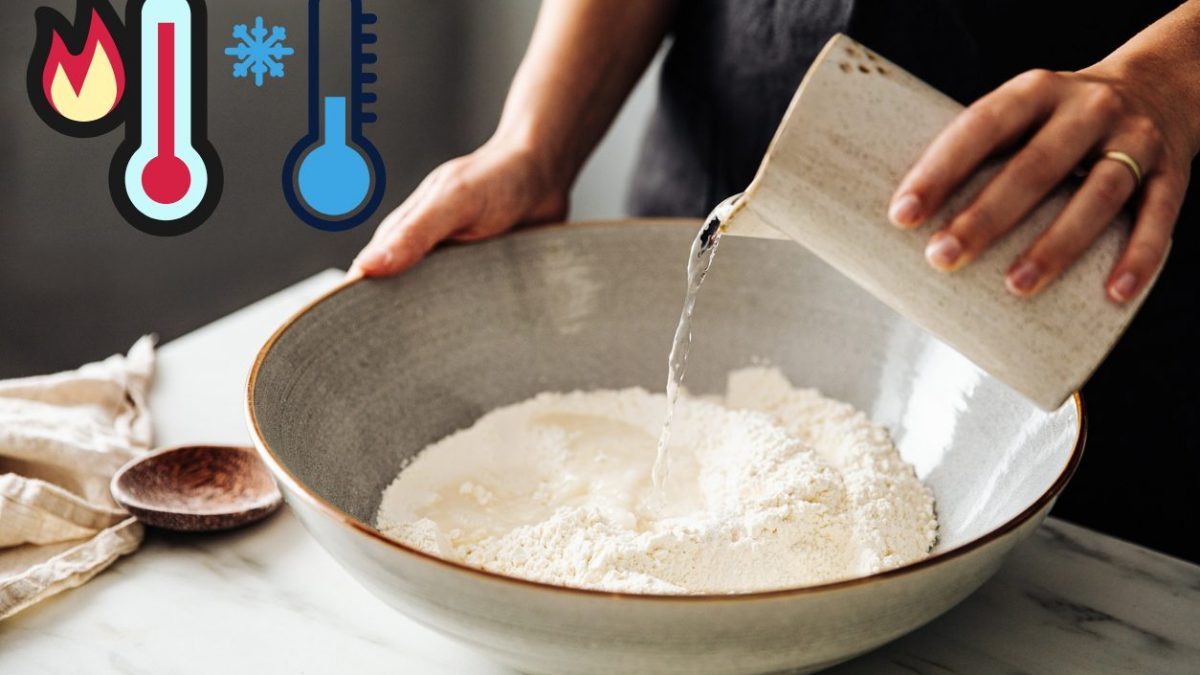
The water temperature for pizza dough is a crucial factor in achieving a tasty, fragrant pizza with the right consistency. Why is it so important? Because it affects the leavening and maturation of the product. Water that's too cold slows leavening, while water that's too hot makes the dough stickier and harder to handle. There's no "ideal temperature" because the choice varies based on the type of product you're aiming for. Generally speaking, it's recommended to stay between 65°F/18°C and 77°F/25°C because it promotes optimal leavening. Let's look at three great pizza chefs' tips.
The Water's Temperature "Is Never Set By Chance"
If you search online, many articles talk about "room temperature," but this doesn't mean anything. In winter, the water could be colder; in summer, the water could be warmer. You have to decide the temperature. Many recipes instead recommend cold water, and this has created quite a few problems for Jacopo Mercuro, owner of 180g Pizza Romana, one of the best pizzerias in Italy, located in the capital. The young maestro began kneading dough at home, "and the first problems I had at home were caused by the cold water." According to Mercuro, choosing this low temperature "helps a lot, but you have to be careful. The cold gives you greater control over the dough, but if you then put it in the refrigerator at 4°C or 5°C, you risk ending up with a dough that isn't very leavened because fermentation doesn't develop at this temperature."

Mercuro tells us that for homemade dough, the best temperature is around 22°C (72°F) for a dough ball that's left to ferment at roughly the same temperature for a couple of hours before refrigeration: "At home, the fear of making a mistake leads you to under-ferment the dough, and that's not good." However, things are different in a pizzeria: "In a professional setting, it all depends on the type of product you're making. There are mornings when I have to make four different doughs, and I have to use different temperatures to get the best result." According to the Roman pizza chef, temperature greatly influences the final result because "the hotter the dough, the faster it ferments," but even in this case, things differ greatly between home and professional experience. "At home we always make small doughs," says Mercuro, "which can weigh up to 3 kilos. A smaller size leads to a more rapid temperature change. If we want to stop the leavening in the fridge to let the dough rise, it will reach the necessary 39°F/4°C very quickly. For large doughs, and in the laboratory we make 25 kilo doughs, more time is needed to let the product ferment properly." 180g specializes in Roman scrocchiarella pizza: Mercuro has elevated the very concept of Roman pizza thanks also to a unique skill in dough making, given by wisdom. "For the pizza, we start with a liquid pre-ferment for two days and on two different doughs," concludes Jacopo Mercuro, "because we are very sensitive to the seasonal temperatures inside the laboratory. On the first day, we have a dough at 68°F/20°C that we ferment at 68°F/20°C for 18 hours. On the second day, we use cold water from the refrigerator, especially in the summer, because the pre-ferment must give me a dough that has a minimum temperature of 69°F/21°C and a maximum temperature of 73°F/23°C. The temperature on the second day is lower because the water from the day before was warmer. We need to manage the liquid temperatures this way, because they help us manage the entire fermentation process."

Much more "strict" is Simone Lombardi, owner of Crosta in Milan, 3 Spicchi Gambero Rosso and long-time teacher at various academies around Italy. For the Milanese master, "water is never added randomly. The temperature of the water is a determining factor in obtaining a certain type of result. If I want to obtain a consistent product, which remains the same over the course of a year, I necessarily have to apply a mathematical formula." Lombardi, among the first pizza chefs to make gourmet pineapple pizza, advises us to "let the dough come out at 68°F/20°C, no higher. At Crosta, we measure all types of dough with a laser thermometer every day because we leave nothing to chance. The raw materials can vary depending on the batch they come from, so we don't base our decisions on the kneading time but on the result of the dough temperature. The temperature varies depending on the result we want to achieve."
So how do you calculate the water temperature to obtain a 68°F/20°C dough for crust? The final temperature of each dough depends essentially on four factors:
- Where it is kneaded, that is, the ambient temperature.
- From the temperature of the flour, which is usually one degree cooler than the working environment.
- Water temperature which we will then calculate.
- The dough heats due to the type of mixer. The fork mixer heats by 42°F/6°C, the spiral mixer by 48°F/9°C, and the plunger mixer by 37°F/3°C. When kneading by hand, the temperature is around 41°F/5°C or 42°F/6°C.
Once we know the final temperature of our dough, we'll calculate the temperature of the water we'll need for kneading. Since we want a dough at 71°F/22°C, we need to do this calculation: 22 x 3 – the sum of the ambient temperature, the flour temperature, and the heating of the machine or our hands. So, let's assume 22 x 3 = 66 (71 x 3 = 213) – 71°F/22°C for the ambient temperature, 69°F/21°C for the flour temperature, and 48°F/9°C for the spiral = 57°F/14°C for the water. The formula is 22 x 3 – 22 – 21 – 9 = 14 (71 x 3 = 213 – 71 – 69 – 48 = 57).

Another formula comes from Angioletto Tramontano, owner of O'Sarracin in Nocera Inferiore, in the province of Naples. The pizza chef, a staunch supporter and innovator of the so-called "cartwheel," uses the famous "rule of 131/55." You need to subtract the temperature of the surrounding environment and that of the flour from the number 55 to obtain the correct water temperature. For example, if the environment is 71°F/22°C and the flour is 69°F/21°C, the calculation to obtain the water's temperature is: 55-22-11=22. In reality, for Tramontano, "the ideal temperature is around 64°F/18°C. I'm a traditional pizza chef, who uses the direct dough method for Neapolitan pizza, so I use the so-called room temperature. For a contemporary pizza, which is not my field, I would recommend using the mathematical formula above." The most important thing for Tramontano is actually something else: "The water must not be too hot, we can play with the rest. Heat kills the yeast: at 122°F/50°C the yeast dies, between 95°F/35°C and 104°F/40°C it speeds up the maturation process but will also result in a much harder dough. This is why the temperature of the water in the dough is so important." With the right water temperature and a little practice, following the advice of the three great pizza chefs, you too will be able to make delicious and fragrant pizzas at home.
What Happens if The Water For The Dough is Too Cold?
Low temperatures slow the yeast's activity, so a very low temperature significantly extends the fermentation time. This can be useful if you want a longer maturation, for example by rising in the refrigerator for 24-48 hours. Ice water is also useful if you use very strong flours, because in this type of product the low temperature facilitates absorption, leading to a more hydrated pizza. The final product is tougher because the low temperature causes the dough to develop a tighter gluten network.
Considering that high hydration of pizza isn't something to brag about (it needs the right amount of hydration) and that the result isn't optimal, we don't recommend using an excessively low temperature. After all, we've said it's useful if you want a long maturation (again, why would you want that? The right amount of time is important, not too much time) or if you're using very strong flours, better suited to panettone than pizza. This trend is becoming popular because some blogger may have seen it in a pizzeria. It can happen in some pizzerias that do a lot of work and have very large but not top-notch mixers that ice water is preferred because it leads to slower overheating of the dough, but at home this never happens, and therefore the end result will simply be less pleasant.
;Resize,width=767;)
