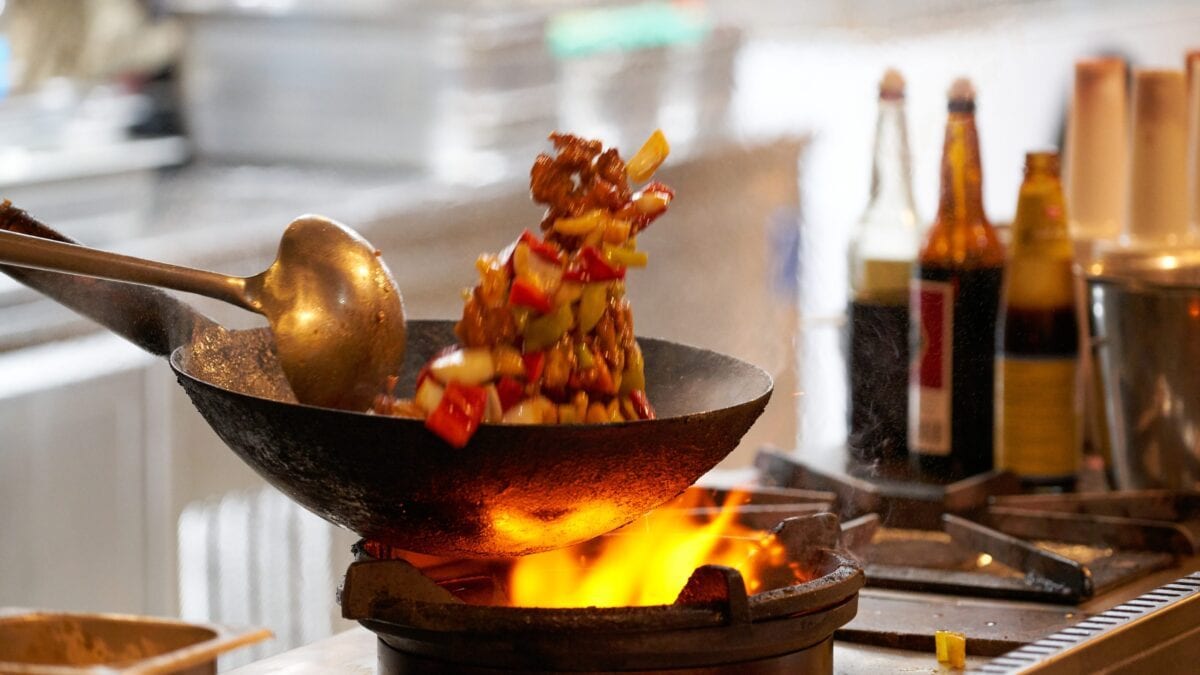
Have you ever wondered why the pork and peppers at the Chinese restaurant fall apart under your teeth as if someone coaxed it, while the same cut sautéed in your pan starts to bounce like a garnish?
The difference does not depend on the animal's pedigree, because between the two results there is a preliminary preparation called velveting.
What is Velveting in Chinese Cuisine?
The term sounds like the name of a laundry softener but actually indicates the rigorous and timed sequence that Chinese cooks reserve for the meat before even lighting the fire under the wok.
It consists of cutting it to a specific thickness, marinating it with starch and egg white and subjecting it to a lightning pre-cooking that brings it to around 70% of the cooking time, before the final jump in the wok, the stir fry, one of the pillars of Chinese cuisine.
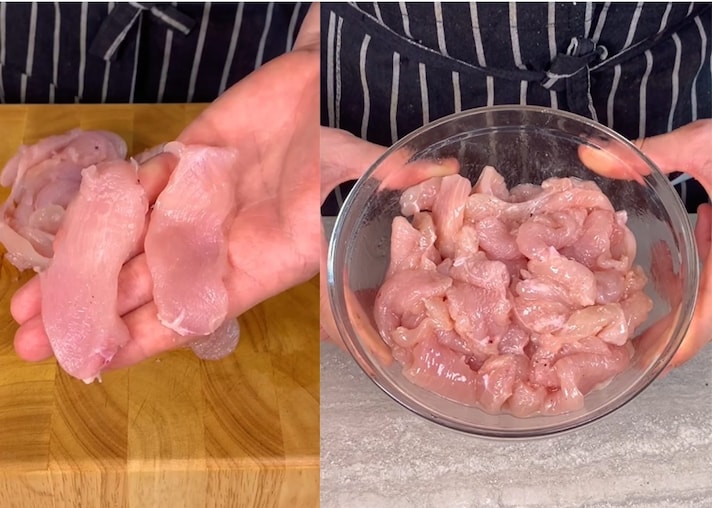
The three stages have proper names and distinct functions, from cutting (改刀, gǎi dāo) to coating with starch (上浆, shàngjiāng), up to passing through "warm" oil (滑油, huáyóu).
The middle layer should not be confused with the frying batter, guàhú (挂糊), which coats the ingredient in a thick, crispy layer. In velveting, the coating remains thin and soft, so much so that once cooked, it is indistinguishable from the surface of the meat.
How to Cut Meat Before Marinating
The first step is called gǎi dāo and involves the knife-cutting phase. The meat must be sliced against the grain, into slices of about 3 millimeters, which can be cut into strips or half-centimeter cubes if desired, because the perpendicular cut shortens the fibers and the smaller size increases the surface area exposed to the marinade.
Velveting Marinade's Ingredients
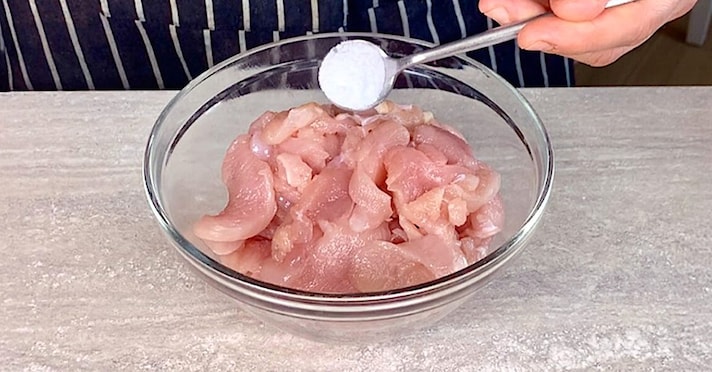
The traditional version calls for 1.5g of salt, 2g of sugar, 0.3g of white or black pepper, 1.5g of light soy sauce (生抽, shēngchōu), 1.5 g of dark soy sauce (老抽, lǎochōu), 2.5 g of Shaoxing wine (绍兴酒, shàoxīngjiǔ), the aged glutinous rice wine from Zhejiang, half an egg white, or approximately 15g, 5g of cornstarch and 7g of seed oil, for every 200 grams of boneless pork or chicken. For beef, add 30g of water and, to taste, 5g of oyster sauce.
Dark soy, denser and characterized by a sweet caramel note, serves above all to offset the paleness of white meats, while the light soy adds flavor.
The egg white must be weighed precisely, as too much would interfere with the starch's action, and the meat must be dried thoroughly, otherwise the residual water will dilute the marinade. Refrigerate the meat for ten minutes to an hour, depending on the thickness and type of cut.
The order of preparation is as important as the quantities. First, the meat is seasoned with salt, sugar, sauces, and water, stirring until the liquid is absorbed, as the shàngjiāng also helps rehydrate the fibers; then, the starch and egg white are added, and finally, the oil, which seals the film and prevents the pieces from sticking together.
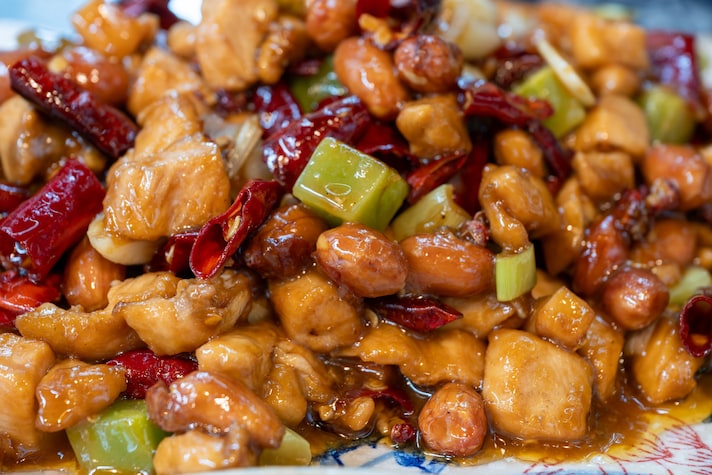
The amount of starch used is governed by an empirical criterion used by Chinese chefs: if the meat's grains are still visible after cooking, the film is too thin, while if the pieces remain stuck together, it is too thick.
Why Velveting Makes Meat More Tender
The main credit goes to the starch, which, when hydrated and subjected to heat, gelatinizes and forms a smooth film on the surface that protects the slices from the violent heat of the wok and retains the liquids inside (with the heat the muscle proteins contract and squeeze out the liquid).
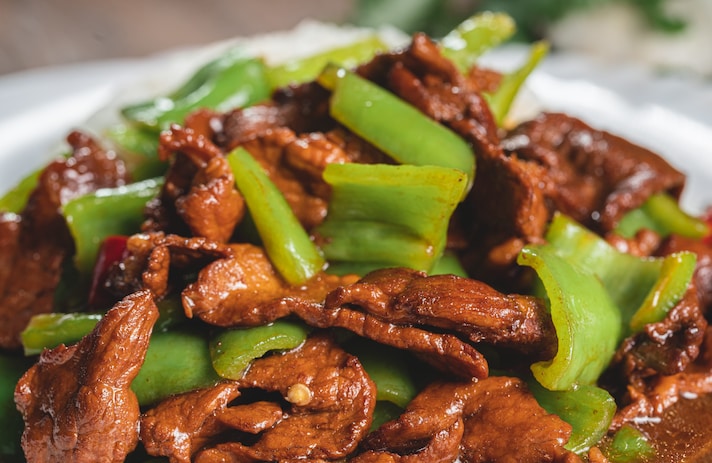
This layer conducts heat much less than the naked meat, so the core of the morsel stays below 140-150°F/60-65°C while the outside comes into contact with the oil, preventing excessive contraction of the muscle proteins and the loss of juices.
The coating, combined with pre-cooking, limits the amount of leakage, an advantage that is especially appreciated on less valuable cuts, which would become very tough if cooked at high heat. Velvetizing a fillet, an already tender cut, would mean wasting time and ingredients.
Baking Soda and Other Alkaline Elements Used in Restaurants
In professional kitchens, the marinade often contains an alkaline ingredient, usually 1.2g of baking soda per 200 grams.
Raw meat has an acidity close to the point where its proteins retain the least water: bicarbonate reduces the acidity and raises the pH, so the negatively charged proteins repel each other, the fibers expand and make more room for liquids. However, you need to be very careful with the doses because an excess of bicarbonate risks giving off a bitter aftertaste.
The effect only affects the outer surface and leaves the connective tissue intact, which makes a braising cut tough and only loosens after hours of cooking. The treatment works, for example, with thin slices of beef shoulder, but on a whole piece of muscle it produces no appreciable results.
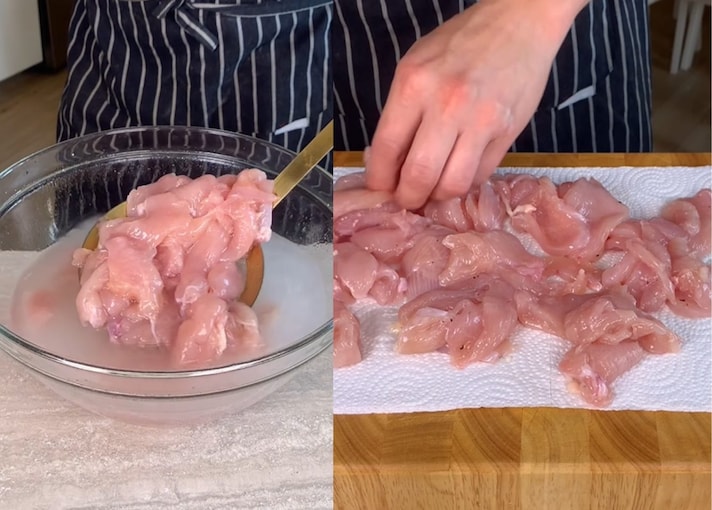
More palate-neutral alternatives are sodium carbonate (碱面, jiǎnmiàn) and lye water (枧水, jiǎnshuǐ), both in the amount of 0.6 g, plus papain, the enzyme extracted from papaya that in China can be found in preparations called nènròufěn (嫩肉粉), literally "meat tenderizing powder".
These mixes should be used with caution: they're so effective that marinating them too long could shred the meat. Then there's nènhuà (嫩化), a soak in a baking soda solution followed by rinsing.
Is It Better to Fry in Oil or in Boiling Water?
The oil transfer, lo huáyóu (滑油), requires a quantity of fat equal to twice the ingredient, so about half a liter to be poured into the wok. The temperature is between 195/90 and 266°F/130°C, with the surface of the oil barely rippling with bubbles. 30-45 seconds are enough, after which the meat is collected with a slotted spoon and left to drain.
The water variant is called guò shuǐ (过水) and is made like this: bring a pot of water with 5g of oil to the boil, immerse the pieces of meat in it, separate them with chopsticks and cook them for 30-40 seconds, until the surface becomes opaque but without cooking the inside.
When comparing the two methods on pork, chicken and cod, no appreciable differences emerge in the white meat, while the fish passed in oil is slightly firmer.
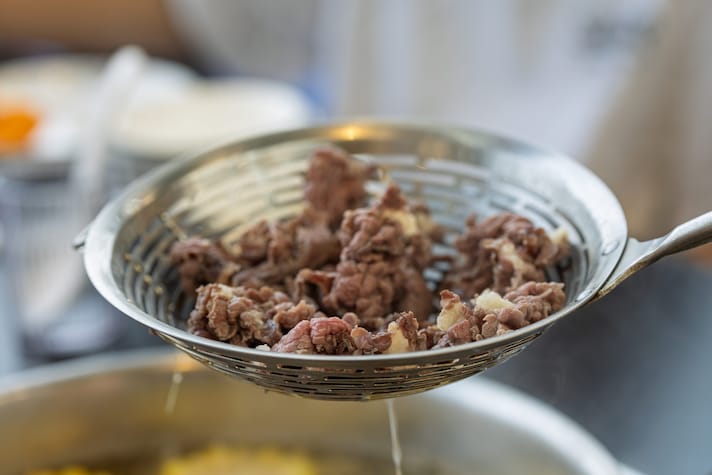
Some cooks consider water a makeshift solution, while others object that blanching meat becomes too moist, risking stewing the vegetables instead of browning them. The method is, however, part of Chinese culinary tradition, which also applies it to soups, such as Sichuan huáròu tāng (滑肉汤), where the starchy meat cooks directly in the broth.
Why The Word Velveting Doesn't Exist in Chinese
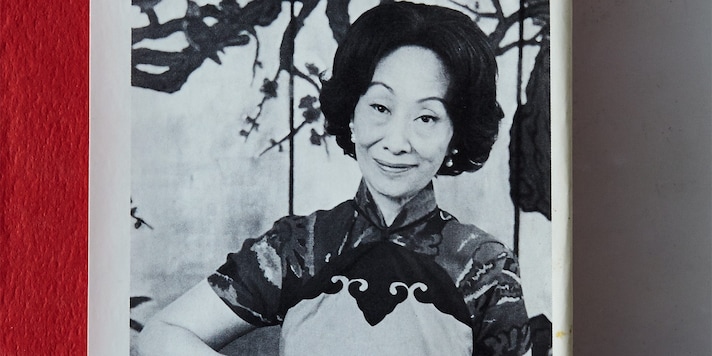
The English word was coined by restaurateur Irene Kuo in 1977, in her book The Key to Chinese Cooking, to refer only to the starch and egg white coating. In Chinese, technical terms exist and are precise, but none of them encompasses all the stages of velveting, since shàngjiāng and huáyóu refer to two separate operations, and the second is even optional.
The definitions in circulation contradict each other between those who identify the velouté with soaking in bicarbonate and those who only identify it with the marinade.
Recipes also vary from province to province. In the North, many cooks omit salt from the marinade; in the Muslim Northwest, alcohol is omitted; while in Yunnan, a sprinkling of star anise and cǎoguǒ (草果), a smoky-scented black cardamom, is added.
Velveting at Home, Without Exaggerating
Of the three steps, the one that almost no one replicates at home is the oiling, because using half a liter of fat to filter and dispose of would discourage anyone. The cross-grain cut and the starch marinade, which alone account for most of the result, are simple and easily replicated. Those aiming for restaurant-quality results can opt for a middle ground: brown the marinated meat yourself, using about twenty grams more fat than usual, drain it, and set it aside while the vegetables cook, then sauté it at the last minute.
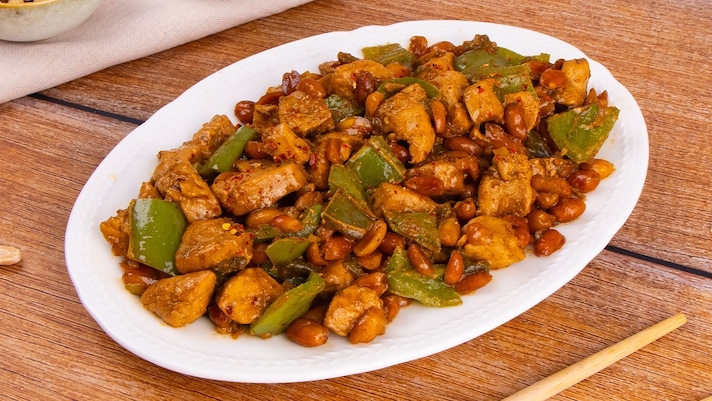
The simplified version remains, with the meat thrown into the wok along with everything else. In that case, it's best to forgo the egg white, which doesn't set evenly without precooking and leaves whitish strings on the plate. Instead, you can simply add a touch of starch, salt, and rice wine—just enough to distinguish homemade kung pao chicken from the kind you get at a restaurant.
The rest is decided by knife, flame, and stopwatch, the same tools that Chinese chefs have been working with for centuries without feeling the need to give a name to what they are doing.
;Resize,width=767;)
