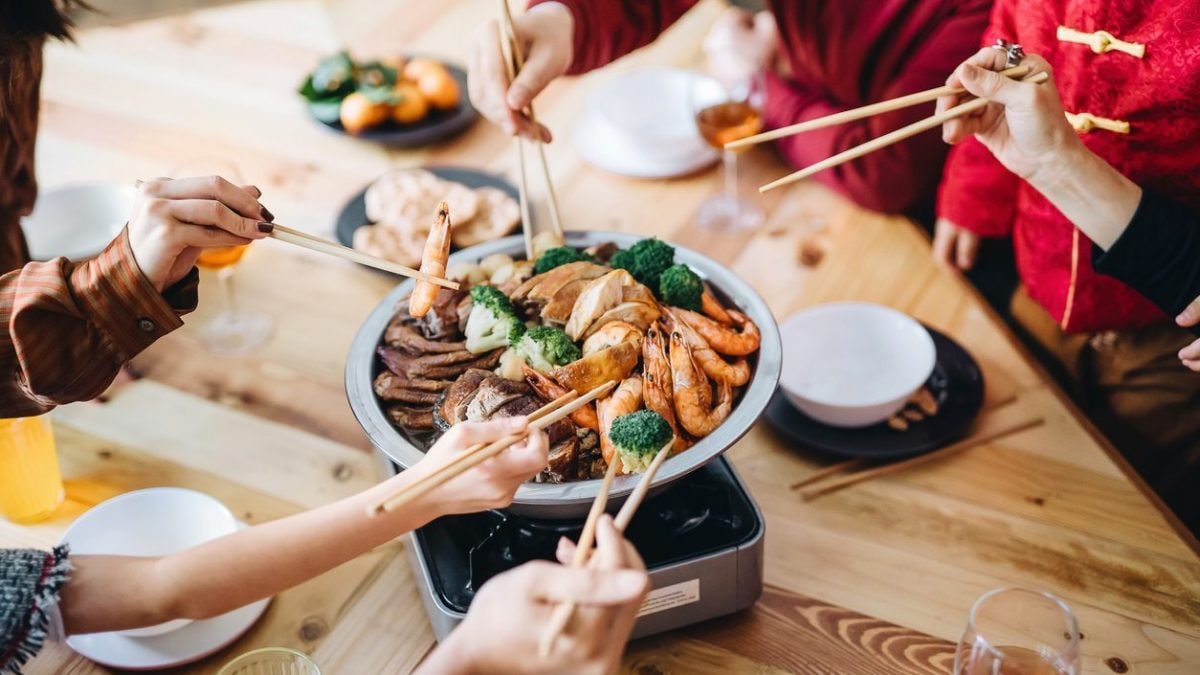
While we're accustomed to eating with a knife and fork in our culinary tradition, this isn't the case when we look to the Far East. In Asia, chopsticks take center stage on the table: sticks of various shapes, internationally known as chopsticks, which take on different names in the different countries where they're used. They're not just utensils: chopsticks are a true cultural symbol that reflects the habits and customs of a population. They come in different materials, shapes, and sizes, and, much like our cutlery, there are rules for how to use them correctly, avoiding etiquette errors. Furthermore, they also have a place of honor in the kitchen, replacing most of the accessories we're used to, because they cut, stir, grasp, and move. In short, it's impossible to do without them.
How to Use Chopsticks
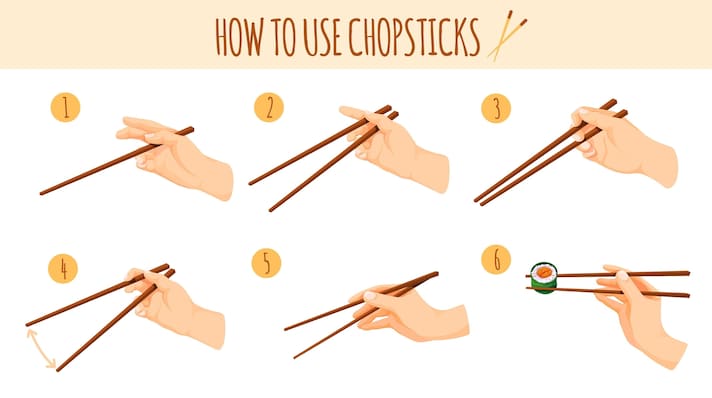
Let's start by thinking about that moment when, sitting in an Asian restaurant, someone surely felt uncomfortable at the sight of those two chopsticks, casually asking if they could use traditional Western cutlery. Chopsticks require a tried and tested technique to be handled in the best possible way: it may seem complicated at first, but once you get the hang of it, everything becomes simple. Remember, in fact, that one chopstick moves, while the other remains fixed. Here's how.
- Place the first chopstick, the one that should remain stationary, in the hollow of your hand between your thumb and forefinger, allowing the thin end to rest on your ring finger. It should feel stable, but not too tight.
- Take the second stick, the movable one, and hold it between your index finger and thumb (as you would with a pen). The pad of your thumb rests on the side to keep it aligned with the other, while your index finger controls the movement of the tip.
- Now practice opening and closing the chopsticks to grab the food: coordination improves with practice, which is the secret to achieving a secure and increasingly natural grip.
Do's and Don'ts of Chopstick Etiquette
Manners and respect for food and fellow diners are fundamental aspects when sharing a meal. As with all rituals, there are rules to follow. Let's see what the main ones are when talking about chopsticks.
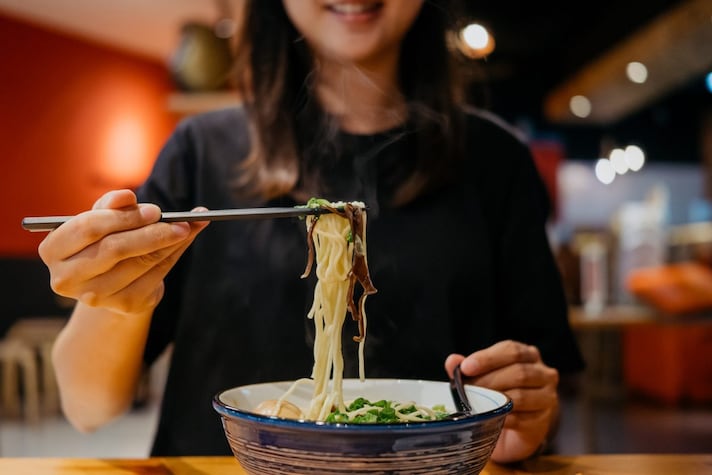
- Don't stab your food: a gesture we've probably all done at least once, out of inexperience or haste, even though chopsticks aren't forks.
- Don't move food around to choose it: it's considered decidedly impolite to touch food on shared plates or mix it up in search of the ingredient you like best. Furthermore, you must take your turn or do it one at a time.
- Never lick or chew them: we know some people dip them in soy sauce while waiting for their sushi, but chopsticks are only for picking up food. Holding them in your mouth while waiting or between courses is considered disrespectful.
- Don't point at diners: just like in our etiquette, you don't point at people using chopsticks; it's rude.
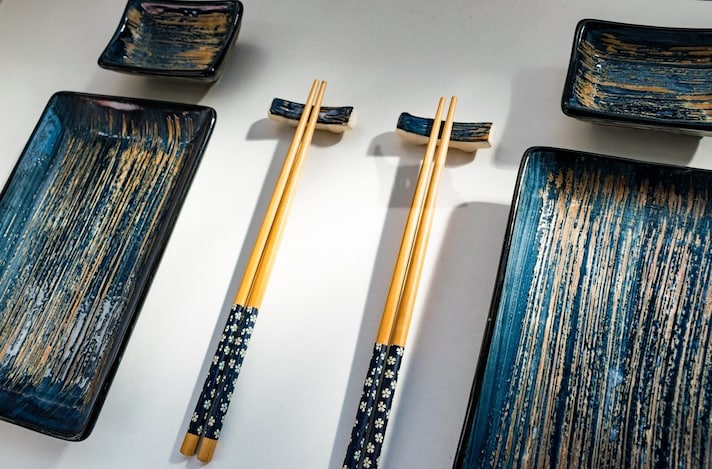
- Don't stick your chopsticks upright in the rice: in Japan, this is considered offensive at the table, as it is practiced during funerals as an offering to the deceased. Another reminder of death is the cross-shaped position of your chopsticks after eating; instead, leave them horizontally on your plate or on a chopstick rest.
- Do not pass food: Still tied to funeral customs, it is taboo to pass food with chopsticks at the table, as it evokes the same action performed with the bones of the deceased during cremation. If you wish to offer something, it is preferable to place it directly on someone else's plate.
- No noise: playing, drumming, or banging chopsticks on the table or plate is prohibited; it is considered rude.
The Thousand-Year History of Chopsticks
The use of chopsticks as a utensil is common throughout East Asia, including China, Japan, Korea, Vietnam, and other countries. Most scholars agree that their origins are very ancient, dating back as far as 5000 BC: the first evidence, however, was found in the Chinese province of Henan around 1200 BC (under the Shang dynasty); they were made of bronze and were used for all-round cooking, rekindling the heat, stirring, and transferring food from the pot to the "plate." Their diffusion dates back to 500 AD when, according to historical reconstructions, a serious economic crisis led to the invention of solutions to limit consumption, including cutting food into smaller pieces to cook it more quickly, thus making the knife superfluous over time. Furthermore, Confucius also seems to have had a hand in this: in his non-violent precepts, the knife was associated with slaughter, as well as war, and this may have favored the popularity of chopsticks. The spoon, however, has not disappeared, having existed before, suitable for soups and millet, a staple food in Northern China before rice: with the advent of rice, noodles also arrived, easier to pick up with chopsticks.
Different Countries, Different Chopsticks
From the 5th century AD, the use of chopsticks spread to other countries, due to migration from China, consolidating in particular in Japan, Korea and Vietnam: the materials with which they are made range from bamboo to wood, passing through steel, silver, ceramic, bone and plastic, reflecting the different cultures thanks to characteristics that make them distinguishable. Let's give some examples.
China
Chopsticks in China are called kuàizi. They are generally longer (about 24–26 cm) and slightly thicker than those in other countries. The tip is blunt, not sharp, and the cross-section can be round or square. They are traditionally made of bamboo or wood.
Japan
In Japan, they are known as hashi. They are shorter than the Chinese ones (on average 20 cm) and are distinguished by their tapered, pointed tip, probably designed to make it easier to grip the fish and remove the bones. They are often made of lacquered wood and decorated on the top, called nuribashi (everyone in the house has their own pair), while the disposable ones are called waribashi. Speaking of length: the women's and children's ones can be shorter, while those used for cooking, called saibashi, are longer.
Korea
Let's move on to Korea, where we find jeotgarak, which differ from the previous ones in that they are thin, flattened and have a rectangular cross-section, but above all in their material: metal, most often stainless steel, while in the past they were mostly made of silver. The reason, in addition to being linked to hygiene (wood is more likely to develop harmful microorganisms because it retains humidity), dates back to court practices, as according to tradition, silver, darkening on contact with certain substances, would allow one to identify whether the food had been poisoned or not. Along with the chopsticks, there is also a spoon (sutgarak), forming a real set, the sujeo.
Vietnam
We conclude with Vietnam, where the domination of China (known as Bắc thuộc) led to the popularity of đũa, a term that takes its inspiration from the ancient Chinese name for chopsticks, which they also resemble in aesthetics and materials, tending to be longer: they are mainly produced in bamboo or lacquered wood.
;Resize,width=767;)
