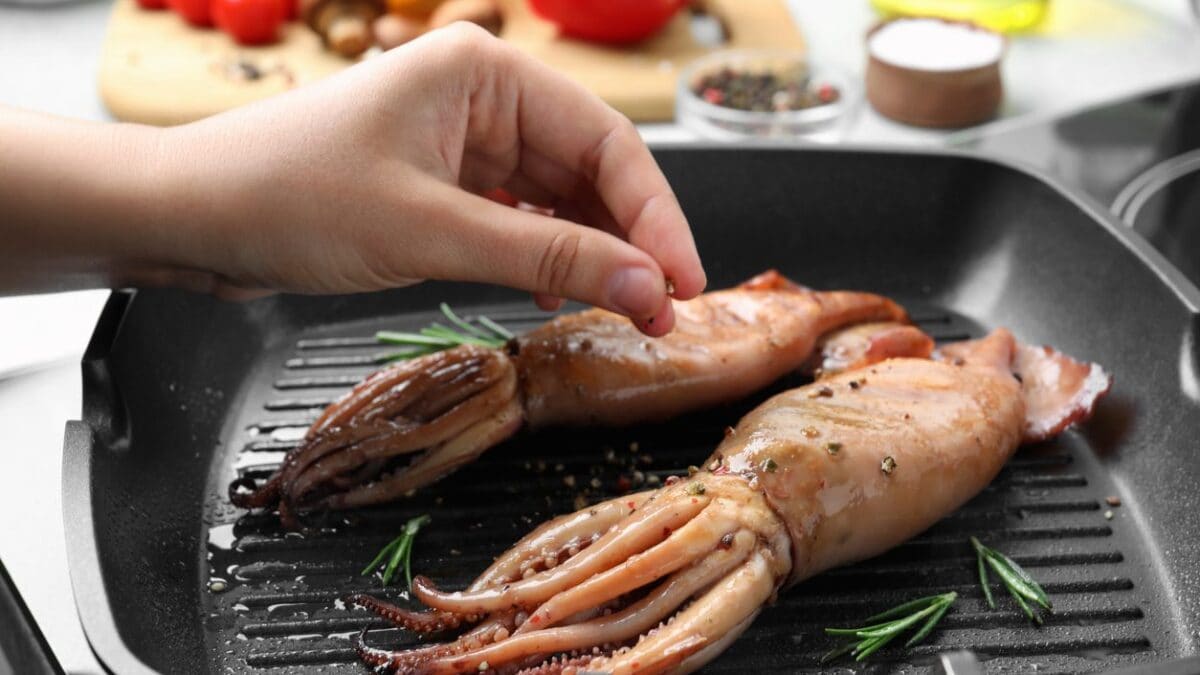
In the vast world of seafood, calamari, squid, and cuttlefish are particularly beloved in the kitchen: they are tasty and versatile foods, perfect for adding to pasta, frying, stuffing, or cooking as a main course in countless ways. It's essential, however, to know how to handle them properly, because their flesh is very sensitive. If you've ever tried cooking them, even just once, you know: it only takes a very short time, even a few minutes, to overcook them and make them unpleasantly rubbery. For this reason, there are very specific rules for cooking calamari, squid, and cuttlefish, which require either very quick cooking or, conversely, very long cooking. But why is the flesh of these mollusks so sensitive? The causes are a series of biochemical and physical processes involving muscle proteins, collagen, and the water contained in the animals' tissues. Let's better understand the phenomenon and how to avoid it.
Why Do Calamari, Cuttlefish and Squid Become Tough When Overcooked?
To understand why calamari, cuttlefish, and squid become tough, we need to start with their musculature: the consistency of their flesh is closely linked to their composition. Unlike fish, these cephalopods possess extremely developed muscle mass, necessary for the rapid movement achieved through jet propulsion. Muscle fibers are rich in contractile proteins, primarily actin and myosin (the same proteins found in the muscles of all animals), and these fibers are organized in a very compact way, supported by a network of connective tissue composed primarily of collagen.

When mollusks come into contact with the boiling water required for cooking, a series of biochemical and physical processes occur that transform the proteins and shrink the collagen, pushing all the water out of the flesh, which consequently becomes rubbery. These reactions, however, occur at a specific temperature, which is why cooking time is crucial: simply avoiding or exceeding the critical stage is enough to avoid obtaining the "rubbery" effect. This phenomenon is also found with octopus, whose flesh, if cooked incorrectly, similarly becomes tough and rubbery due to the denaturation of the proteins and connective tissue caused by excessive heat or over-rapid cooking. For this reason, as a preventative technique, fishermen vigorously slam the caught octopus against hard surfaces to break down its tough muscle fibers and collagen: this is called "curling," a traditional seafaring practice that serves to make the mollusk's flesh tender, digestible, and perfect for eating both cooked and raw.
What Happens to Collagen During Cooking
When heat reaches the muscles of squid, cuttlefish, and calamari, the first transformation involves the proteins. At temperatures between approximately 105/40 and 140°F/60°C, actin and myosin molecules begin to denature, meaning they lose their original three-dimensional structure. Denaturation is an irreversible process: the proteins "unroll" and subsequently aggregate together, forming a more compact network. Furthermore, the fibers shorten, stiffen, and retain less moisture: it is this loss of water, together with the greater compactness of the coagulated proteins, that gives the typical rubbery sensation . But that's not all: cooking not only affects muscle fibers and proteins but also acts on collagen, the main protein in connective tissue. Collagen has a very resistant structure that holds muscle fibers together and contributes to the animal's initial consistency.
If the cooking time isn't short enough, the collagen remains largely intact, while the muscle proteins have already contracted. This is the worst stage in terms of tenderness: the muscle is now rigid, but the collagen hasn't yet had time to transform, which is precisely why calamari, squid, and cuttlefish are incredibly tough during intermediate cooking times. The proteins are already coagulated and contracted, but the connective tissue continues to act as a resistant scaffolding that prevents the fibers from softening. As a result, the texture becomes elastic, tough, and difficult to chew.

If cooking continues for long enough, however, the picture changes again. At around 160-175°F/70-80°C, maintained for a prolonged period, the collagen slowly begins to hydrolyze, turning into gelatin. This process takes time because collagen is a very stable protein, but once completed, it radically changes the consistency of the tissue. The supporting network weakens, the muscle fibers separate more easily, and the flesh gradually softens again. This is why a cuttlefish braised for an hour or a squid cooked slowly can be surprisingly tender, despite having been subjected to prolonged exposure to heat. In practice, the consistency of these mollusks follows a sort of curve. Initially, they are tender, then during the first few minutes of cooking they progressively harden, reaching maximum rubberiness, and finally, with sufficiently long and gentle cooking, they soften again thanks to the transformation of the collagen into gelatin.
The Right Cooking Times to Keep Squid, Cuttlefish and Calamari Tender
In light of the physical phenomena explained, the best strategies for keeping calamari, squid, and cuttlefish tender are two, opposite but both correct: either cook them for a very short time or cook them for a very long time. Very rapid cooking, often less than two minutes for small, pre-cut specimens, limits protein denaturation and doesn't allow the fibers time to contract significantly. Slow, prolonged cooking, however, bypasses the critical phase, allowing the collagen to dissolve. Intermediate cooking times, on the other hand, typically between 5 and 30 minutes (which can extend up to 40 minutes for larger specimens), generally produce the least pleasant texture.

This is the general rule, but obviously times vary based on the species, size of the animal, and cooking method. In general, remember that:
- Calamari is generally the most tender of the three cephalopods and lends itself very well to quick cooking. If you're sautéing, grilling, or frying them, it's best to cook them for 1-2 minutes, up to a maximum of 3 minutes for larger specimens or sliced into thick rings; beyond this time, they quickly begin to toughen. If you're stewing or braising them, it's best to extend the cooking time to 30-45 minutes, enough time for the collagen to begin to gelatinize and restore tenderness to the flesh.
- Squid have more developed muscles and a greater amount of connective tissue than calamari, making them naturally tougher. For quick preparations, it's best not to cook them for more than 1-2 minutes. If you opt for a stewed, stuffed, or sauce-based dish, it's best to cook them for at least 45-60 minutes, while particularly large specimens may require 75-90 minutes to reach a truly tender consistency.
- Cuttlefish have a robust muscular structure, but respond very well to slow cooking. If grilled or sautéed, the ideal cooking time is 2-3 minutes, avoiding unnecessary cooking time. For traditional stews, such as the classic "squid ink" or seafood stews, cooking for 45-60 minutes is recommended ; large cuttlefish may require 70-90 minutes.
The Best Cooking Methods for Calamari, Squid and Cuttlefish (And Mistakes to Avoid)
As we've explained, the best cooking methods for calamari, squid, and cuttlefish follow two opposing strategies: very short or very long, so as to avoid leaving the mollusk at the stage where the muscle proteins are already contracted but the collagen has not yet transformed into gelatin. Following this approach, which recipes best enhance calamari, squid, and cuttlefish? Let's start with the first option, which is using high temperatures for very short times: in this case, grilling, griddling, pan-frying (but very hot), or frying are ideal, all techniques that allow you to quickly cook the surface while keeping the interior still juicy. All cephalopods are delicious grilled, griddled, or fried, and if you scrupulously follow the few-minute cooking rule, a good result is guaranteed.
As for the second option, slow and very prolonged cooking, stewing is ideal: it's no coincidence that many traditional recipes call for the use of this technique, for example stewed cuttlefish or squid in sauce. In this case, in fact, the long cooking time on the heat doesn't ruin the product, but rather improves its consistency.

Another useful trick to influence and improve the final texture of shellfish is to use some preliminary treatments. Acidic marinades, such as those with lemon juice or vinegar, superficially alter the proteins, accelerating their denaturation, but they only penetrate a few millimeters and cannot deeply soften the muscle tissue. A more significant effect can instead come from proteolytic enzymes present in ingredients such as kiwi, pineapple, or papaya, capable of degrading part of the proteins in the muscle and connective tissue. However, if used too long, these enzymes can make the surface excessively soft and compromise the structure of the food, so it's fine to marinate sparingly and for a short time.
Regardless of the specific recipe you decide to cook, there are some mistakes you should never make (besides getting the cooking time wrong):
- Using too low temperatures when cooking quickly, because this causes the shellfish to release water before they've even browned. Instead of developing a light crust on the surface, they end up cooking slowly in their own juices, remaining longer in the temperature range that favors the toughening of the muscle fibers.
- Excessively high temperatures during long cooking times are equally wrong: cooking at too high a heat for a long time tightens the fibers and dehydrates them.
- Overfilling the pan. When too many pieces are added at once, the temperature drops rapidly and the released liquid doesn't evaporate quickly enough. This results in less uniform cooking, poor browning, and an increased risk of rubbery texture.
;Resize,width=767;)
