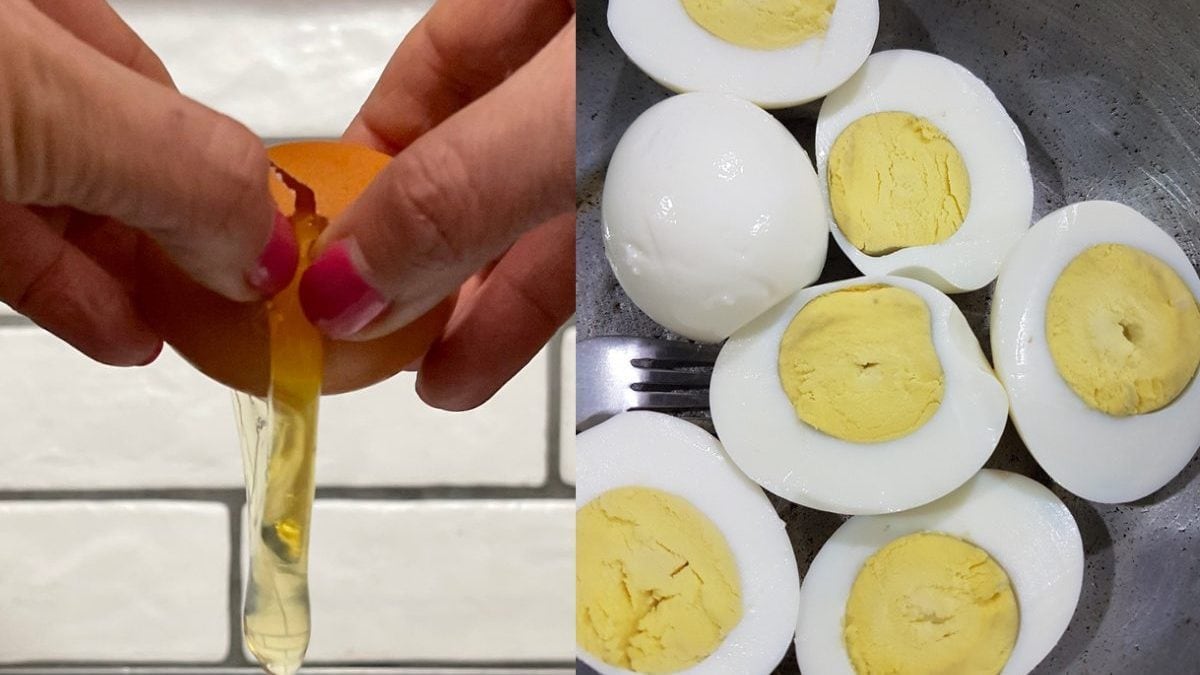
Egg whites are transparent, so why do they turn white when we cook them? This is just one of the many mysteries surrounding eggs, and especially egg whites: after all, they are a liquid that, with a certain amount of force, can be whipped into stiff peaks, creating the base for delicious desserts. It's not magic, it's just physics, and university students in Germany have treated it as such: let's unravel the mystery behind the color transformation of egg whites during cooking.
Egg Whites Are Very Sensitive to Heat
Researcher Nafisa Begam of the University of Tübingen and Siegen in Germany has assembled a team of researchers to try to uncover all the secrets of eggs. The team of university students has published an interesting article on the prestigious APS website, titled "Network Formation Kinetics and Heterogeneous Dynamics of an Egg White Gel Revealed by Coherent X-ray Scattering." A long title, difficult for non-physicists to understand, but it actually explains everything that happens inside eggs when heat is applied.

The doctor explains that to understand the structural evolution of the product, "it's necessary to study the phenomenon on a micrometric scale," that is, thousandths of a millimeter. This is what they did, heating the egg in a controlled manner and analyzing it with X-rays. During the first three minutes, a protein network forms that grows exponentially and reaches its maximum development after five minutes. It's this network that gives the egg white its characteristic color. After this time, practically nothing happens structurally: you can burn the egg, but the protein network doesn't change, nor does the consistency.
There's also a second part of the study, aimed at following the temperature dynamics in the formation of the egg's meshes: the higher the protein density, the lower its mobility, slowing the separation of the various molecules. For this reason, the hard-boiled egg has a more "solid" consistency than other recipes: higher temperature for a prolonged period.
According to the researchers, it is important to understand how the structure of eggs changes given the massive presence of this raw material in food throughout the world. However, the project actually goes well beyond the food industry: according to the Ministry of Education and Research, the main funder of the study, the application of these research techniques will be fundamental to finding new ways to study the dynamics of biomolecules, which are fundamental in many fields such as chemistry, physics, mechanics, and medicine.
;Resize,width=767;)
